I&B Ministry
Budgetary support to I&B upped 3 billion


NEW DELHI: The Budgetary support to the information and broadcasting ministry for 2004-05 fiscal year has been hiked by over Rs 3,000 million, signifying hectic activity to be undertaken by the ministry.
But the total grant-in-aid to pubcaster Prasar Bharati has been shaved off by Rs 320 million, while its loan component has been upped to fund its expansion of broadcast services.
According to the Budget papers laid in Parliament by finance minister Jaswant Singh, while presenting an interim Budget today, I&B ministry’s share stands at Rs 9,550 million, up from Rs 6475 million allocated to it in the last fiscal year.

The hike in the ministry’s allocation was explained by officials as money obtained, by and large, for development of broadcasting services of Doordarshan and All India Radio managed by Prasar Bharati and other related
infrastructure.
So significantly, the loan amount to Prasar Bharati has seen an increase over last fiscal from Rs 690 million to Rs. 1,690 million.
Under the Plan head, Prasar Bharati would get about Rs. 1540 million, while under the non-plan head it would receive Rs 8210 million.
The Budget papers say that out of the I&B ministry budgetary allocation, a sizeable amount would go to Prasar Bharati as a lumpsum for undertaking developmental projects in the remote north-eastern region of the country and Sikkim, bordering China.
The loan to Prasar Bharati has been explained as money to finance the capital expenditure, while the remaining amount of the ministry’s allocation would be spent on sundry activities like expansion of the photo division and
capital expenditure on building a swanky new information centre.
In a year when general elections would be held, the government is sparing no effort to reach out to the farthest corner of the country where cable and/or terrestrial transmission don’t reach.
One of the ambitious projects undertaken by Prasar Bharati is to start a free-of-subscription direct-to-home television service covering the whole India, but mainly targeted at the north-eastern region.
The KU-band DTH service is slated to go on air early April.
Government officials explained that an increase in I&B ministry’s budgetary allocation, mainly meant for Prasar Bharati, was possible because of active cooperation and comprehension of the issue by Planning Commission secretary, RR Shah, who earlier was with the I&B ministry and had held additional charge of director-general of DD.
The Planning Commission is a government think-tank on economic policies.





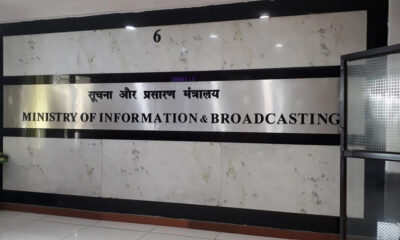


MUMBAI: When the numbers go silent, the noise on screen gets a little harder to measure. Ministry of Information and Broadcasting has extended the suspension of television rating data for news channels, directing Broadcast Audience Research Council (BARC) to withhold TRPs for another four weeks. The latest order, issued on March 31, 2026, builds on an earlier directive from March 6 that had paused ratings for a month. The ministry has clarified that the blackout will continue for four weeks or until further instructions are issued whichever comes earlier keeping the industry in a prolonged state of data drought.
The reasoning, officials suggest, lies far beyond domestic screens. With geopolitical tensions in West Asia continuing to escalate, the government has flagged concerns over how such developments could influence news consumption and presentation. The move is aimed at curbing excessive sensationalism and speculative coverage during what it describes as a sensitive global moment.
For the broadcast ecosystem, the absence of Television Rating Points (TRPs) is more than symbolic, it removes the industry’s primary scorecard. Ratings dictate advertising flows, shape editorial strategies and fuel the competitive pecking order among news channels. Without them, broadcasters are effectively operating without a public performance benchmark.
The timing only adds to the complexity. Amid a high-intensity global news cycle, channels must now navigate audience engagement without the weekly feedback loop that typically drives programming decisions. Advertisers, too, are left recalibrating, leaning on proxies such as brand strength, reach and distribution instead of hard viewership data.
While framed as a temporary regulatory intervention tied to maintaining public order, the extended suspension underscores a broader unease about the tone and direction of news coverage. For now, the ratings race is on pause but the battle for attention continues, just without a scoreboard.






