News Broadcasting
Budget 2022: 5G & rural broadband BharatNet to boost overall internet connectivity

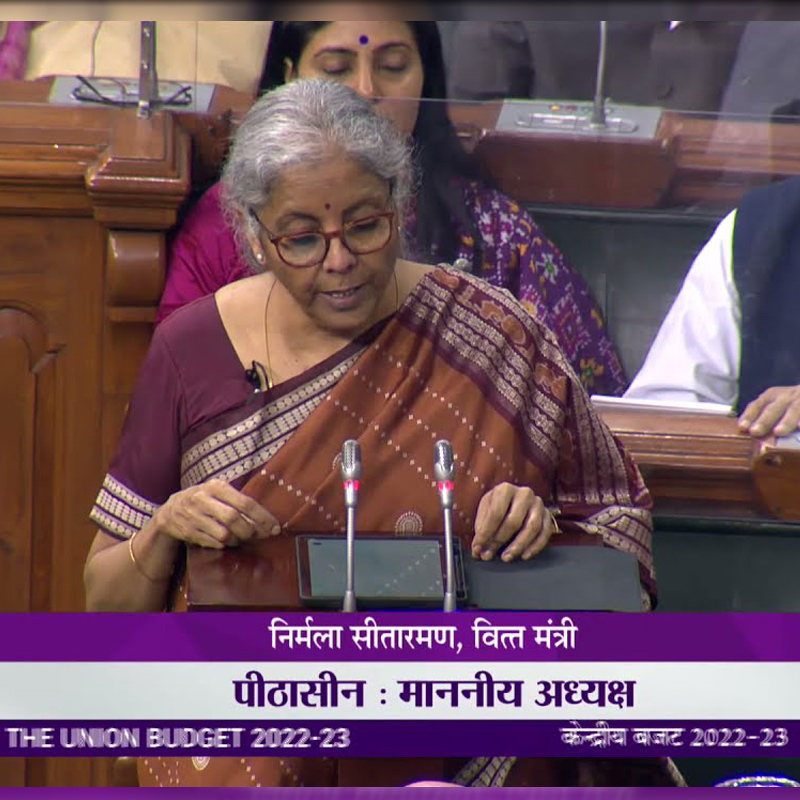
Mumbai: Giving a boost to the country’s Digital India ambitions, finance minister Nirmala Sitharaman while announcing the union budget 2022 on 1 February said that 5G telecom services will be introduced in India in FY2022-23. Spectrum auctions are likely to be held soon to facilitate the roll-out of 5G by private telecom companies. Design-led initiatives for 5G and other technologies will henceforth be included in the production linked incentive (PLI) scheme, added Sitharaman.
Among other big announcements impacting telecom/internet connectivity, BharatNet broadband is expected to be ready by 2025. Contracts for laying optical fibres in all villages will be awarded under the project through public-private partnerships in 2022, 2023. “Our vision is that all villages and their residents should have the same access to e-services as urban areas,” stated Sitharaman while adding that five per cent of the annual collections Universal Service Obligation Fund will be allocated to enable affordable broadband and mobile penetration in rural and remote areas.
The government’s flagship rural broadband connectivity program, BharatNet aims to bring broadband to 361,000 villages across 16 states, including 1.37 lakh gram panchayats. by acting as a middle-mile network allowing Internet service providers (ISPs), local cable operators, MSOs and other agencies to use its bandwidth and incremental fibre.

According to the economic survey released on 31 January 2022, as on September 2021, 5.46 lakh km Optical Fiber Cable has been laid, a total of 1.73 lakh Gram Panchayats (GP) have been connected by Optical Fiber Cable (OFC) and 1.59 lakh Gram Panchayats are service ready on OFC under the BharatNet project. In addition, 4173 GPs have been connected over satellite media. Wi-Fi hotspots have been installed at 1.04 lakh Gram Panchayats of which services are being provided at 0.64 lakh, catering to more than 16.17 lakh subscribers with a data usage to the tune of 5670.42 TB per month
The survey further revealed that internet penetration in the country is growing steadily with internet subscribers increasing from 302.33 million in March 2015 to 833.71 million in June 2021. While 67.2 percent of internet subscribers had narrowband connections and 32.8 percent had broadband connections in 2015, the composition had reversed by June 2021 with only 4 percent of subscribers having narrowband and 96 percent with broadband connections. As of September 2021, around 161 villages out of 354 villages have been covered with mobile service.
Here is what the industry experts had to say:
Elara Capital’s Karan Taurani noted, “Push towards affordable and high speed fixed broadband internet will boost digital content consumption and smart TV penetration into rural and smaller towns. It will also lead to shifting of eyeballs from TV to digital at a much rapid pace in smaller towns too, just like it has happened in metros.” This will help enable strong user and consumption growth for the B2C-led internet and new-age companies, which in turn will lead to a rapid shift from traditional to digital. According to him, this could have a positive impact on overall advertising, as internet companies now account for a sizable share of ad spends in India.
However, Taurani rued the absence of initiatives to protect the interests of traditional media despite the negative impact of Covid. “There was no relaxation on the license fees or royalty for radio industry, no financial grant or tax benefit for the traditional media which has seen a sharp decline over last two years and still struggles to get back to pre Covid levels, and no reduction in GST for cinema ticket prices, despite cinema being one of the most impacted medium during the pandemic,” he said.
Welcoming the push for internet connectivity, Logicserve Digital founder and CEO Prasad Shejale said, 5G spectrum auctions will finally make the dream of a tech-savvy India a reality, further boosting the country’s digital infrastructure. Additionally, the launch of a design-led manufacturing scheme for the 5G ecosystem as part of the PLI scheme will ensure affordable broadband and mobile communication even in far-flung areas. The availability of high-speed internet connectivity in urban as well as rural areas will encourage marketers to experiment with blockchain, AR, VR. The overall budget is future tech-enabled and balanced.”
“Media consumption is in for a disruption like never before. 5G is going to change the way digital functions and is going to just accelerate the metaverse and Web3 adoption,” added White Rivers Media CEO and co-founder Shrenik Gandhi.
Specialised task force for AVGC
The M&E industry will also benefit from setting up a specialised task force for the promotion of Animation, visual effects, gaming and comics (AVGC) industry, as well as the expansion of the ‘One class, one TV channel’ program of PM eVIDYA from 12 to 200 TV channels proposed under the budget.
Zeel MD and CEO Punit Goenka said, “The holistic focus on broad-based economic recovery in the Union Budget, with a huge emphasis on job creation and digital ecosystem of the country, is positive for India Inc. at large. The steps announced to build domestic capacity for the Animation, Visual-Effects, Gaming, and Comics segment will certainly help enhance capabilities, enabling the Country to compete more effectively at a global stage. An extension in the credit line guarantee scheme is also a welcome move, which will provide some much-needed relief to the relevant sectors which were impacted due to the pandemic.”
According to vernacular audio platform Khabri’s co-founder and CEO Pulkit Sharma, regional languages will be empowered through the program, which enables all states to provide supplementary education in regional languages for classes 1 to 12. “These digital initiatives will provide for a more conducive environment for the adoption of tech-based learning and which will directly route to empowering youth from real Bharat,” he said.





News Broadcasting
Network18 channels lead YouTube news viewership in March 2026
CNN-News18, News18 India and CNBC channels top categories with record views
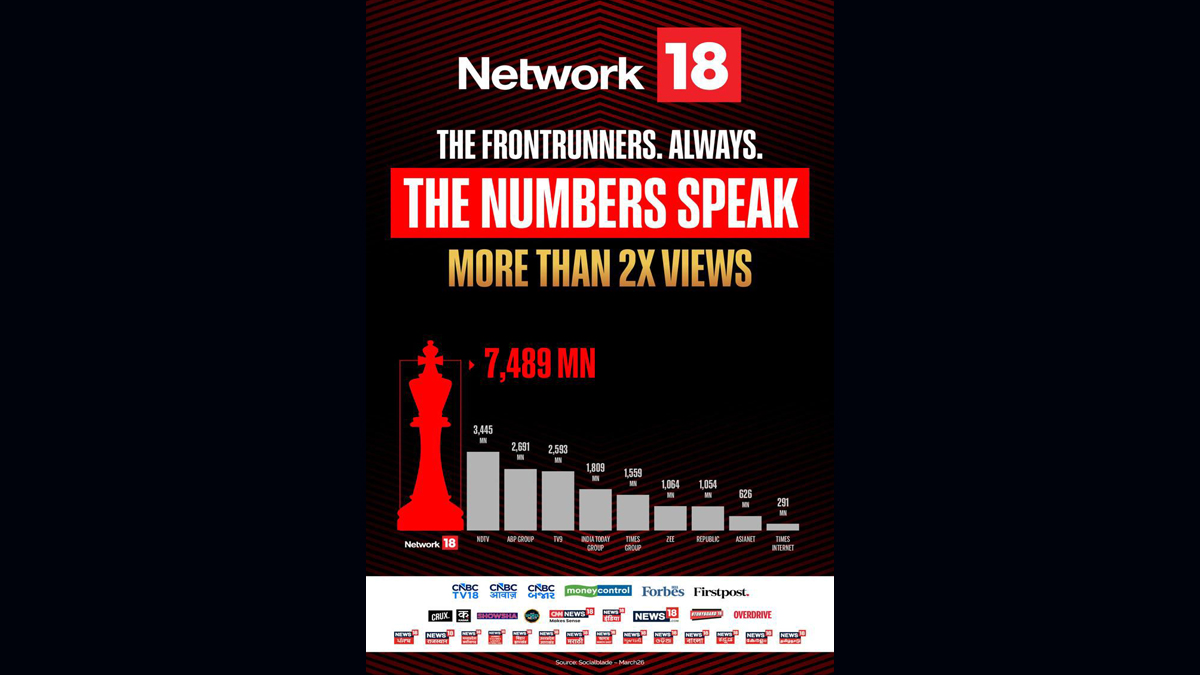
MUMBAI: When the world hit refresh on breaking news, Network18’s channels were already streaming ahead. As geopolitical tensions and war-driven headlines fuelled a surge in global news consumption, the network’s digital playbook delivered big clocking record Youtube viewership across English, Hindi and business news categories in March 2026.
At the forefront was CNN-News18, which emerged as the clear leader in the English news segment with 130 million live and video-on-demand views. The channel edged past competitors such as Times of India (126.5 million), Times Now (101.1 million), India Today (88.2 million) and NDTV (77.5 million), according to Databeings data for March.
In the Hindi news arena, News18 India delivered a commanding performance, racking up a staggering 3,297 million views on YouTube. The channel comfortably outpaced NDTV India, which recorded 3,119 million views, underlining its deep reach and consistent engagement with mass audiences, as per Playboard data.
The network’s dominance wasn’t confined to general news. In the Hindi business segment, CNBC Awaaz topped the charts with 92 million views, narrowly ahead of Zee Business (90 million) and well ahead of ET Now Swadesh (57 million). Meanwhile, its English counterpart CNBC-TV18 posted a strong 58 million views, reinforcing the network’s cross-category strength.
The spike in viewership reflects a broader shift in audience behaviour, with viewers increasingly turning to digital platforms particularly Youtube for real-time updates and in-depth coverage during high-intensity news cycles. For Network18, the numbers signal more than just scale; they underline the effectiveness of a multi-platform strategy that blends speed, credibility and continuous coverage.
In a month where the news never paused, it seems viewers chose to stay tuned where the stream never stopped.






