Hollywood
Brothers in arms The Wrecking crew smashes action with heart

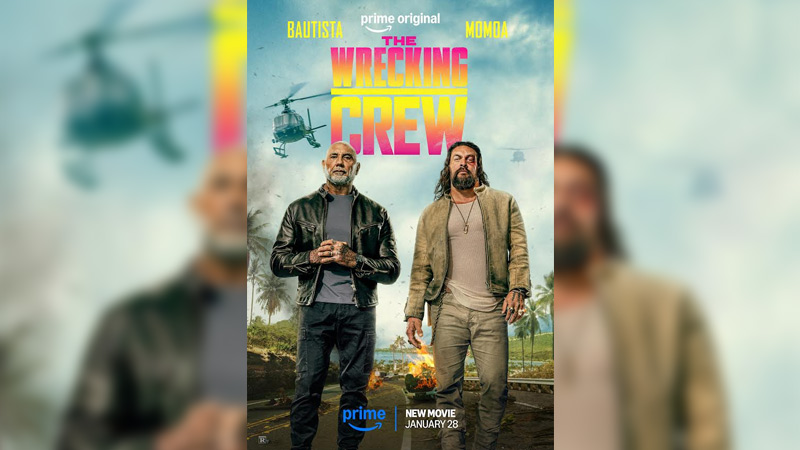
MUMBAI: Some family reunions come with hugs. Others come with fists, secrets and the occasional explosion. That is the premise powering The Wrecking Crew, an action comedy that brings together two of Hollywood’s most physically commanding stars, Jason Momoa and Dave Bautista, as estranged half-brothers forced back into each other’s orbit. Set against the sun-soaked streets of Hawaii, the film blends brute-force spectacle with bruised emotions, turning sibling rivalry into a full-throttle mystery.
Momoa plays Jonny and Bautista stars as James, brothers separated by time and temperament, reunited only after their father’s mysterious death. What begins as an uneasy truce soon spirals into a deeper investigation, as buried family truths and long-simmering resentments rise to the surface. The closer they get to answers, the clearer it becomes that the conspiracy they have stumbled into could tear what remains of their family apart. The result is a story where loyalty is tested as often as bones, and nothing is off-limits once the gloves come off.
The film is directed by Ángel Manuel Soto, following his work on Blue Beetle, and written by Jonathan Tropper. Production duties are shared by a heavyweight team including Jeff Fierson, Jason Momoa, Dave Bautista, Matt Reeves and Lynn Harris, signalling a project designed to balance scale with character. At 2 hours and 2 minutes, the runtime leaves room for both chaos and contemplation.

Beyond its leading duo, The Wrecking Crew features an eclectic supporting cast that adds texture and tonal contrast. The ensemble includes Claes Bang, Temuera Morrison, Jacob Batalon, Frankie Adams, Miyavi, alongside scene-stealing turns from Stephen Root and Morena Baccarin.
What sets the film apart, however, is not just the muscle on display. At its core, The Wrecking Crew is a story about brotherhood, masculinity and redemption, probing what it means to face the parts of your past you would rather outrun. The chemistry between Momoa and Bautista, long talked about by fans, finally finds its outlet here, mixing self-aware humour with moments of unexpected tenderness.
In an action landscape often dominated by interchangeable explosions, The Wrecking Crew positions itself as something sturdier. Loud when it needs to be, but surprisingly heartfelt when it matters, the film suggests that even the hardest-hitting action comedies work best when they remember what is really at stake.



Hollywood
Paramount eyes $24bn Gulf support to fund Warner Bros Discovery merger: Reports
Sovereign funds line up funding as media giants chase streaming scale
NEW YORK: Paramount Skydance is in talks to secure nearly $24 billion in equity commitments from Gulf sovereign wealth funds to support its planned takeover of Warner Bros. Discovery, according to a WSJ report.
The funding push comes as Paramount Skydance advances its proposed $110 billion deal for Warner Bros. Discovery, which carries an equity valuation of $81 billion and is expected to close in the third quarter of 2026.
At the heart of the financing plan are three major Gulf investors. Saudi Arabia’s Public Investment Fund is expected to contribute roughly $10 billion, while the Qatar Investment Authority and Abu Dhabi-based L’imad Holding are likely to make up the remainder.
Crucially, the proposed investments are structured as non-voting stakes. This means the Gulf backers would not have direct control in the combined entity, a move designed to ease regulatory concerns in the United States. Paramount executives reportedly do not expect the deal to trigger scrutiny from bodies such as the Committee on Foreign Investment in the United States or the Federal Communications Commission.
If completed, the merger would bring together a formidable portfolio of entertainment and news assets, including CNN and CBS. The combined entity aims to better compete in a fast-evolving media landscape where streaming platforms are steadily pulling audiences away from traditional television.
The deal reflects a broader shift in global media, where scale is increasingly seen as essential to survive the streaming wars. By pooling content libraries, technology and distribution, Paramount Skydance and Warner Bros. Discovery are betting on size and synergy to drive future growth.
The involvement of deep-pocketed Gulf investors also underscores the growing role of sovereign wealth in shaping global media consolidation, particularly at a time when high-value deals demand equally large financial backing.
With shareholder votes and regulatory milestones still ahead, the proposed tie-up remains one of the most closely watched media deals of the year. If it clears the final hurdles, it could redraw the competitive map of the global entertainment industry.






