News Headline
Broadcasters split over TRAI’s directive to BARC on TV viewership data

MUMBAI: The latest episode in the ongoing tariff order implementation saga saw industry watchdog and regulator, the Telecom Regulatory Authority of India (TRAI), direct TV ratings monitoring body – Broadcast Audience Research Council (BARC) – to publish ratings and TV viewership data from the week ending 8 February on its website with immediate effect. BARC, which was set up as an industry-funded body, citing the implementation of the new framework, has been releasing the data only to its subscribers. Earlier, the audience measurement firm published the weekly data on its website every Thursday.
Indiantelevision.com spoke to several broadcasters, none of who wanted to be identified, about the latest development to gain perspective.
“ISA has already advised that you should not use this data for planning. If there is a transition happening it will reflect in the data. Advertisers need to figure out how they want to maximise their investment in the market place. In my point of view, it (weekly data) should be used as a broad indicator. I’m in the favour of it being published,” the CEO of a news network said.

“This is the transition period and they (BARC) are not publishing on the site but data is available between all the stakeholders, agencies, clients and broadcaster. In my opinion, the people who are not paying for the data should not get the data,” said another CEO of a news network.
Recently, TRAI extended the deadline for consumers to select television channels under its new tariff regime till 31 March. Subscribers that don’t opt for new channels would be moved to ‘Best Fit Plans’, which would be developed as per usage pattern, language and channel popularity, the sector regulator said in its statement.
“There are two ways to look at it—if the ratings are being published given the level of disruption, advertisers and marketers would want to know what is going on at the ground level. Implementation takes time and some markets may have done more implementation than other markets. So, if the data is viewed in that light then it is fine but if it’s not then it starts becoming a bit of an issue because people will plan based out of an erratic pattern and obviously no one wants that,” argued a business head of a major network.
The Indian Society of Advertisers' (ISA) executive council had advised its members to not use the BARC data for media buying, planning and evaluation perspective during the transition period, which it feels will stretch up to six weeks.
“If people view the interim data correctly and look at it and understand what it is over a period of time, then it is fine. But if they make decisions by viewing one week or two week data, then that’s when mistakes will be made. This is why there were two thoughts whether to publish the data or not. But on the other hand, it is good because people will see the progress of whether a channel is up or down. I think people should use this and make plans for the medium to long term,” he further added.
The sector regulator had asked BARC to furnish compliance by 25 February 2019, "failing which, appropriate action would be initiated" under relevant sections of the TRAI Act.
“According to me, BARC should publish the data. There’s no logic for them to not publish the viewership data. The only thing here is that consumers may be misguided because of the fluctuating viewership ratings of the channels,” opined the promoter of a regional network.
According to TRAI, BARC has ignored its previous directives of publishing ratings and viewership data for television channels.
Several industry watchers told Indiantelevision.com that it was in fact the broadcasters that weren’t keen on weekly data being published on the BARC website.
“Yes, nobody was in favour of the data being published initially. Now that the system has somewhat stabilised, we are better equipped to tackle potential issues. TRAI’s directive is on expected lines,” said a senior executive of a major broadcast network.
TRAI held a meeting on Friday with distribution platform operators (DPOs) where it was informed that almost all cable consumers have either made their channel preferences or moved to ‘best fit plan’ under the new tariff regime.
The meeting was attended by multi-system operators (MSO) and all major DTH players to review the progress of migration of TV viewers under the new framework.
"According to inputs received by the regulator from players, in the case of DTH services, about 43 per cent customers have made their channel preferences known. When combined with statistics for ‘best fit plan’, this number rises to 57 per cent," stated TRAI secretary SK Gupta.







NEW DELHI: Hamdard Laboratories gathered a cross-section of India’s achievers in New Delhi on Friday, handing out the Hakeem Abdul Hameed Excellence Awards to figures who have left their mark across healthcare, education, sport, public service and the arts.
The ceremony, attended by minister of state for defence Sanjay Seth and senior officials from the ministry of Ayush, celebrated individuals whose work blends professional success with a sense of public purpose. It was as much a roll call of achievement as it was a reminder that influence is not measured only in profits or podiums, but in people reached and lives improved.
Among the headline awardees was Alakh Pandey, founder and chief executive of PhysicsWallah, recognised for turning affordable digital learning into a mass movement. On the sporting front, Arjuna Awardee and kabaddi player Sakshi Puniya was honoured for her contribution to the game and for pushing women’s participation onto bigger stages.
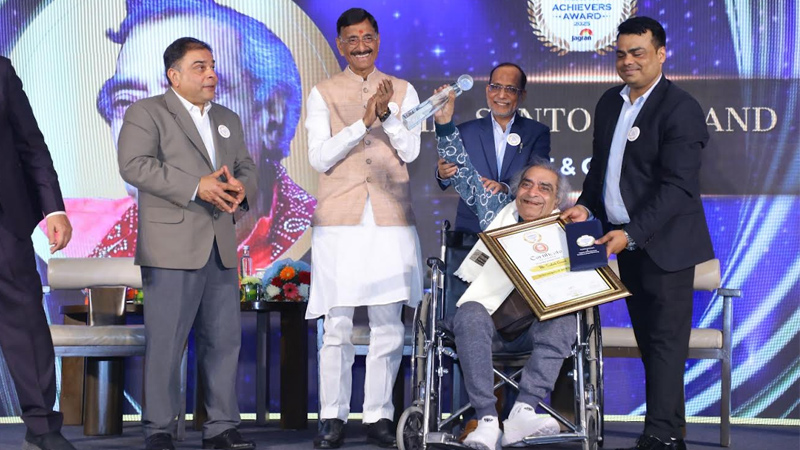
The cultural spotlight fell on veteran lyricist and poet Santosh Anand, whose songs have echoed across generations of Hindi cinema. At 97, Anand accepted the honour with characteristic humility, reflecting on a life shaped by perseverance and hope.
Healthcare honours spanned both modern and traditional systems. Manoj N. Nesari was recognised for strengthening Ayurveda’s place in national and global health frameworks. Padma shri Mohammed Abdul Waheed was honoured for his research-backed work in Unani medicine, while padma shri Mohsin Wali received recognition for his long-standing contribution to patient-centred care.
Education and social development also featured prominently. Padma shri Zahir Ishaq Kazi was honoured for decades of work in education, while former Meghalaya superintendent of Police T. C. Chacko was recognised for public service. Goonj founder Anshu Gupta received an award for his dignity-centred rural development initiatives, and the Hunar Shakti Foundation was honoured for empowering women and young girls through skill development.
The Lifetime Achievement Award went to former IAS officer Shailaja Chandra for her long career in public healthcare and governance, particularly in the traditional systems under Ayush.
Speaking at the event, Hamdard chairman Abdul Majeed said the awards were a tribute to those who combine excellence with empathy. “These awardees reflect Hakeem Sahib’s belief that healthcare, education and public service must ultimately serve humanity,” he said.
Minister Seth struck a forward-looking note, saying India’s young population gives the country a unique opportunity to become a global destination for learning, health and wellness by 2047.
The ceremony also featured the trailer launch of Unani Ki Kahaani, an upcoming documentary starring actor Jim Sarbh, set to premiere on Discovery on 11 February.
Instituted in memory of Unani scholar and educationist Hakeem Abdul Hameed, the awards have grown into a national platform that celebrates those building a more inclusive and resilient India. For one evening at least, the spotlight was not just on success, but on service with substance.