News Headline
Broadcasters promoting pay-TV on Free Dish are shooting themselves in the foot – Saurabh Sancheti

Mumbai: With a 40 million base, which is constantly growing at the cost of Pay-TV, Prasar Bharati’s DD Free Dish is not just another competing platform, but considered by many as a precursor to the success of Free Ad-Supported Television (FAST) model in India. The implementation of NTO 2.0 is going to further intensify this cannibalisation. While broadcasters are riding the FTA wave, some fairly and some in an unfair manner, distribution platform owners are pushing for regulatory intervention and new ways to tackle the challenge.
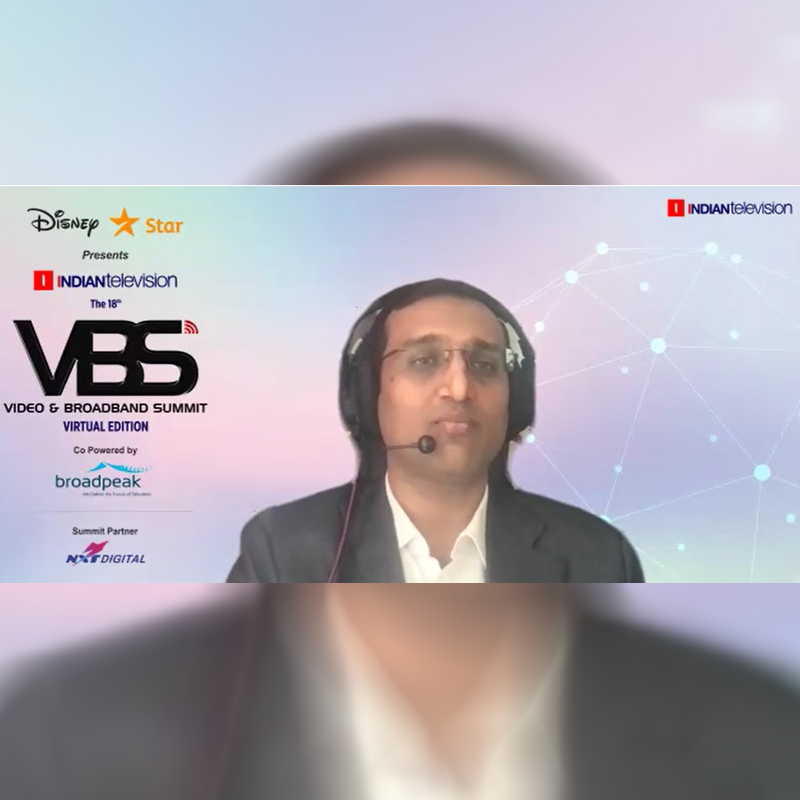
Saurabh Sancheti – Business Head | Hathway GTPL, has long been advocating and working towards building a ‘rupee-a-day’ product that can take on Free Dish. At the Video & Broadband Summit organised by Indiantelevision.com on 19 January, he outlined the approach that is needed to arrive at this solution.
“Out of the country’s 280-300 million households, nearly 200 million own a television set, and of this, only about 120 million have Pay TV. MSOs and broadcasters have to work together on wooing the remaining 80 mn base with a customised product. LCOs too need to reinvent themselves by adopting digital technology that serves their customers better,” he said. Sancheti is confident that if all players can collaborate on it, not only can the economics be worked out, but the pay-TV basket can be grown by at least 30-40 million in the next couple of years.

Cog in the wheel
In the current scenario, (short-term) gains and survival concerns are driving the top and bottom of the pyramid. Elaborating on what he terms as “death by annual plan”, Sancheti remarked, “Broadcasters promoting Pay-TV on Free Dish are shooting themselves in the foot. No matter how big you become on Free Dish, the platform cannot be monetised.”
“They need to understand the possibilities of working with the DPOs. As people’s income levels increase, they will spend more on subscriptions. Those who join at a Free Dish equivalent pricing today, can become our regular and even premium customers tomorrow. But instead of thinking about taking customers up the funnel, and about the long-term growth of pay-TV, they are worried about their annual and quarterly targets,” he rued.
Further, he noted that with infrastructure sharing and cheaper bandwidths making it possible to achieve last-mile delivery to the level of a gram panchayat at very low costs, distribution networks will also have to re-engineer themselves to align with the broadband revolution that’s underway.
It’s obvious that the postulated rupee-a-day product cannot run in the same high-touch manner as the current base is running and hence the requirement of “lot more digital, lot more long-term packs and lot more of DIY”.
Would that mean LCOs losing control of the last mile and eventually dropping out of the value chain? Commenting on the long-standing issue, Sancehti stated, “The primary models have failed, and MSOs realise that they cannot reach out to consumers directly, but only through the LCOs. That being said, today, consumers want more control. This is the reason why DTH, which has declined globally, is still surviving in India. It is the only medium that allows you to do everything yourself; from channel selection to bill payments. So, the risk of being eliminated is clearly there, however, it’s not because of the large players but the LCOs’ unwillingness to reinvent.”
The next big opportunity
Sancheti believes that the linear TV model still has a lot of scope left. Out of the 200 million TV-owning households in India, the top tier of 20-25 mn has both pay-TV and fixed-line connectivity. Their number is growing, and so is their OTT consumption.
The second set of 100 mn households, which is 70 per cent urban, consumes linear TV on the large screen and OTT on private/mobile screen. It will gradually go the 25 mn way.
The remaining 80 million (TG for the rupee-a-day product) are the ‘cord nevers’ who are subscribed to either analogue or Free Dish today. As their income levels increase and more content and services suitable for them are made available, they will move up the ladder into the pay-TV base.
Sancheti, however, finds the 100 million ‘TV nevers’ equally if not more promising than the 80 mn cord nevers. “At Den, Hathway, and GTPL, we believe this is where the opportunity lies to as much as double our base. As the economy progresses, spends on services will increase exponentially, and we are reinventing ourselves for the change; whether it is by way of working on connectivity/network or by value engineering the set-top boxes that begin at an 800 Rupees price point today.”
Pinpointing the 100 mn challenge and opportunity, he added, “It’s not like the cable hasn’t reached the ‘villages’. The problem is that it has found only 500-odd homes/subscribers there. The art is in doubling this number by offering the right product and pricing.”
Impact of NTO 2.0
Winding up the discussion with a word on the present state of regulation and the impact of NTO 2.0, Sancheti observed that “whatever rationalisation had to happen in terms of channel selection at the customer end has already happened with NTO (2019). Beyond a point, more à la carte will only do more harm. With NTO 2.0 we are looking at a 25-30 per cent increase in prices as per published broadcaster RIOs. India being a price-sensitive and value-seeking market, this will further pressurise the PayTV base, leading to more people opting out of it.”
Please Note : “The views expressed are personal and do not represent the views of Reliance Industries Limited or any of group companies”







NEW DELHI: Hamdard Laboratories gathered a cross-section of India’s achievers in New Delhi on Friday, handing out the Hakeem Abdul Hameed Excellence Awards to figures who have left their mark across healthcare, education, sport, public service and the arts.
The ceremony, attended by minister of state for defence Sanjay Seth and senior officials from the ministry of Ayush, celebrated individuals whose work blends professional success with a sense of public purpose. It was as much a roll call of achievement as it was a reminder that influence is not measured only in profits or podiums, but in people reached and lives improved.
Among the headline awardees was Alakh Pandey, founder and chief executive of PhysicsWallah, recognised for turning affordable digital learning into a mass movement. On the sporting front, Arjuna Awardee and kabaddi player Sakshi Puniya was honoured for her contribution to the game and for pushing women’s participation onto bigger stages.
The cultural spotlight fell on veteran lyricist and poet Santosh Anand, whose songs have echoed across generations of Hindi cinema. At 97, Anand accepted the honour with characteristic humility, reflecting on a life shaped by perseverance and hope.
Healthcare honours spanned both modern and traditional systems. Manoj N. Nesari was recognised for strengthening Ayurveda’s place in national and global health frameworks. Padma shri Mohammed Abdul Waheed was honoured for his research-backed work in Unani medicine, while padma shri Mohsin Wali received recognition for his long-standing contribution to patient-centred care.
Education and social development also featured prominently. Padma shri Zahir Ishaq Kazi was honoured for decades of work in education, while former Meghalaya superintendent of Police T. C. Chacko was recognised for public service. Goonj founder Anshu Gupta received an award for his dignity-centred rural development initiatives, and the Hunar Shakti Foundation was honoured for empowering women and young girls through skill development.
The Lifetime Achievement Award went to former IAS officer Shailaja Chandra for her long career in public healthcare and governance, particularly in the traditional systems under Ayush.
Speaking at the event, Hamdard chairman Abdul Majeed said the awards were a tribute to those who combine excellence with empathy. “These awardees reflect Hakeem Sahib’s belief that healthcare, education and public service must ultimately serve humanity,” he said.
Minister Seth struck a forward-looking note, saying India’s young population gives the country a unique opportunity to become a global destination for learning, health and wellness by 2047.
The ceremony also featured the trailer launch of Unani Ki Kahaani, an upcoming documentary starring actor Jim Sarbh, set to premiere on Discovery on 11 February.
Instituted in memory of Unani scholar and educationist Hakeem Abdul Hameed, the awards have grown into a national platform that celebrates those building a more inclusive and resilient India. For one evening at least, the spotlight was not just on success, but on service with substance.







