News Broadcasting
Brand Arnab unhurt by controversies

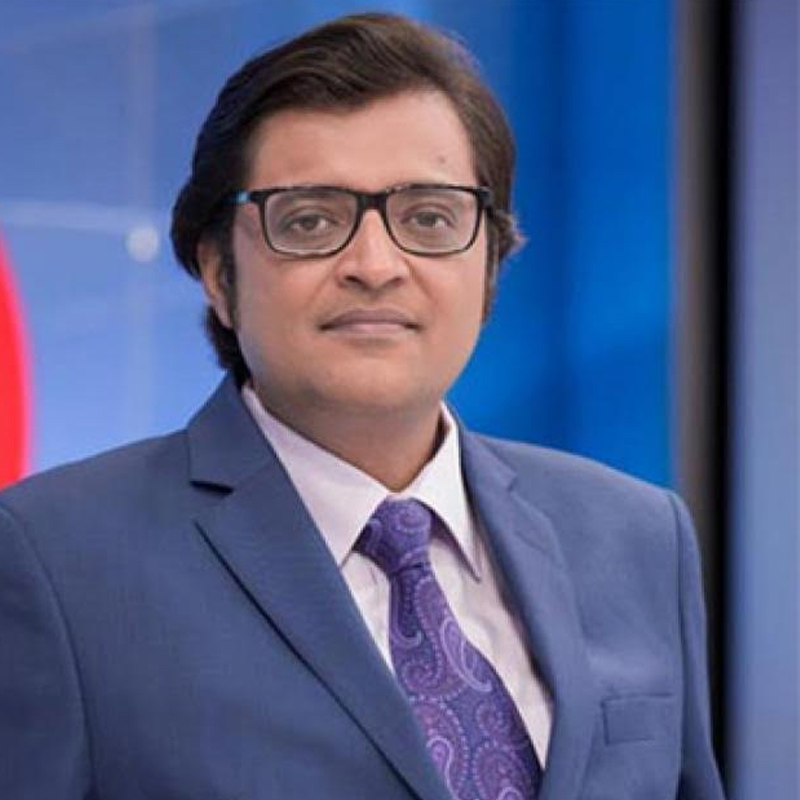
MUMBAI: Arnab Goswami has been hogging the limelight from the beginning of this week, first with his impromptu resignation from the Editors Guild of India during a live television debate show, and now for the multiple FIRs filed against him for making derogatory comment against a political personality during a live debate. The Supreme Court has given him three weeks’ protection from arrest.
Follow Tellychakkar for the consumer facing news & entertainment
Goswami, a founding member and editor-in-chief of the Republic Media Network, has hogged the limelight even as the country is racked by the COVID-19 crisis. But will these recent controversies affect the brand image of Goswami and his channel? Certainly not! On the other, they will only help Republic TV gain some traction, point out media agencies and brand experts.

“The controversy will have little effect on viewership or sponsorship; in fact, it might attract more viewers,” says FCB Ulka executive creative director Anindya Banerjee. “As a brand, Republic TV has managed to stay in the news in more ways than one. The people, who watch it, know it, and love it.”
Banerjee further says: “The brands which are associated with the channel are aware of it and love the fact that consumers engage with the news channel.”
Echoing the same view, Havas Media, India and Southeast Asia chief executive officer Anita Nayyar says: “Logically, any positive controversy lends positivity and a negative one lends negativity. And, the controversy garners a lot of eyeballs and in any case brands ride on it, if deemed fit.”
The apex court has ruled in favour of Goswami, granting protection from arrest in the case of FIRs filed against him in various states. A source close to the Republic TV says: “This case will probably set a benchmark and precedent of any such future cases. Here, multiple FIRs were filed. But tools like this cannot be used in any negative manner. It’s a big win for the media company.”
Republic TV has been the most-watched news channel in India for the straight fifteenth week so far this year, according to the Broadcast Audience Research Council (BARC) of India. And, while dwindling ad revenues have affected the majority of television channels due to the COVID-19 crisis, the Republic is unaffected by any such revenue losses, according to a top official of the network.
Says DigitalKites senior vice-president Amit Lall: “Brands relate to Arnab Goswami because of his success story as an individual. The moment it comes to brands, it always picks and chooses people who are safe and try to be neutral. They don’t like people, who are volatile or impromptu. Brands will continue to put money into it (Republic TV), purely because it has viewership. And, don’t think controversies like such would impact the advertising sales of the network,” says Lall.
Comniscient Group chief executive officer N Chandramouli says: “Arnab Goswami understands its audience well and have managed to create an audience clutter which nobody has. People believe in his perspective and take him seriously, which helps him get viewership and TRPs for his news channels. He is driven by his audience; we think he has an agenda but his audience has an agenda. Republic TV is completely audience-driven and believes he delivers for his consumers.”
Arnab Goswami rose to become one of the prominent journalists during his 10-year stint at Times Network where he was an editor-in-chief and primetime anchor of Times Now, which went on to become one of the most-watched news channels then under his editorship. The channel had eventually started getting traction due to his face value. In 2016, Goswami started his own news network, Republic Media, and holds a controlling stake in the company with over 80 per cent of shares.






News Broadcasting
Network18 channels lead YouTube news viewership in March 2026
CNN-News18, News18 India and CNBC channels top categories with record views
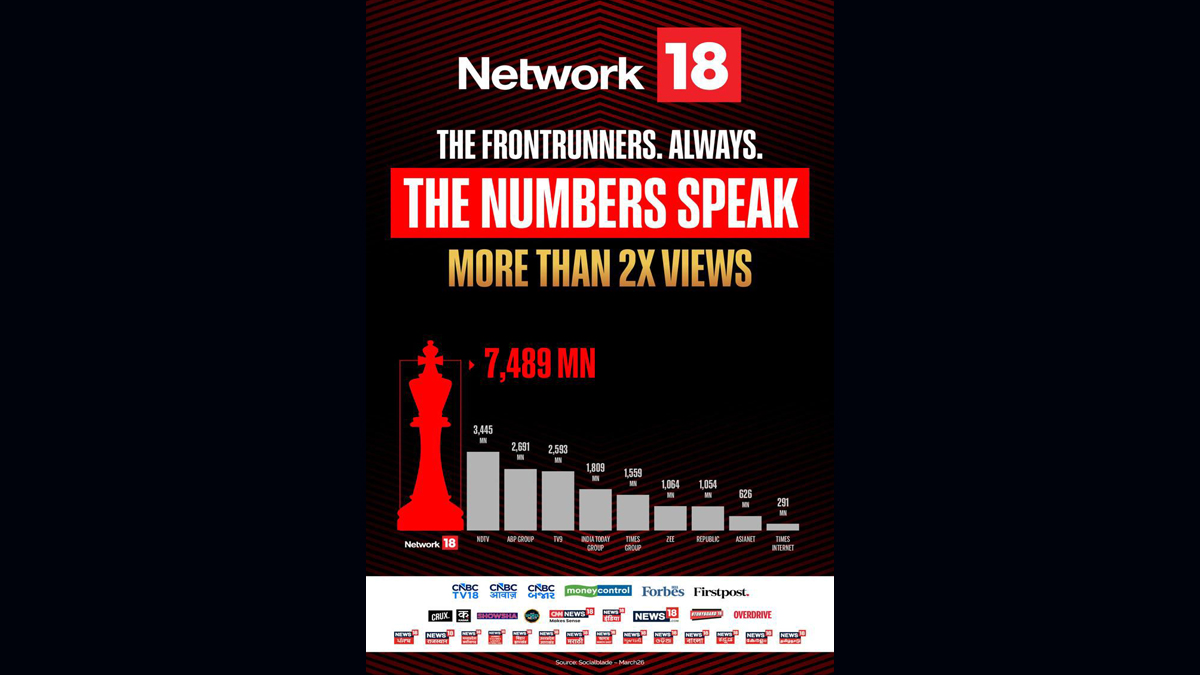
MUMBAI: When the world hit refresh on breaking news, Network18’s channels were already streaming ahead. As geopolitical tensions and war-driven headlines fuelled a surge in global news consumption, the network’s digital playbook delivered big clocking record Youtube viewership across English, Hindi and business news categories in March 2026.
At the forefront was CNN-News18, which emerged as the clear leader in the English news segment with 130 million live and video-on-demand views. The channel edged past competitors such as Times of India (126.5 million), Times Now (101.1 million), India Today (88.2 million) and NDTV (77.5 million), according to Databeings data for March.
In the Hindi news arena, News18 India delivered a commanding performance, racking up a staggering 3,297 million views on YouTube. The channel comfortably outpaced NDTV India, which recorded 3,119 million views, underlining its deep reach and consistent engagement with mass audiences, as per Playboard data.
The network’s dominance wasn’t confined to general news. In the Hindi business segment, CNBC Awaaz topped the charts with 92 million views, narrowly ahead of Zee Business (90 million) and well ahead of ET Now Swadesh (57 million). Meanwhile, its English counterpart CNBC-TV18 posted a strong 58 million views, reinforcing the network’s cross-category strength.
The spike in viewership reflects a broader shift in audience behaviour, with viewers increasingly turning to digital platforms particularly Youtube for real-time updates and in-depth coverage during high-intensity news cycles. For Network18, the numbers signal more than just scale; they underline the effectiveness of a multi-platform strategy that blends speed, credibility and continuous coverage.
In a month where the news never paused, it seems viewers chose to stay tuned where the stream never stopped.






