Hindi
Box office: ‘Phantom’ fails to impress

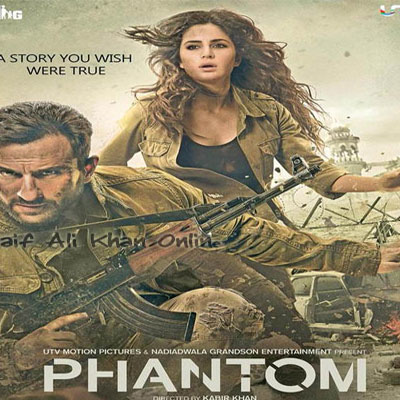
MUMBAI: Kabir Khan’s Phantom, starring Saif Ali Khan and Katrina Kaif, has opened with poor response. The first day figures hover around a little over Rs 8 crore. However, the film showed a reasonable jump on day two with collections growing by about 35 per cent this being a solo release with the advantage of Raksha Bandhan holiday. The word of mouth still remained against the film as the Sunday collections failed to match Saturday figures. The film collects Rs 33.2 crore in its opening weekend.
Kaun Kitney Paani Mein fails to make its presence felt at the box office.

Baankke Ki Crazy Baraat flops badly.
All Is Well fails to entertain with Rishi Kapoor and Abhishek Bachchan playing out a poor script and a patchy production. The film had a miserable opening and got worse as the week progresses to end its first week with collection figures of Rs 13.9 crore.
Manji – The Mountain Man matches the appreciation it earned from the critics and turns it to its advantage at the box office. The film collects a handsome Rs 9.45 crore in its first week.
Brothers shrinks to as much as 10 per cent of its first week collections in its second week. The film collects Rs 7.15 crore to take its two week total to Rs 76.7 crore.
Drishyam keeps box office ticking, though on a smaller scale. The film adds Rs 3.45 crore in its fourth week to take its four week total to Rs 79.95 crore.
Bajrangi Bhaijaan begins its countdown on its last rounds collecting Rs 1.3 crore in its sixth week. With this the film’s six week total stands at Rs 317.35 crore.
Bahubali (Hindi-Dubbed) adds Rs 1.4 crore in its seventh week to take its seven week total to Rs 108.6 crore.







Hindi
Government backs film production through DCDFC, co-production push
Scheme funds cinema, WAVES 2025 boosts global ties and industry growth.

MUMBAI: Lights, camera… policy action. As India’s screens glow brighter at home and abroad, the government is quietly scripting a bigger role behind the scenes funding films, fuelling collaborations and nudging the country closer to its “create for the world” ambition. At the centre of this effort is the Development, Communication & Dissemination of Filmic Content (DCDFC) scheme, a 100 per cent centrally funded initiative designed to support film production across the country. Through this scheme, the government provides direct financial backing to projects, aiming to strengthen both mainstream and alternative storytelling ecosystems while encouraging cinematic excellence.
The implementation runs through the National Film Development Corporation (NFDC), which plays a key role in facilitating film production, including regional cinema and documentaries. Beyond the screen, the scheme also feeds into the broader economy creating jobs for local technicians, artists and service providers, and strengthening grassroots production networks across states.
The push, however, is not limited to funding alone. India’s ambition to position itself as a global content powerhouse was on display at the World Audio Visual & Entertainment Summit 2025 held in Mumbai, which brought together creators, producers, startups and global stakeholders from over 100 countries. The summit acted as a convergence point for Indian storytelling and international capital, with OTT platforms, investors and technology leaders exploring partnerships in a rapidly evolving content economy.
Complementing this is the government’s focus on audio-visual co-production agreements, which effectively operate on a public-private partnership model. By enabling Indian and international producers to collaborate, these agreements are designed to bring in investment, global expertise and advanced filmmaking practices while also giving Indian stories a wider global footprint.
Support also extends to film culture and preservation. Grants are provided for domestic film festivals recommended by state governments, alongside curated film packages, masterclasses and workshops to nurture talent and audience engagement. The NFDC further collaborates with State Film Development Corporations, offering technical expertise across the filmmaking value chain and supporting the preservation of local film heritage.
Many states, in parallel, are encouraging the development of film infrastructure including production studios often through public-private partnership models, signalling a coordinated push to build a more robust audiovisual ecosystem.
The update was shared in Parliament by Ashwini Vaishnaw in response to a query from Thirumaavalavan Tholkappiyan, outlining a multi-layered approach that blends funding, infrastructure, policy and global outreach.
Taken together, the message is clear: India is not just telling more stories, it is building the machinery to tell them bigger, better and to the world.






