DTH
Bharti Airtel responds to BSE query on Tata Play buyout

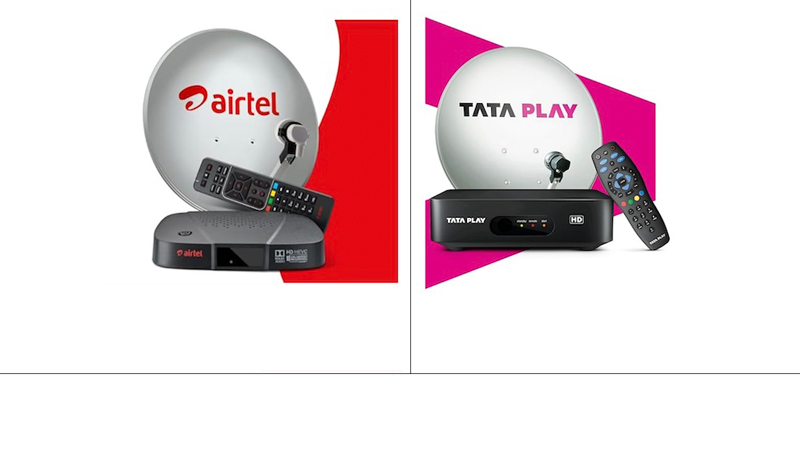
MUMBAI: The Sunil Mittal-owned Bharti Airtel has responded to a query from the Bombay stock exchange (BSE) regarding news reports that it is in advanced talks to acquire the lossmaking DTH market leader and Tata group company Tata Play, led by Harit Nagpal.
The company told the BSE that from time to time it or its subsidiaries evaluate various opportunities. And that it saw no reason why it should make any disclosures now, keeping in mind Securities Exchange Board of India (Sebi) regulations for listed companies.
In a letter addressed to both the National Stock Exchange and BSE, it responded as follows:

“We wish to clarify that the Company (on its own or through its subsidiary companies) evaluates various opportunities of alliances/ acquisitions and other similar avenues as per its requirements from time to time, in the ordinary course of business. There is no material event/ information that requires disclosure under Regulation 30 of the Securities and Exchange Board of India (Listing Obligations and Disclosure Requirements)
Regulations, 2015 (‘SEBI Listing Regulations’). As a responsible corporate that follows the highest standards of corporate governance, the Company is fully conscious of its disclosure obligations under SEBI Listing Regulations and will duly make appropriate disclosures in compliance with applicable laws.”
It may be recalled that The Economic Times had reported a couple of days ago that Tata Sons which holds a 70 per cent stake in Tata Play is looking at exiting along with Walt Disney, which holds 30 per cent. The DTH provider’s valuation has reportedly plummeted from around $3 billion pre-covid to around $1 billion today. Tata Sons had bought out Singapore’s Temasek Holding’s 10 per cent investment in Tata Play for around $100 million in April 2024. Bharti Airtel is expecting to close the purchase at the same valuation, the Economic Times report had stated.
Bharti Airtel owns the second largest DTH platform in India in Airtel DTH and the Tata Play acquisition will reportedly bolster its subscriber base.




DTH
Prasar Bharati’s WAVES earns Rs 2.9 crore in first year
Platform scales content, users but monetisation gaps limit revenue growth.
MUMBAI: Big waves, small ripples at least for now. When Prasar Bharati launched its OTT platform WAVES at the 55th International Film Festival of India in November 2024, it pitched a bold vision: a homegrown rival to global and domestic streaming giants, blending video, audio, gaming and commerce into a single digital ecosystem. Five months into FY2024–25, however, the platform’s revenue stands at just Rs 2.90 crore, a figure that underscores the gap between ambition and monetisation.
On paper, WAVES looks anything but modest. The platform has ingested 13,608 titles, totalling 9,495 hours of content, with over 13,000 titles already live. It has streamed more than 575 live events from the Mahakumbh Amrit Snan and the 76th Republic Day parade to the Hockey India League, Kabaddi World Cup and Mann Ki Baat while offering 74 live TV channels and 12 radio channels. With over 10 lakh registered users and more than 200 content partners onboarded, the scale resembles that of a fully operational streaming service rather than a pilot project.
The architecture supporting this scale is equally robust. Built under Prasar Bharati’s Central Archives vertical, WAVES runs on a cloud-based infrastructure with DRM, encryption and an integrated analytics dashboard. It includes dedicated units for content ingestion, quality control, publishing, graphics, marketing and billing, and is distributed across platforms such as OTTplay, Tata Play and BSNL. The offering extends beyond video to include audio-on-demand, e-games and even e-commerce via ONDC integration.
Yet, the numbers reveal a core disconnect. Despite its scale, WAVES generated just Rs 2.90 crore in a market where India’s OTT industry crossed Rs 23,000 crore in 2024. A key bottleneck lies in monetisation infrastructure: subscriptions cannot currently be purchased within the app and must be completed via an external website. In a mobile-first country where over 95 per cent of OTT consumption happens on smartphones, this extra step creates friction that most users are unlikely to overcome.
Ironically, content is not the problem, it is the platform’s biggest strength. Prasar Bharati holds one of the world’s richest broadcast archives, including 45,154 hours of digitised Akashvani programming and 35,723 hours from Doordarshan. For WAVES alone, over 3,800 hours of archival content have been made OTT-ready, including classics such as Ramayan and Shaktimaan, alongside rare cultural recordings and historical broadcasts.
There are early signs that this library holds commercial potential. Revenue from archival content licensing rose sharply to Rs 3.38 crore in FY24, up from Rs 67 lakh the previous year. Meanwhile, free digital platforms continue to drive massive reach, the PB Archives Youtube channel clocked 119.78 million views and added 4,02,000 subscribers in FY2024–25, crossing 1.7 million in total, while DD News has over 5.84 million subscribers.
That, however, presents a strategic dilemma. While free distribution builds scale, it also conditions audiences to expect content at zero cost making it harder to transition to paid models. WAVES, designed as a hybrid AVOD-SVOD platform with advertising and subscription layers, is yet to fully crack this balance.
The broader challenge is not technological but strategic. In an ecosystem dominated by platforms offering seamless payments, aggressive pricing and high-budget originals, WAVES is still bridging the gap between being a content repository and a commercially viable product.
For now, the platform reflects both promise and paradox. It has the scale, the content and the infrastructure but until monetisation catches up, WAVES remains less a revenue engine and more a digital showcase of what India’s public broadcaster could become.






