News Broadcasting
Bennett Media Worldwide announces programming line up at Mipcom 2006


MUMBAI: Bennett Media Worldwide (BMW), the Bennett Group’s global distribution operation, has announced at Mipcom 2006, their programming slate for global broadcasters. It will feature three all-new high-defintion series, including Playing In Paradise, Beyond the List and Oh, No! It’s Kato!
Said BMW president Paul Rich, “The Bennett Group reflects our company’s new industry positioning as a full-fledged, fully-integrated entertainment studio, with all areas of production and distribution all under one corporate ‘roof.’ Through Bennett Group’s four distinct divisions, we have the capacity to take a project from concept through every phase of production and post-production, as well as domestic and international distribution.”
“Our new high-def line-up further underscores our company as the production leader in this burgeoning format,” said Bennett Productions president Casey Bennett. “We are recognized as a pioneer in the production of HD programming having created and produced high-def series and specials as far back as 1998. Today, Bennett Productions is widely regarded for our HD productions which are backed by complete surround sound audio.”

The new-to-Mipcom Bennett Media Worldwide slate includes:
Playing In Paradise – Viewers experience a new dimension of exotic travel as top bikini models guide the audience through the world’s most desirable locations from the Bahamas to Thailand.
Beyond the List – It covers the hippest threads, cars, gadgets and what it takes to get a sneak peek into the world’s most exclusive lifestyles where only a recognized face or name on the list gains entrance.
Oh, No! It’s Kato!- After being rejected by Hollywood, Kato Kaelin takes his quick wit and sharp tongue to hot spots around the world in Oh, No! It’s Kato! From crashing the sidelines for the inside story at the Lingerie Bowl to sneaking into the Spring Break bikini pageant in Cancun, viewers are able to join Kato on his mission-possible journeys where the perfect mix of comedy and adventure drive each episode, informs an official release.
In addition to Bennett Media Worldwide, the newly established Bennett Group, housed at its West Los Angeles headquarters, encompasses: Bennett Productions, the content development and production division that includes state-of-the-art in-house soundstages; Bennett Music, a newly-created producer and supplier of both production and original music that is also home to complete recording studios as well as recording, mixing and mastering facilities utilizing the most current in digital recording technology; and Bennett HD/LA, one of the few fully-HD post-production facilities in Los Angeles.







News Broadcasting
Network18 channels lead YouTube news viewership in March 2026
CNN-News18, News18 India and CNBC channels top categories with record views
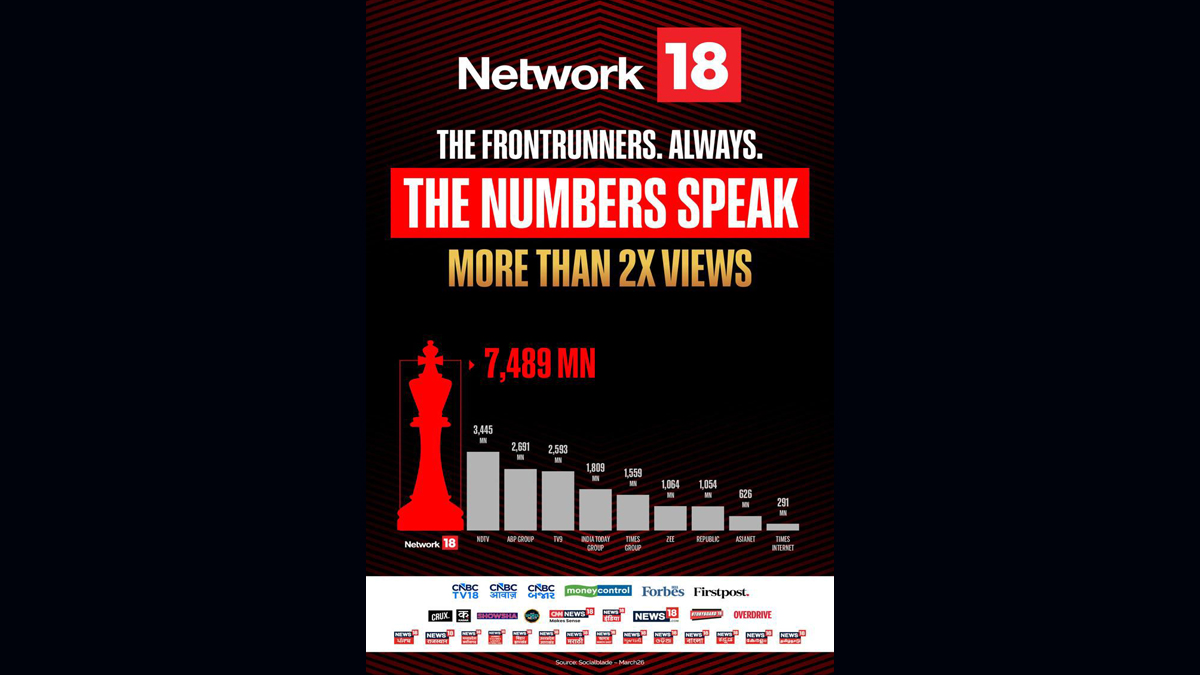
MUMBAI: When the world hit refresh on breaking news, Network18’s channels were already streaming ahead. As geopolitical tensions and war-driven headlines fuelled a surge in global news consumption, the network’s digital playbook delivered big clocking record Youtube viewership across English, Hindi and business news categories in March 2026.
At the forefront was CNN-News18, which emerged as the clear leader in the English news segment with 130 million live and video-on-demand views. The channel edged past competitors such as Times of India (126.5 million), Times Now (101.1 million), India Today (88.2 million) and NDTV (77.5 million), according to Databeings data for March.
In the Hindi news arena, News18 India delivered a commanding performance, racking up a staggering 3,297 million views on YouTube. The channel comfortably outpaced NDTV India, which recorded 3,119 million views, underlining its deep reach and consistent engagement with mass audiences, as per Playboard data.
The network’s dominance wasn’t confined to general news. In the Hindi business segment, CNBC Awaaz topped the charts with 92 million views, narrowly ahead of Zee Business (90 million) and well ahead of ET Now Swadesh (57 million). Meanwhile, its English counterpart CNBC-TV18 posted a strong 58 million views, reinforcing the network’s cross-category strength.
The spike in viewership reflects a broader shift in audience behaviour, with viewers increasingly turning to digital platforms particularly Youtube for real-time updates and in-depth coverage during high-intensity news cycles. For Network18, the numbers signal more than just scale; they underline the effectiveness of a multi-platform strategy that blends speed, credibility and continuous coverage.
In a month where the news never paused, it seems viewers chose to stay tuned where the stream never stopped.






