International
Belinda Lui steps down as MPA head – APAC; Urmila Venugopalan to replace her

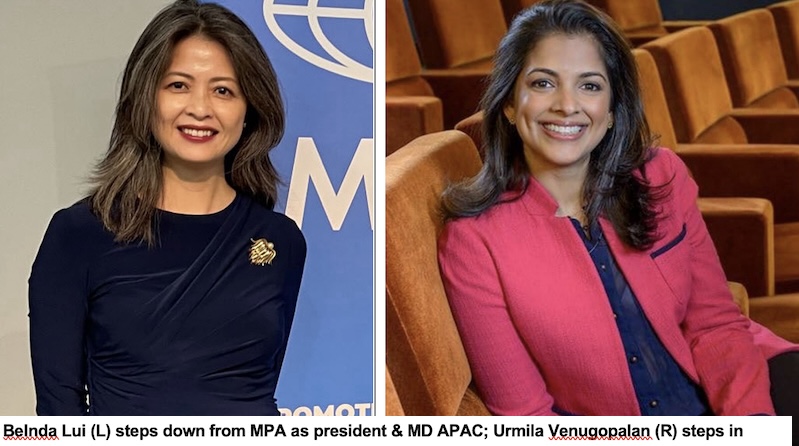
MUMBAI: It’s time to say goodbye to the Motion Picture Association (MPA). Belinda Lui who led the MPA for the past five years as president & managing director for the Asia Pacific has decided to hang up her boots.
Belinda during her five years did a lot of work to take the Asia Pacific film industry forward as well as push Hollywood in the region. According to her during her term, the MPA:
• Improved cultural exchanges between nations, through expanding access for American films and TV dramas to priority markets like China and achieving 15-20 per cent incremental box office revenue.

• Fueled local economies and built capacity in markets like Australia, Japan, India, New Zealand and Thailand through competitive film and TV production incentives (up to 40 per cent in tax rebates in Australia alone).
• Supported thousands of emerging filmmakers from almost 30 countries/territories in the Asia-Pacific through our film grants and LA training programs, with some of those projects going on to win the Academy Award and international Emmy.
Belinda, who, through her 30 year career, worked for companies like Warner Media, Microsoft and Baker McKenzie, has decided to offer her services to companies as an independent non-executive director and spend as much time as she can with her family.
She is being replaced on 31 January by Urmila Venugopalan , currently executive vice president of strategy & global operations at the MPA. In her new role, Venugopalan will work on expanding access to local markets and promoting production in new areas, as well other advocacy activities across the region. She also will work with the MPA’s anti-piracy arm, the Alliance for Creativity and Entertainment, or Ace. Venugopalan will retain her duties as the MPA’s corporate board liaison.
She will be based in Tokyo and report to MPA senior vice president, global policy & government affairs Gail MacKinnon.
MPA chairman & CEO Charles Rivkin said in a statement that Venugopalan “is a veteran leader who thrives at the complex intersections of business, public policy, and global affairs.”
He said that she “joined the MPA (in 2017) at a time of critical change and helped revitalise and realign its structure and priorities, strengthening our organisation from the inside out. I have full confidence that her deep experience working with every aspect of our global business operations, coupled with her existing corporate board liaison responsibilities, will advance our members’ objectives across the Asia Pacific and beyond.”
“Venugopalan is a trusted advisor who has earned the respect of colleagues and member companies. Her work has already touched every part of our organization, and she maintains a wide-angle lens on key political and sectoral trends – all while remaining laser-focused on how we can best tell the story of a creative industry that drives local economies, creates jobs, and connects communities everywhere,” said MacKinnon. “With her at the helm of our APAC operation, I am confident the MPA will achieve even greater impact in the fastest-growing region. I am also grateful to Belinda for her effective stewardship and counsel, which has greatly benefited the MPA and our member studios in the region.”
“The Asia-Pacific region has already played an important part in the history of our industry – and is set to assume a starring role in the future of great storytelling,” said Venugopalan. “At this critical juncture for the film, television and streaming industries, MPA members are more excited than ever about the vitality of this region – its enthusiastic and engaged audiences, its relentless dynamism, and its immensely talented casts and crews. I look forward to supporting our member studios and their local partners in their collective efforts to fuel local economies and enrich cultures across the region.”
Before joining the MPA, Venugopalan served as a member of the policy planning staff at the US state department in Washington and as a senior consultant at the Albright Stonebridge group. She holds a bachelor’s degree from McGill University and a master’s degree from the London School of Economics & Political Science.






International
Russia-India cinematic spectacle Persimmon of My Love set for grand Moscow debut
Hindi cinema style musical revives Indo-Soviet cinema ties for today

MUMBAI: A new chapter in cross-border storytelling is set to unfold as Persimmon of My Love gears up for its premiere in Moscow on 1 April 2026, marking the first large-scale cinematic collaboration between Russia and India in decades.
Positioned as a modern nod to the cultural exchange that once brought Indian classics to Soviet audiences, the film blends Hindi cinema flair with Russian storytelling, aiming to rekindle a long-standing cinematic friendship.
Directed by Marius Weisberg, the musical comedy follows two brothers navigating a lively world of music, family and romance. The lead roles are played by Demis Karibidis and Mikhail Galustyan, with Karibidis also contributing as a screenwriter.
Shot entirely in India, the production leans heavily into Hindi cinema style spectacle. Filming took place across Mumbai studios and the cities of Udaipur and Jodhpur, whose architecture was used to create the fictional setting of Khurmada. A crew of over 350 worked on the project, with large-scale sequences featuring up to 1,000 extras.
The film also brings Indian creative talent into the mix. Dance sequences are choreographed by Jay Kumar, while music by Zurab Matua features songs in both Hindi and Russian, adding to its cross-cultural appeal.
Backed by TNT channel, MyWayStudio and the Russian Cinema Fund, the project reflects a broader push to strengthen cultural ties between the two countries.
With its mix of colour, comedy and cross-border collaboration, Persimmon of My Love is not just a film release but a reminder that cinema, much like music, travels well across borders.






