Fiction
BBC Worldwide India: Women team makes fiction push


MUMBAI: Keeping the viewers glued to their television screens on prime time to cheer for their favourite Jhalak star with each new season of Jhalak Dikhhla Jaa, getting them riled up over the closer- to-home love stories in Dil ko phir Aaj jeene ki Tamanaa hai, taking the nation aback with television’s first ever gay relationship in Kaisi Yeh Yaariaan, and breaking the gender moulds with Girls On Top — BBC Worldwide India has had a very busy year and it doesn’t look like it’s slowing down anytime soon.
 |
While it’s been busy signing a joint venture with Sony Pictures Network to launch Sony BBC Earth, producing local productions of BBC Worldwide formats like Aaj Ki Raat Hai Zindagi (Tonight’s the Night) and exploring interesting partnerships in the digital space with its finished content like Doctor Who, Top Gear and Sherlock, the company’s non-production businesses has driven the revenues significantly in the past year.

“I genuinely feel that we have done so much and have so much more to look forward to this year. The team’s been kept busy between big and small projects. We haven’t taken any breaks,” expresses BBC Worldwide India SVP and GM Myleeta Aga.
 |
As head honcho, Aga wears many hats. She is responsible for creative content development in both the fiction and nonfiction space and for partnerships in the market as well as new business development. She also manages talent and overall growth within the organisation. When asked how she goes about fulfilling these distinct and key roles, she reveals that she is tuned in with everything but isn’t hands-on with each and every activity.
“I run multiple businesses within BBC Worldwide and I have a large team that I look after. My way of managing is by hiring great people and trusting them to do a good job. I don’t interfere in the day-to-day details. Of course, if you ask me about any specific information on a show that’s in production, or any data on a commercial deal in place, I have an answer – thanks to my team that keeps me up to date. We discuss and consult about everything we do. But you can’t scale if you do everything on your own,” Aga says.
The production business within BBC Worldwide in India has evolved in the last 12 months – the amount of fiction content that the organisation has churned out has increased . “This is the first year that we have had as many productions in fiction as we’ve had in non-fiction,” Aga says proudly and rightly so. Breaking assumptions as a corporate company that ‘only produces good nonfiction content’ and sinking teeth in to the highly competitive fiction market didn’t always come easy for the organisation.
To not depend just on co-productions and engage in a larger creative playing field within the market, it was necessary to cultivate the skill sets from within the organisation. And that was what Aga did three years ago when she made the decision for BBC Worldwide India to also operate in the fiction space.
“When we decided to invest in talent in fiction, I knew that it would take us years to change the mind-set in the industry. The industry needed convincing that there really aren’t separate skills needed for fiction and nonfiction. One is ultimately telling a story, whether it is of a reality star or an actor in a soap – the only difference is in the way you execute it.”
It was a heady risk to take. Fortunately, it is one that has paid off.
Today Aga proudly treasures the fact that she has an uncompromising team ready to tackle any kind of content across fiction and nonfiction. Interestingly, BBC’s top production executives in India are all women. Yes, you read it right, all women.
Richa Yamini, creative head for fiction content and production, was the first one to be picked in the fiction category. Her journey with BBC includes shows like Kaisi Yeh Yaariyan and DD’s Dil Ko Aaj Fir Jine Ki Tamanna Hai. “BBC was perceived as a nonfiction company when I joined. We started off with little steps to build awareness for our fiction content. We did a telefilm for Star Plus, followed by some coproduction work with Life Ok and Bindass. Then, we got our first fiction show with MTV. We’ve had a steady flow of productions since then.
 |
Yamini works closely with the head of fiction production, Dixitaa Thakar who joined the team almost three and half years ago. With 32 years of production experience under her belt, Thakar is a veteran whose guidance has helped grow the fiction category within the organisation to its current stature. “It was my responsibility to train the existing production team on the specific nuances of producing fiction shows. There was a lot of unlearning and relearning involved in the process.”
 |
The problem, as Yamini and Thakar both point out, lay in the general assumption amongst broadcasters that a corporate organization like BBC Worldwide wouldn’t do good job in fiction. “Shows are not given to production houses, but to individual well known writers, irrespective of the production houses he or she works in partnership with. We are changing this practice.” Yamini explained.
The third pillar in BBC Worldwide’s all girl production team is Soniya Kulkarni who heads nonfiction — the company’s stronghold. With a reputation to maintain, Kulkarni naturally works under a lot of pressure to keep up the standards, especially when the nonfiction pie is too thin in any given market.
“The healthiest of broadcasters do two hours of nonfiction programing in a week, as compared to thirty hours of fiction. So to get a new show on or to continue a series on is a struggle year on year. While we have been doing Jhalak for nine years now and in spite of its growing popularity, we can’t depend on just one big format for the business. Thanks to the huge catalogue of formats that BBC has, we have been able to introduce some good shows to India, like, Aaj Ki Raat Hai Zindagi, the Tonight’s the Night format from the BBC. But a lot of the bread and butter of nonfiction lies in developing home grown formats in the market, and we are dedicated to that,” Kulkarni elaborates.
Creative producer Palki Malhotra, who had worked nearly six years under an individual producer, joined BBC Worldwide to help build and grow the fiction chapter. She took the job as it offered her the freedom of working within a start-up, as well as the security of a job, as she puts it. “BBC hasn’t restricted me within the fiction and nonfiction boundaries. While I have worked in a show like Bindass Naach, I am also having fun producing a show like Girls On Top.”
Given the legacy of brand BBC, the production house may give off the assumption of a corporate work environment, but Aga paints a different picture, while acknowledging the benefits of working for a large organisation. “I prefer not to think of us as a corporation. Our work environment is informal with an open work space, where we share desks and executives don’t lock themselves in cabins. Yes, we have systems and processes, and we have values that we align ourselves with. All these things empower the team to have a long term vision rather than simply a short term target.”
 |
Commercial head Deepali Handa seconds the thought. “The company puts the brand and its image and relations with the stakeholders first. Something as simple as treating your actors well, not upsetting your stakeholders and respecting our work, may sound common sense, but it’s exactly these tenets that have clients coming back to us over and over again.” Handa asserts that BBC’s policies makes it easier for actors, artists, crews and other contractors to have a conducive working experience with the team.
BBC Worldwide has also done some fascinating work in the past in branded content Asian Paints Har Ghar Kuch Kehta Hai which aired for the first time on Colors in 2013 followed by a second season in 2014 with Vinay Pathak as the host, was developed by a dedicated team.
When asked if having a dedicated branded content arm puts her in an advantage to address the emerging requirements of the digital space, Aga answers, “Right now a lot of work on digital does revolve around the branded content category. But ultimately digital is just a platform. An advertiser would prefer to put branded content, a content aggregator would look at straightforward content, while if you partner with a broadcaster, you will look at a catch up service. Each of these OTT players have different requirements and given the fact that we can cater to all of them puts us at an advantage. Eventually people are looking for ideas that work,” Aga explains.
If all this isn’t enough to keep Aga and her team occupied, BBC Worldwide in India also keeps busy, working with broadcasters to put award-winning and highly rated BBC programmes onto their platforms. For example, Doctor Who on FX has performed incredibly well, as has Sherlock, Orphan Black and Top Gear on AXN. It has also worked with OTT platforms like Hungama and Vuclip to deliver award-winning and highly rated shows like Prey, War and Peace and Doctor Foster.
So what’s next for the very busy team at BBC Worldwide in India? Well, in addition to their already hectic schedules, they’re also in talks with several other local OTT players to provide original content on the web including nonfiction shows. Many of these will see the light of day, undoubtedly. And when they do, it will be more power to the BBC top team.




Fiction
Banijay merges with All3Media in $6.65 billion deal
Marco Bassetti will lead the combined company as CEO
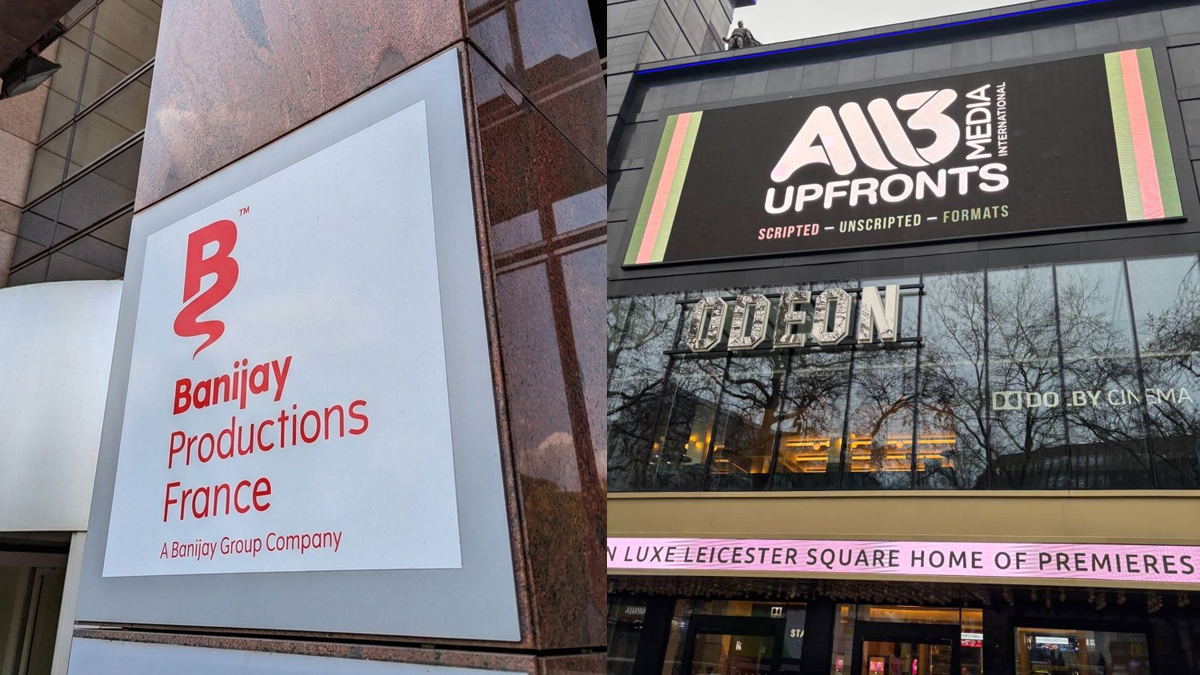
PARIS: Six years after acquiring Endemol Shine at the height of the pandemic, Banijay has struck again. The European production heavyweight is merging with All3Media in a deal that will create a television titan with $6.65 billion in revenue and redraw the contours of a fast-consolidating market.
The combined company will trade under the Banijay name and be owned 50 per cent each by Banijay Group and RedBird IMI, which acquired All3Media in 2024. The transaction is expected to close by autumn, subject to regulatory approvals.
Banijay Entertainment CEO Marco Bassetti, will take the top job at the enlarged group. All3Media CEO Jane Turton becomes deputy CEO. RedBird IMI CEO Jeff Zucker will serve as chairman.
The logic is scale. Broadcasters are commissioning less, streamers are tightening budgets and global buyers are fewer but bigger. Against that backdrop, heft matters. The merged entity will generate roughly $6.65 billion in revenues based on 2024 figures, giving it sharper elbows in rights negotiations and deeper pockets for franchise-building.
“Entrepreneurialism, ambition and creativity” remain core to Banijay’s DNA, Bassetti said, flagging plans to invest more heavily in new intellectual property, live events and emerging platforms. Turton struck a similarly bullish note, pointing to All3Media’s journey from a 2003 start-up to a global supplier of hit formats and high-end drama.
Between them, the two groups control a formidable slate. Banijay’s catalogue spans MasterChef, Big Brother, Survivor, Black Mirror, Peaky Blinders and Deal or No Deal. All3Media’s labels include Studio Lambert, producer of The Traitors and Squid Game: The Challenge; Two Brothers, behind The Tourist; and Neal Street, currently producing the forthcoming Beatles biopics directed by Sam Mendes for Sony.
The back catalogue is equally muscular. Banijay Rights holds some 220,000 hours, while All3Media International adds around 35,000 hours, forming one of the industry’s largest libraries.
Banijay, controlled by French entrepreneur Stéphane Courbit and listed in Amsterdam, counts more than 130 production companies across 25 territories. All3Media operates over 40 labels, with strong positions in the UK, US and Germany. The enlarged group will also lean into live entertainment, building on Banijay’s Balich Wonder Studio, which produced the opening ceremony of the Milan-Cortina Winter Olympics, and the Independents.
The deal marks a shift in tone. As recently as October, Bassetti suggested that mergers and acquisitions were not a priority. But the drumbeat of consolidation has grown louder. Mediawan has moved for Peter Chernin’s North Road. David Ellison’s Paramount has agreed to a $110 billion takeover of Warner Bros, with plans to combine HBO Max and Paramount plus. ITV has explored selling its media and entertainment arm to Comcast-owned Sky, though talks have reportedly slowed.






