News Broadcasting
BBC World going digital 1 December


Television news channel BBC World, which completed 10 years of operations in India last month, is going digital from 1 December, 2001.
Speaking to indiantelevision.com, Erica Rowe, head of specialist news distribution, BBC World, said to ensure a smooth transition to a digital feed, the 24-hour British news channel would be operating a dual illumination feed, continuing the analog feed on the PAS 10 satellite till 31 March 2001.
Rowe and Gerrie Richie, head of network development, are currently in India for the dual purpose of announcing the digitalisation plan and meeting cable operators from across the country to “thank them for the support they have extended to BBC World” over the last ten years.

Richie said the conversion of BBC World to a digital field “was part of an overall strategy we have for the distribution of BBC World.”
Rowe said she was in India for the next four weeks as part of a communication effort celebrating BBC’s ten years in India where meetings with cable operators were being organised across the four metros of Mumbai, Delhi, Bangalore and Calcutta.
Over 500 guests were invited for the Mumbai bash held last night at the Taj Hotel in south Mumbai, Rowe said. There would be similar parties in Bangalore (12th November), Delhi (16th) and Calcutta, 23rd, Rowe said.
The digitisation effort was not restricted to India but would extend across the full footprint of the PAS-10 satellite’s BBC World South Asia feed, Rowe said. This would cover Pakistan, Nepal, Sri Lanka, Middle East, Bhutan and Bangladesh, Rowe said.
On the distribution front, Richie said BBC World reached 11 million households in India. Worldwide, BBC is received as a 24-hour service in 81 million homes.
An important area where attention is paid is distribution in hotels. BBC World is available in over 55,000 hotel rooms around the world and there is a a separate person dedicated to ensuring that BBC World “is received in all the major hotels in the region,” Richie said.
Queried as to why BBC hadn’t considered a free-to-air encrypted feed, Rowe said: “BBC’s philosophy for India is we want as many people as possible to view our channel. We don’t want to restrict it any way?” Richie replied in the negative when asked whether there were any possibilities of BBC allying with a bouquet or channel. “Our principle objective is to make sure there is a smooth transition from analog to digital and to hold on to the distribution numbers that we have. We haven’t considered at this stage tying up with any of the other players in the marketplace.”
Technical Specifications Post Digitalisation
Satellite: Panamsat PAS-10
Transponder: 14C
Downlink Polarisation: Vertical
Downlink Frequency: 3970 MHz



News Broadcasting
UDF poised to return to power in Kerala, says Manorama-CVoter survey
Massive opinion poll projects shift in Kerala politics ahead of 2026 Assembly elections.
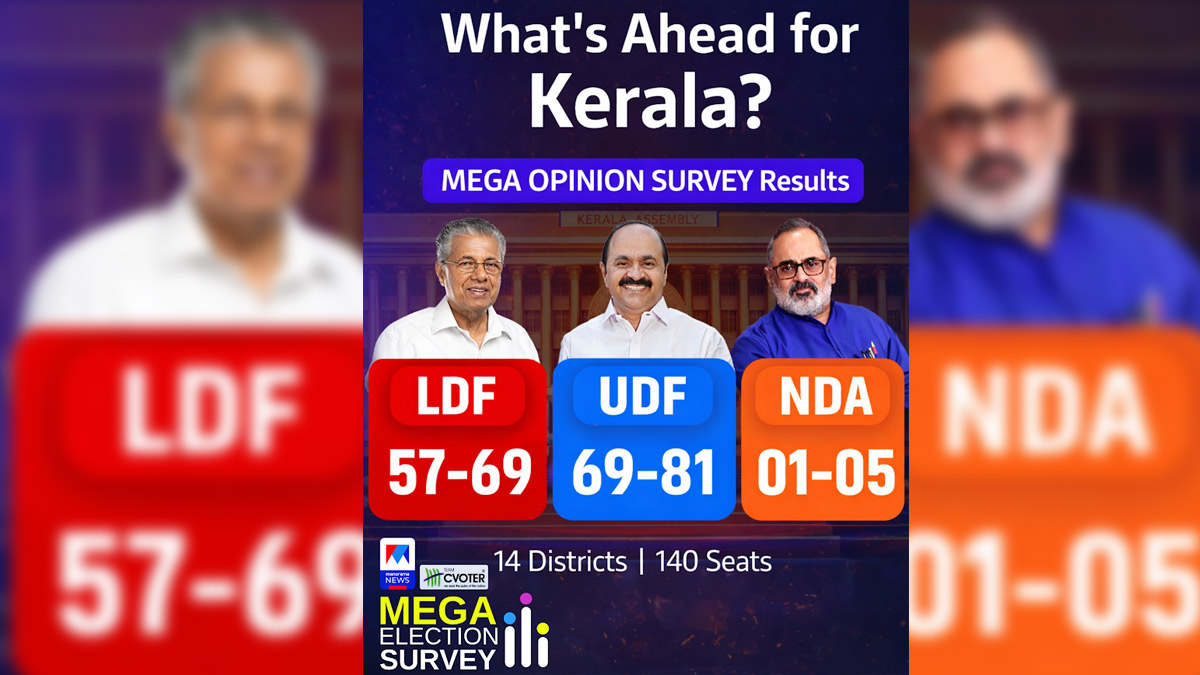
MUMBAI: The winds of change appear to be blowing through Kerala’s political landscape and this time, they seem to favour the United Democratic Front. A comprehensive mega opinion survey conducted by Manorama News in partnership with CVoter projects a potential comeback for the UDF in the upcoming Kerala Legislative Assembly Elections 2026. The survey, covering all 140 constituencies with a massive sample size of nearly 90,000 respondents, predicts the UDF could win between 69 and 81 seats.
The ruling Left Democratic Front (LDF) is expected to secure 57 to 69 seats, a significant drop from the 99 seats it won in the 2021 elections. This would mean the LDF losing 30 to 42 of its sitting seats. Meanwhile, the National Democratic Alliance (NDA), which drew a blank in 2021, is projected to open its account with 1 to 5 seats.
Region-wise, the UDF is expected to make strong gains in Malabar, winning 25 to 34 out of 48 seats, and in Central Kerala, where it could bag 29 to 33 out of 53 seats. In South Kerala, the LDF is likely to retain an edge with 21 to 25 seats, while the UDF may improve to 12 to 16 seats. The NDA could pick up 1 to 3 seats in the southern region.
The survey was conducted between 14 and 26 March 2026, with additional tracker and snap polls carried out from December 2025 to March 2026. A total of 89,693 respondents participated, ensuring representation across all demographics and social segments.
Manorama News has a strong track record of accuracy, with its previous projections closely matching the actual results of the 2019 and 2024 Lok Sabha elections as well as the 2021 Kerala Assembly polls.
In Kerala’s famously fierce political battles, this survey suggests the pendulum may be swinging back. Whether the final verdict matches these numbers or throws up another surprise, one thing is clear, the 2026 Assembly elections are shaping up to be one of the most keenly watched contests in the state’s history.






