News Broadcasting
BBC revenue growth in 2002 ‘significant’


NEW DELHI: Continuing to be bullish on the Indian market, BBC World feels that the subcontinent still offers the channel great potential in terms of revenue and audience, according to a senior executive of the channel.
“Revenue has grown significantly in the (calendar) year 2002 globally. Within India, the growth has been significant and it is more significant now,” Jonathan Howlett, director of airtime sales, BBC World, told indiantelevision.com today in an interview.
Howlett also said that as part of a strategy to increase audience share which will result into increased advertising revenue, BBC World is also tapping directly “tertiary and secondary markets” like Germany, the Philippines, Indonesia as also parts of Eastern Europe.

According to Howlett, India becomes more significant as a market for BBC World (India is the only market in the world where BBC is ahead of its main competitor CNN) as there is a new interest amongst advertisers and media planners for news channels as a vehicle for carrying messages.
“I see that the mental block which probably was there earlier amongst advertisers that BBC World is a niche channel and that too a global news channel is going away,” Howlett said, adding, “I also see that there is a new interest for news channels (as a vehicle) in India and it is in my interest that I closely follow what is happening in the market and what the other (news) channels are doing.”
A person who has come to India quite often, Howlett has sniffed out that not only is the Delhi air more clean (than when he was last here) now, but there are business opportunities in India which need to be exploited to offset some less robust markets elsewhere in the world.
“There is greater connectivity between India and the rest of the world today and vice versa,” Howlett said, pointing out that the channel is getting more queries (on advertising) from companies in the US, for example, for advertising in India.
“I’d say that the Indian market is more robust than several other markets and that is why we feel there are opportunities here,” he said.
Howlett feels that since BBC World is targeting the “upscale” audience in mostly SEC A and B categories, in a way even National Geographic is a competition (for BBC) in India.
According to him, the need of the hour is to focus on existing properties on the channel (like Top Gear, Asia Business News in the morning and Mastermind India) and “crystallise” them rather than go about collecting more local content.
“The agenda is to focus on India and exploit the channel as we have it rather than getting more local content or commission Indian TV production houses,” Howlett said.
Does that mean that BBC is actually cutting down or going in for a status quo where its India-specific localisation bid is concerned? Howlett is quick to see the ‘journalistic trap’ and points out: “I am not saying anything of that sort. What I am saying is that we must focus more on the existing product rather than go about trying to change it drastically.”
Though Howlett is absolutely mum on any sort of figures, making a point on relevance of India at present, he said that any given time some 40-odd brands advertise on the channel, out of which about 50-60 per cent would be from India or of those companies who want to target India.






News Broadcasting
UDF poised to return to power in Kerala, says Manorama-CVoter survey
Massive opinion poll projects shift in Kerala politics ahead of 2026 Assembly elections.
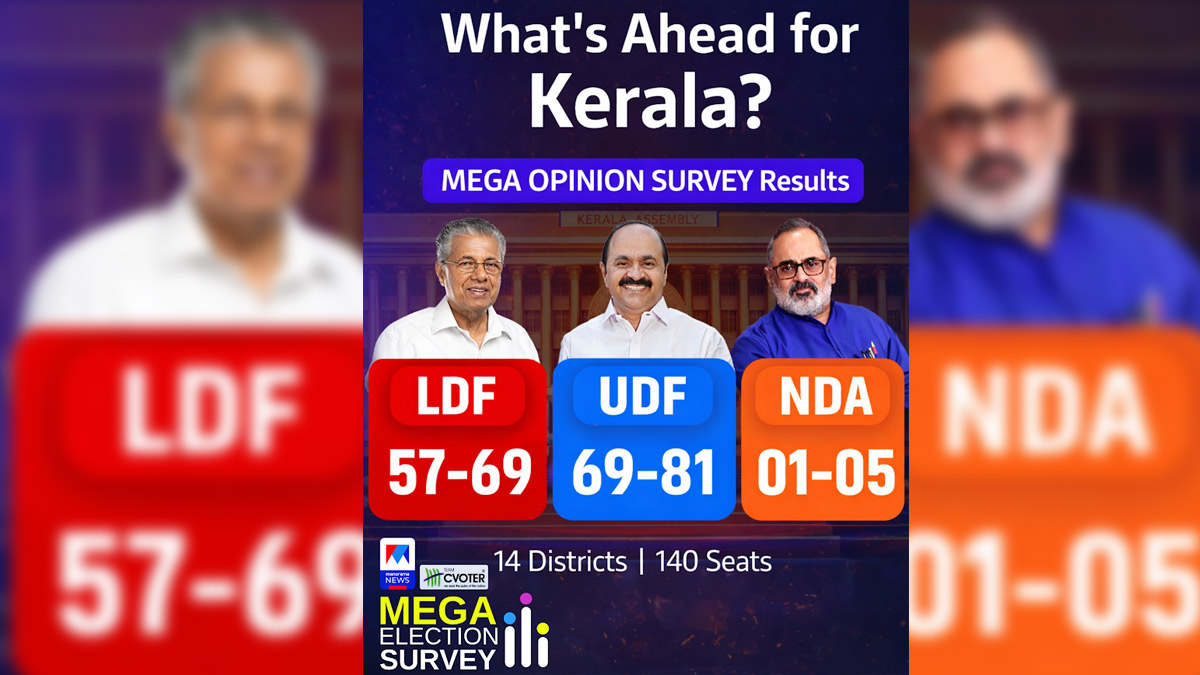
MUMBAI: The winds of change appear to be blowing through Kerala’s political landscape and this time, they seem to favour the United Democratic Front. A comprehensive mega opinion survey conducted by Manorama News in partnership with CVoter projects a potential comeback for the UDF in the upcoming Kerala Legislative Assembly Elections 2026. The survey, covering all 140 constituencies with a massive sample size of nearly 90,000 respondents, predicts the UDF could win between 69 and 81 seats.
The ruling Left Democratic Front (LDF) is expected to secure 57 to 69 seats, a significant drop from the 99 seats it won in the 2021 elections. This would mean the LDF losing 30 to 42 of its sitting seats. Meanwhile, the National Democratic Alliance (NDA), which drew a blank in 2021, is projected to open its account with 1 to 5 seats.
Region-wise, the UDF is expected to make strong gains in Malabar, winning 25 to 34 out of 48 seats, and in Central Kerala, where it could bag 29 to 33 out of 53 seats. In South Kerala, the LDF is likely to retain an edge with 21 to 25 seats, while the UDF may improve to 12 to 16 seats. The NDA could pick up 1 to 3 seats in the southern region.
The survey was conducted between 14 and 26 March 2026, with additional tracker and snap polls carried out from December 2025 to March 2026. A total of 89,693 respondents participated, ensuring representation across all demographics and social segments.
Manorama News has a strong track record of accuracy, with its previous projections closely matching the actual results of the 2019 and 2024 Lok Sabha elections as well as the 2021 Kerala Assembly polls.
In Kerala’s famously fierce political battles, this survey suggests the pendulum may be swinging back. Whether the final verdict matches these numbers or throws up another surprise, one thing is clear, the 2026 Assembly elections are shaping up to be one of the most keenly watched contests in the state’s history.






