News Headline
Avinash Kaul shares his journey from Kashmir exile to media leader

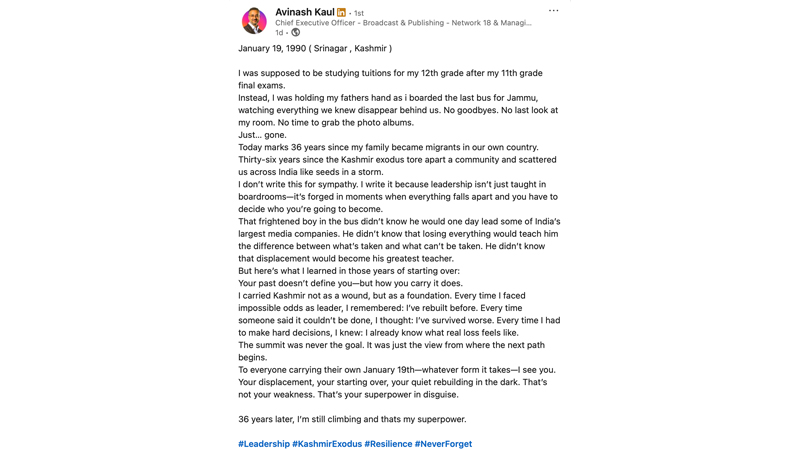
MUMBAI: On 19 January 1990, a 12th-grade student held his father’s hand and boarded the last bus out of Srinagar, leaving behind his home, his room, his memories, and everything he knew. That boy was Avinash Kaul.
Thirty-six years on, Kaul, ex-CEO of Network18, reflected on that day in a heartfelt LinkedIn post. His family had become migrants in their own country, displaced by the Kashmir exodus. He did not write for sympathy; he wrote to share a lesson in resilience and leadership forged in the harshest of circumstances.
“I carried Kashmir not as a wound, but as a foundation,” Kaul wrote. “Every time I faced impossible odds as a leader, I remembered: I’ve rebuilt before. Every time someone said it couldn’t be done, I thought: I’ve survived worse. Every time I had to make hard decisions, I knew: I already know what real loss feels like.”

Kaul’s story is a rare reminder that leadership is often born not in boardrooms but in moments of profound uncertainty. The frightened boy on that bus could not have imagined that decades later he would oversee India’s largest news network, managing 20 news channels in 16 languages and reaching over 700 million viewers.
From fleeing conflict to shaping the nation’s information landscape, Kaul has transformed adversity into strength. “To everyone carrying their own January 19th, whatever form it takes, I see you. That’s not your weakness. That’s your superpower in disguise,” he wrote.
Across a 27-year career, including 15 years as CEO, Kaul has become a respected figure in the media industry. He has shaped standards for audience measurement and advertising through contributions to the Media Research Users Council, the Broadcast Audience Research Council, and The Advertising Club.
Yet it is the human story behind the titles that resonates most. Kaul’s journey shows that displacement and loss can be the greatest teachers, turning survival into vision and courage into leadership.
Thirty-six years later, he is still climbing. “And that’s my superpower,” Kaul wrote. The lesson is clear: the trials of yesterday can define the leaders of today, and the scars of the past can fuel the triumphs of the future.







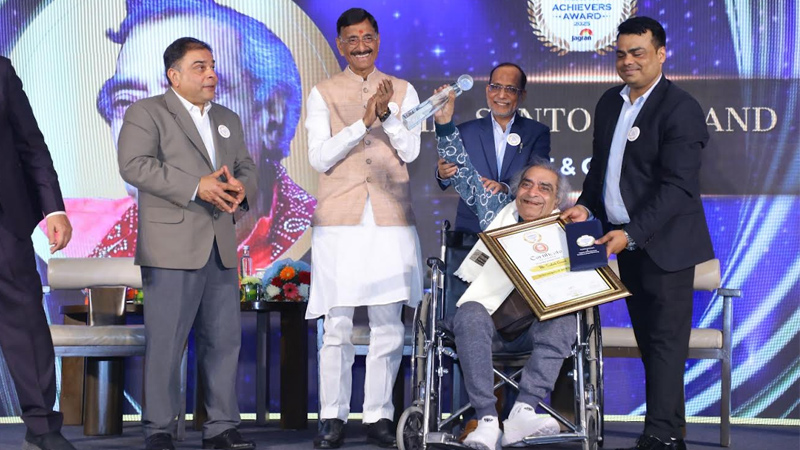
NEW DELHI: Hamdard Laboratories gathered a cross-section of India’s achievers in New Delhi on Friday, handing out the Hakeem Abdul Hameed Excellence Awards to figures who have left their mark across healthcare, education, sport, public service and the arts.
The ceremony, attended by minister of state for defence Sanjay Seth and senior officials from the ministry of Ayush, celebrated individuals whose work blends professional success with a sense of public purpose. It was as much a roll call of achievement as it was a reminder that influence is not measured only in profits or podiums, but in people reached and lives improved.
Among the headline awardees was Alakh Pandey, founder and chief executive of PhysicsWallah, recognised for turning affordable digital learning into a mass movement. On the sporting front, Arjuna Awardee and kabaddi player Sakshi Puniya was honoured for her contribution to the game and for pushing women’s participation onto bigger stages.
The cultural spotlight fell on veteran lyricist and poet Santosh Anand, whose songs have echoed across generations of Hindi cinema. At 97, Anand accepted the honour with characteristic humility, reflecting on a life shaped by perseverance and hope.
Healthcare honours spanned both modern and traditional systems. Manoj N. Nesari was recognised for strengthening Ayurveda’s place in national and global health frameworks. Padma shri Mohammed Abdul Waheed was honoured for his research-backed work in Unani medicine, while padma shri Mohsin Wali received recognition for his long-standing contribution to patient-centred care.
Education and social development also featured prominently. Padma shri Zahir Ishaq Kazi was honoured for decades of work in education, while former Meghalaya superintendent of Police T. C. Chacko was recognised for public service. Goonj founder Anshu Gupta received an award for his dignity-centred rural development initiatives, and the Hunar Shakti Foundation was honoured for empowering women and young girls through skill development.
The Lifetime Achievement Award went to former IAS officer Shailaja Chandra for her long career in public healthcare and governance, particularly in the traditional systems under Ayush.
Speaking at the event, Hamdard chairman Abdul Majeed said the awards were a tribute to those who combine excellence with empathy. “These awardees reflect Hakeem Sahib’s belief that healthcare, education and public service must ultimately serve humanity,” he said.
Minister Seth struck a forward-looking note, saying India’s young population gives the country a unique opportunity to become a global destination for learning, health and wellness by 2047.
The ceremony also featured the trailer launch of Unani Ki Kahaani, an upcoming documentary starring actor Jim Sarbh, set to premiere on Discovery on 11 February.
Instituted in memory of Unani scholar and educationist Hakeem Abdul Hameed, the awards have grown into a national platform that celebrates those building a more inclusive and resilient India. For one evening at least, the spotlight was not just on success, but on service with substance.







