News Broadcasting
Asia increasingly buying into French animation


SAINT-TROPEZ: Vive la France! That’s a message that is finding an increasing number of listeners in Asia Pacific. At least if one goes by the figures of French television programming exports released by the French television producers association TVFI, The Institute National de l’Audiovisuel (INA), and the Centre national de la cin�matographie (CNC) at the Rendez-Vous 2002 organised by TVFI in Saint-Tropez in the south of France on 10 September.
These rose by 32 per cent in 2001 from 8.2 million Euros to 10.2 million euros in 2000. Japanese broadcasters accounted for 40.3 per cent of these sales, China for 10.4 per cent, while Australia and New Zealand chipped in with 9.9 per cent.
Singapore, India and other countries grabbed 13.4 per cent of the exports, South Korea 8.8 per cent while Indonesia did 3.8 per cent. Asian broadcasters exported more fictional programming than Central European broadcasters accounting for a 15.5 per cent share of the pie, which was led by West Europe (49.4 per cent) and North America (8.2 per cent).

Asia also had a large part of French documentary acquisitions with a 14.1 per cent share in a genre segment that was once again led by west Europe (59.8 per cent), North America (8.9 per cent). West Europe accounted for 76.6 per cent of French animation exports, north America for 11.9 per cent and Asia for 4.2 per cent. “French animation is finding increasing buyers in Asia. Acquisitions by broadcasters are rising at a fast clip,” says TVFI executive director Mathieu Bejot. Amongst the Asian countries that figured prominently in the buyers list are Japan, China, and South Korea.
While the appetite for French television productions in Asia has been on the rise, sales on the whole declined by 2.1 per cent from 129.3 million euros in 2000 to 126.7 million Euros in 2001. There was however, a rise in of 21.8 per cent in pre-sales and co-productions from 171.2 million Euros to 208.5 million Euros. “We have had these results at a time when the economy and television companies have been having rough ride,” says TVFI president Jean-Louis Guillaud. “Post 11 September in 2001 everyone has been having a tough time.”
That tough time is likely to continue in 2002 too. “The first six months trend has been a little slow. We will have to wait till MIP TV to see if the market for programming acquisitions picks up,” says Bejot. “However, it’s a long term perspective we have on the business.”
Bejot adds that TVFI is considering making a push for French television programming in India in the coming year through special meets between potential Indian buyers and French animation producers and are also inviting the latter to showcase their programmes in India.





News Broadcasting
News18 India launches Command Centre war explainer with Arya
New show shifts from debates to decoding global conflicts and impacts
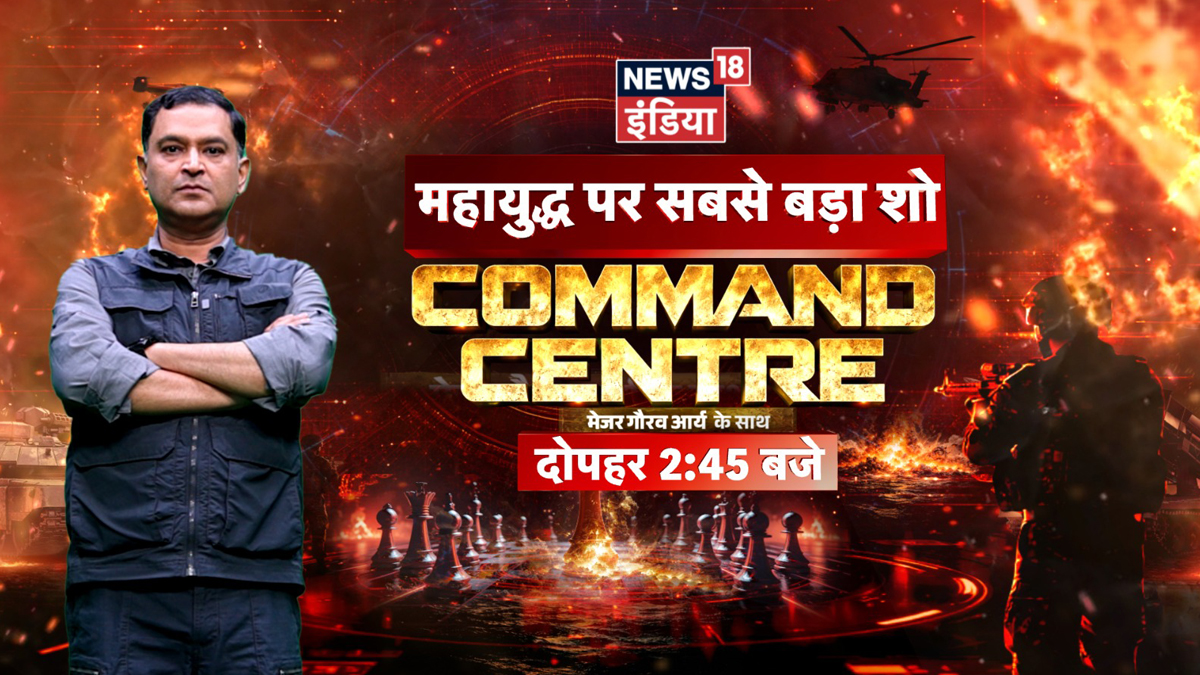
MUMBAI: News18 India has rolled out a new war-focused programme, Command Centre, featuring Gaurav Arya, as it looks to offer viewers a sharper, more grounded take on global conflicts amid rising tensions in West Asia.
Positioned as an “insider war room”, the show moves away from conventional panel debates and instead focuses on explaining military developments, decoding strategy and connecting global events to their everyday impact, from fuel prices to economic shifts.
The format leans heavily on visuals and data. The studio has been designed like a command hub, complete with large LED war maps, real-time graphics and an alert system to track developments as they unfold.
At the centre of it all is Arya, who brings his military background to simplify complex war strategies for viewers. His signature line, “Seedhi baat samjhiye”, anchors the show’s promise of clarity over noise.
News18 India managing editor Jyoti Kamal said, “Command Centre, featuring Major Gaurav Arya is designed to deliver accurate insights and a clear perspective on how evolving conflicts impact everyday life, from household budgets to national security. With expert voices analysing every development in real time, the show goes beyond headlines to decode what’s happening now, what it means, and what could come next.”
Echoing the intent, Gaurav Arya added, “In times of war, confusion is the biggest threat. With News18 India’s Command Centre, we are bringing viewers inside the war room, decoding strategies, tracking every escalation, and explaining, in the simplest terms, what it means for India and for every household. Seedhi baat samjhiye, this is where you understand not just what is happening, but what happens next.”
The weekday show will air in the afternoon slot and will also feature Gaurav Shukla, adding to its editorial depth.
With its mix of analysis, visuals and a clear focus on impact, the show reflects a broader shift in news consumption. Viewers are no longer just watching events unfold, they are looking to understand what those events mean for them.






