Hindi
Arjun is a visual delight

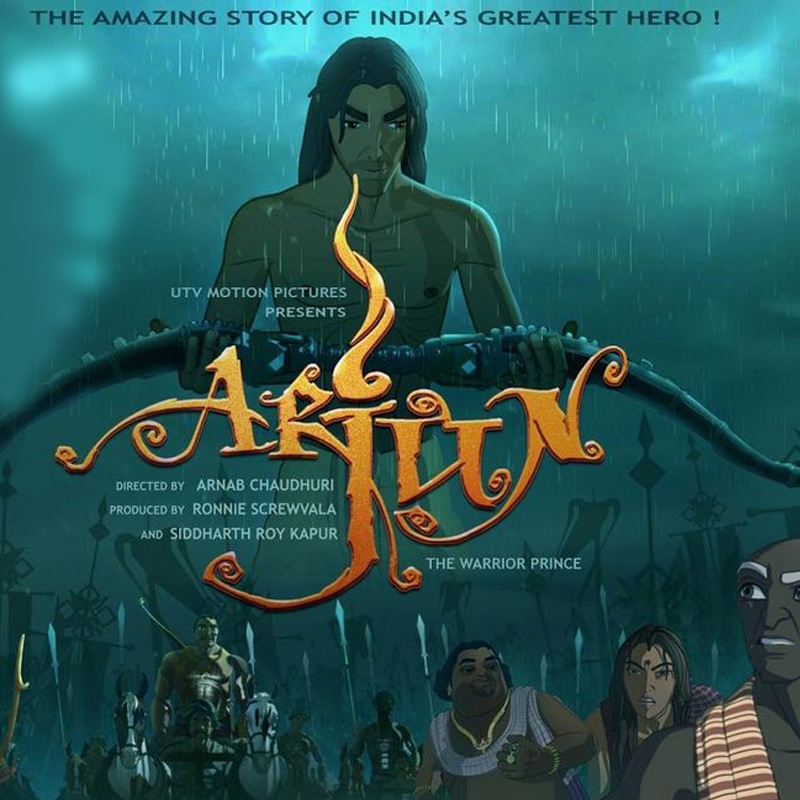
MUMBAI: Now that mythological films can no longer be made for mainstream, they provide ample material for animation films. Indian mythology is full of heroes so there is no need to create more. Arjun is one such here. Here the character has been singled out from the five Pandavs and the Mahabharat to tell his story alone.
 |
|
Producer: Ronnie Screwvala,Siddharth Roy Kapur. |
The cousins, Pandavs and Kauravs, are under the tutelage of Guru Drona in mastering the art of warfare. During the archery lessons, the guru wants a bird roosting on the tree to be shot through the eye. While Arjun has only the bird‘s eye in his target, the rest of the pupils are not so committed. This, while establishing Arjun‘s mastery and his future as a great warrior, also shows the jealousy and deceit of Kauravs. In another contest, a chariot race, Duryodhan, the lead Kaurav, tries to kill Bheem, Arjun‘s brother.

The film proceeds to tell the story of the Pandavs‘ banishment from Hastinapur to a barren place where they go on to build a beautiful kingdom called Indraprastha. But they are driven away from there too following a gamble in a game of choupad. They are banished to 12 years in exile and a year further incognito when they should not be recognised by anyone. In this duration, Arjun takes up a challenge at the Draupadi swayamvar and wins her as his bride.
While building Indraprastha, the Pandavs have Lord Krishna by their side protecting them against evils perpetuated by Kauravs. The crucial time comes when Pandavs are on the last phase of their exile and Duryodhan tries all his guile to make them surface and be recognised so they can be exiled for a further 12 years. His ploy is foiled with the help from Krishna. The great battle of Mahabharat is not dealt with here.
The story is told in a patchy manner. Also left out are parts about Kunti asking all brothers to share equally what they have brought home, which happens to be Draupadi. She is projected here as belonging only to Arjun. Also left out is the sequence about Draupadi‘s cheerharan. The other characters apparently do not merit introductions, as it is assumed that the viewer knows about them. The visuals are delightful. Musical score is functional.
Arjun has its best chance at the box office over the weekend with IPL final game on Sunday being a formidable opposition to face.
Noble effort falls short
 |
|
Producer: Hemendra Aran. |
Yeh Khula Aasmaan deals with the dilemma of a teenager whose parents have gone abroad for work. The boy is left to find his own way in his pursuit of education, entry to IIT and life generally. Juxtaposed with this is the lonely grandfather who thinks the boy also needs to enjoy life in native India and tries to imbibe in him all things Indian, including the family passion of kite flying.
Raj Tandon has to fulfil huge expectations of his UK-based parents, Yashpal Sharma and Manjusha Godse, who prefer the colour of the pound sterling over the rupee and migrate to UK. Tandon fails to get into IIT and also gets poor grades in high school. Dejected, he seeks solace under the care of his paternal granddad, Raghubir Yadav. This gives a purpose to the granddad, who has been leading a lonely life in Bhagalpur in a huge haveli ever since his son left.
Raghubir Yadav picks up from where he left off when he used to dote on Raj Tandon as child. He wants his ward to wander in the wildness and enjoy the open skies. He puts him in the care of neighbourhood girl, Anya Anand. As the duo enjoy small town life and become closer to each other, the traditional kite flying competition and the running family rivalry between Raghubir Yadav and Gulshan Pandey resurfaces. Initiating Raj Tandon into kite flying and finally giving him the confidence to win is what Yeh Khula Aasmaan is all about.
Even as the intentions are noble, the identification with today‘s metro generation is limited. Also the kite flying part is too long in an era of ‘instant‘. Gitanjali Sinha, who has embarked on a mission to promote films which find a balance between art and masala, has to make sure that her film caters to the money-spending viewer in cities. Alas, kite scenes don‘t pass the scrutiny of the lover of this sport. Nonetheless, her eye for details of small town life is praiseworthy.
Music by Anand Milind is soothing but short of haunting. Dialogue is sensible. Editing needed to be crisper.
Rakhtbeej is amateur on all counts
 |
|
Producer: Om Sai Jyoti Films. |
Rakhtbeej seems to be one from the cottage industry of films that are made by an individual with his own resources to promote himself. Manas would normally pass for a trader or a shopkeeper but here he plays parallel roles of Abhay Singh Jatav and Ajay; the former a simpleton turned dacoit and latter as his son, a celebrity CEO in Mumbai (if such creatures do exist in corporate world). Though a few decades apart, both stories are told simultaneously.
Ajay cracks the telecom domain deal for his company, which is distressing for the head of a rival company. Ajay has stolen a march over his rival by quoting zero charge for talking on cell phone since he expects his company to reap the benefits accruing out of other growing markets like tele-banking, SMS and so on. This makes Ajay not only win over his boss and boss‘ daughter‘s heart but also headlines in national dailies. The boss, Rajesh Khattar, appoints Ajay the new CEO of the company, in the process earning him an enemy in Dharam, a colleague.
While the boss‘s daughter, Mansi Dovhal, may love Ajay, her love is one-sided because he has fallen deeply in love with Priya, a model he met on an ad shoot. He is unaware that Priya is a honey trap set up by Dharam to belittle Ajay in the eyes of the boss.
The story of Abhay Jatav is on similar lines. He joins a dacoit gang after his father is killed and he is humiliated. When he sees the gang leader ill-treat other members who actually do all the hard work, he can‘t bear it. He kills the leader and is duly proclaimed the new leader by Julia Dutta, a fellow gang member, who loves him. However, Abhay Jatav has met and fallen in love with Amanjot.
Both, father and son share same fate. But while the father‘s detractors succeed in backstabbing and killing him, the son Ajay is spared that fate. He survives and finds his lost love as well as the ‘celebrated CEO‘ post.
Rakhtbeej is an amateur attempt on all fronts. Moreover, there is no glamour or beauty on screen and an item number by Rakhee Sawant only adds to the torture. It is an exercise in self-gratification.





Hindi
Rashmika Mandanna, Shanaya Kapoor and Naila Grrewal climb IMDb’s Indian celebrity rankings
Upcoming films and returning shows are driving fan interest across Bollywood and streaming

MUMBAI: Bollywood’s popularity contest has a new weekly scorecard, and the numbers are telling. IMDb’s Popular Indian Celebrities list for this week places Shanaya Kapoor at number six, buoyed by buzz around her film Tu Yaa Main. Naila Grrewal slots in at seven on the back of the returning comedy series Maamla Legal Hai, while Rashmika Mandanna climbs to eighth, riding mounting anticipation for Cocktail 2.
The list, available exclusively on the IMDb app for Android and iOS, tracks trending Indian entertainers and filmmakers each week, drawing on data from more than 200m monthly visits to the platform worldwide.
Further down the rankings, Raaka is keeping two of its biggest names in the spotlight. Deepika Padukone holds 11th position, with Allu Arjun close behind at 13th, as the film continues to find traction with audiences.
The list offers fans a weekly pulse on who is breaking through, who is holding steady, and who is fading. It is a barometer as unsparing as the box office itself.