News Headline
Ariane 5 may launch Insat-3C in November

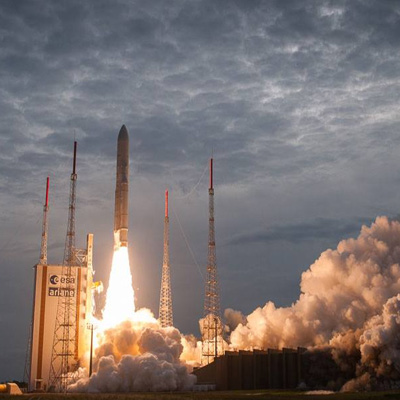
India’s next generation communication satellite Insat-3C, which was scheduled for launch on 11 September on an Ariane 5, is likely to be lifted into orbit only in late November instead of September as earlier scheduled.
There has been speculation over what would happen to the Insat-3C launch after Ariane 5’s Flight 142, launched on 12 July, failed to achieve proper orbit.

A seven-member probe team instituted by Arianespace after the launch failure identified combustion instability during upper stage engine ignition as the source of Flight 142’s malfunction. The origin of the combustion instability was attributed to an unfavourable hydraulic dynamic coupling between the propellant feed system and the internal fluid cavities of the combustion chamber.
The upper stage malfunction, which occurred during Flight 142’s final propulsion phase, resulted in the mission’s dual satellite payload being delivered to a lower than expected orbit, the probe team concluded.
Arianespace has set a comprehensive recovery plan to address the upper stage malfunction and now expects to return Ariane 5 to commercial service by late November. This represents a delay of two months compared to the original launch manifest and will cause relatively minor schedule implications for the remainder of 2001 and early 2002, an official release states .
Insat-3C, which has 30 transponders, will be catering to the growing demand for V-SATs (very small aperture terminals) and broadcast services in the country.
The 1,170 kg Insat-3C will provide fixed satellite services (FSS) in the normal and extended C-bands, as also broadcast satellite services and mobile satellite services in the S-band.
Insat-3C will replace India’s current workhorse, Insat-2C, whose capacity would be transferred to the new bird. Insat-2C is expected to reach the end of its seven-year life span in another six months.
The next launch schedule for Arianespace (flight 143) originally set for 24 August has now been rescheduled to 30 August. An Ariane 4 4L launcher is putting an Intelsat 902 communications and television satellite into orbit.
REMOTE SENSING DATA POLICY ANNOUNCED IN PARLIAMENT:
It was announced in the Rajya Sabha (upper house of Parliament) that India plans to develop high resolution imaging satellites in the near future.
The government has approved and adopted a comprehensive Remote Sensing Data Policy (RSDP) for the acquisition and distribution of satellite remote sensing data – from Indian and foreign satellites for civilian users in India. The policy comprehensively covers guidelines for satellite data acquisition and distribution in the country and also for licensing the IRS capacities to other countries. Department of Space (DOS) will be the nodal agency for implementing the policy.
As per the policy, government permission is required for operating a remote sensing satellite from India and also for distribution of satellite images in India. The National Remote Sensing Agency (NRSA) has been identified as the national acquisition/distribution agency for all satellite data within India and has been allowed to enter into agreements for any foreign satellite data distribution in India. Antrix Corporation (of DOS) is identified to license IRS capacities outside of India.
The policy has safeguards for ensuring that images of sensitive areas are screened out, so that national security interests are protected. In particular, the policy streamlines the distribution of high-resolution data to Government users; private users involved in developmental activities with government and other private/academic/foreign users.







NEW DELHI: Hamdard Laboratories gathered a cross-section of India’s achievers in New Delhi on Friday, handing out the Hakeem Abdul Hameed Excellence Awards to figures who have left their mark across healthcare, education, sport, public service and the arts.
The ceremony, attended by minister of state for defence Sanjay Seth and senior officials from the ministry of Ayush, celebrated individuals whose work blends professional success with a sense of public purpose. It was as much a roll call of achievement as it was a reminder that influence is not measured only in profits or podiums, but in people reached and lives improved.
Among the headline awardees was Alakh Pandey, founder and chief executive of PhysicsWallah, recognised for turning affordable digital learning into a mass movement. On the sporting front, Arjuna Awardee and kabaddi player Sakshi Puniya was honoured for her contribution to the game and for pushing women’s participation onto bigger stages.
The cultural spotlight fell on veteran lyricist and poet Santosh Anand, whose songs have echoed across generations of Hindi cinema. At 97, Anand accepted the honour with characteristic humility, reflecting on a life shaped by perseverance and hope.
Healthcare honours spanned both modern and traditional systems. Manoj N. Nesari was recognised for strengthening Ayurveda’s place in national and global health frameworks. Padma shri Mohammed Abdul Waheed was honoured for his research-backed work in Unani medicine, while padma shri Mohsin Wali received recognition for his long-standing contribution to patient-centred care.
Education and social development also featured prominently. Padma shri Zahir Ishaq Kazi was honoured for decades of work in education, while former Meghalaya superintendent of Police T. C. Chacko was recognised for public service. Goonj founder Anshu Gupta received an award for his dignity-centred rural development initiatives, and the Hunar Shakti Foundation was honoured for empowering women and young girls through skill development.
The Lifetime Achievement Award went to former IAS officer Shailaja Chandra for her long career in public healthcare and governance, particularly in the traditional systems under Ayush.
Speaking at the event, Hamdard chairman Abdul Majeed said the awards were a tribute to those who combine excellence with empathy. “These awardees reflect Hakeem Sahib’s belief that healthcare, education and public service must ultimately serve humanity,” he said.
Minister Seth struck a forward-looking note, saying India’s young population gives the country a unique opportunity to become a global destination for learning, health and wellness by 2047.
The ceremony also featured the trailer launch of Unani Ki Kahaani, an upcoming documentary starring actor Jim Sarbh, set to premiere on Discovery on 11 February.
Instituted in memory of Unani scholar and educationist Hakeem Abdul Hameed, the awards have grown into a national platform that celebrates those building a more inclusive and resilient India. For one evening at least, the spotlight was not just on success, but on service with substance.






