Cable TV
Arasu can’t operate outside Tamil Nadu despite DAS compliance


NEW DELHI: Tamil Nadu government-owned multi system operator (MSO) Arasu TV Corp has been told by the Ministry of Information and Broadcasting (MIB) that it cannot operate outside of Tamil Nadu despite having a provisional MSO licence.
The MSO was granted the provisional licence in April this year and was given several extensions to prove that it had become fully digital addressable system (DAS) compliant. Arasu claimed to have gone entirely digital by 1 September 2017.
Godfather Communication is another MSO that can only operate in Punjab, Haryana, Jammu & Kashmir, Rajasthan, Chandigarh and Himachal Pradesh. Godfather’s registration is dependent on a court verdict in which it had challenged the MIB’s cancellation of its provisional registration for in Amritsar.

There are just 1471 MSOs even after seven months of DAS in the country. Apart from Arasu and Godfather, the remaining 1469 provisional licence holders have been permitted to operate anywhere in the country, according to the list of MSOs as on 31 October 2017 placed on the MIB website.
Early this year, the government had said all provisional MSOs will be deemed as having regular licences. They were also free to operate in any part of the country.
The MIB had earlier this year told indiantelevision.com that it had been made clear to Arasu that the provisional licence was subject to the centre taking a final decision on the recommendation of the Telecom Regulatory Authority of India (TRAI) that no government-owned body should be permitted in the field of running or distributing television channels. TRAI had in 2008, 2012 and 2014 held that state governments and political parties should not be permitted to own TV channels or distribution channels.
Also read :
Post-DAS, tardy MSO registrations in six months, 14 new additions
Including Arasu, total number of MSOs goes up to 1376, to ensure DAS implementation
37 new MSOs in 45 days takes total to 1421, seven among 59 cases sub-judice






Cable TV
Hathway Cable appoints Gurjeev Singh Kapoor as CEO
Leadership change comes as cable TV faces shrinking subscriber base and modest earnings pressure
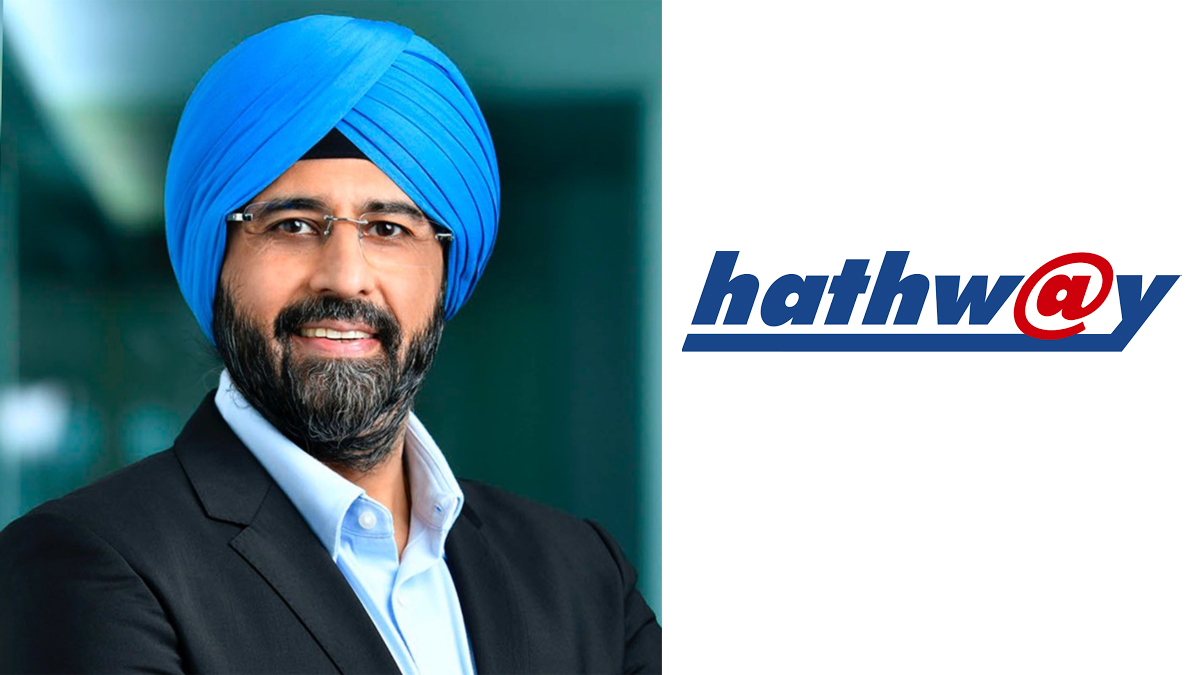
MUMBAI: Hathway Cable and Datacom has tapped industry veteran Gurjeev Singh Kapoor as chief executive officer, marking a leadership pivot at a time when India’s cable television business is under mounting strain.
Kapoor will take over from Tavinderjit Singh Panesar, who is set to retire in August after a long innings with the company. Panesar, chief executive since 2023, has held multiple leadership roles at Hathway, including his latest stint beginning in 2022.
Kapoor brings more than three decades of experience in media and entertainment. He most recently led distribution at The Walt Disney Company’s Star India business, now part of JioStar. His career spans television distribution and affiliate partnerships, with stints at Sony Pictures Networks India, Discovery Communications and Zee Entertainment.
Panesar, with over three decades in the industry, has worked across strategic planning, distribution and business development in media, broadcasting and manufacturing. His past associations include ESPN Star Sports, Star India, Apollo Tyres and JK Industries.
The transition lands as the cable sector grapples with structural disruption. Traditional operators are losing ground to streaming platforms, while telecom and broadband players tighten the squeeze with bundled offerings.
An EY report estimates India’s pay-TV base could shrink by a further 30 to 40 million households by 2030, taking the total down to 71 to 81 million. The slide follows a loss of nearly 40 million homes between 2018 and 2024, a contraction that has already wiped out more than 37,000 jobs in the local cable operator ecosystem.
Hathway’s numbers reflect the strain. The company reported a consolidated net profit of Rs 93 crore for FY25, down from Rs 99 crore a year earlier. Revenue inched up to Rs 2,040 crore from Rs 1,981 crore. As of December 2025, it had about 4.7 million cable TV subscribers and roughly 1.02 million broadband users.
Kapoor steps in with a familiar brief but a shrinking playbook. In a market where viewers are cutting cords faster than companies can reinvent them, the new chief executive inherits a business fighting to stay plugged in.







