Cable TV
APOS 2020: Why Indian pay TV still holds a lot of potential

KOLKATA: Even as the doomsayers have been predicting impending doom for India’s television business and tomtomming the growth of streaming services, Tata Sky CEO Harit Nagpal and IndiaCast Media Distribution Group CEO Anuj Gandhi believe that there’s tremendous scope to grow pay-TV in India. Taking part in a roundtable as part of Media Partners Asia’s virtual APOS 2020, both said television has barely been penetrated yet.
Tata Sky’s Harit Nagpal – who's running, arguably, one of India's most respected DTH platforms – highlighted that there is a distribution game which needs to be played well. Nagpal mentioned two ways that the business can get a growth impetus: one is reaching out to the un-penetrated households and secondly selling more to existing consumers.
He backed his statement with facts. According to Nagpal, 100 million homes in India are TV-less, and would go on to buy one eventually. Moreover, 35 million TV watchers have subscribed to free to air service DD Freedish. According to him, the Indian consumers are gradually moving from no TV to FTA to pay-TV, acknowledging that those in the higher end of pay-TV spectrum in urban areas are migrating to OTT and broadband. While he acknowledged the movement to OTT, he also mentioned that it is slower compared to the growth of linear TV and it will continue for a while.

“Households without a TV have not bought one so far, and those that bought one have moved to FTA because they could not afford the Rs 300 plan which the platforms charge,” says Nagpal.
Hence, he added that expecting them to pay Rs 1000 for bandwidth to watch Rs 300 worth of content is a bit much. He stated that they would start with linear TV paying only for content while they may migrate to new media in the next decades.
“In the last two years, we have seen a huge surge in small screen viewing of content essentially because data cost was abysmally low. As the data prices find their right level, which is what it should be, I guess the projections we all are making will level up,” he stated.
Indiacast’s Gandhi agreed with Nagpal’s view on the distribution game and the growth opportunity. He pointed out while pay TV’s potential has been spoken about a lot, the industry has barely made any change in the past six-seven years.
The silver-lining is that fictitious numbers of cable subscribers were floating up in the market before the NTO while after its implementation the industry now agrees on the number of 120-130 million paying subs. According to Gandhi, the growth opportunity is low-ARPU market which is partly either on DD or getting pirated content needs to be converted. This ongoing process cannot be taken away by streaming services.
Moreover, Gandhi stated that the pandemic has made the industry realise that overly depending on advertising revenue is a troubling trend. Until now, content players have not focused on subscription revenue by not creating cohorts or not helping the platforms to plan for a better ARPU or upselling. Hence, while there are opportunities in the pay-TV business: one has to build a robust subscription model by tweaking, changing, remodelling the existing one.
The statistic of 500 million smartphone users has been touted enough but Gandhi noted that all of them may not have four-inch plus screens or enough memory to have more than seven-eight apps on their devices. Hence, he opined that despite the fact that a part of the high-end consumers have started subscribing to streaming services – some of them live – using connected TVs and devices, linear TV cannot be replaced for most of the consumers.




Cable TV
Hathway Cable appoints Gurjeev Singh Kapoor as CEO
Leadership change comes as cable TV faces shrinking subscriber base and modest earnings pressure
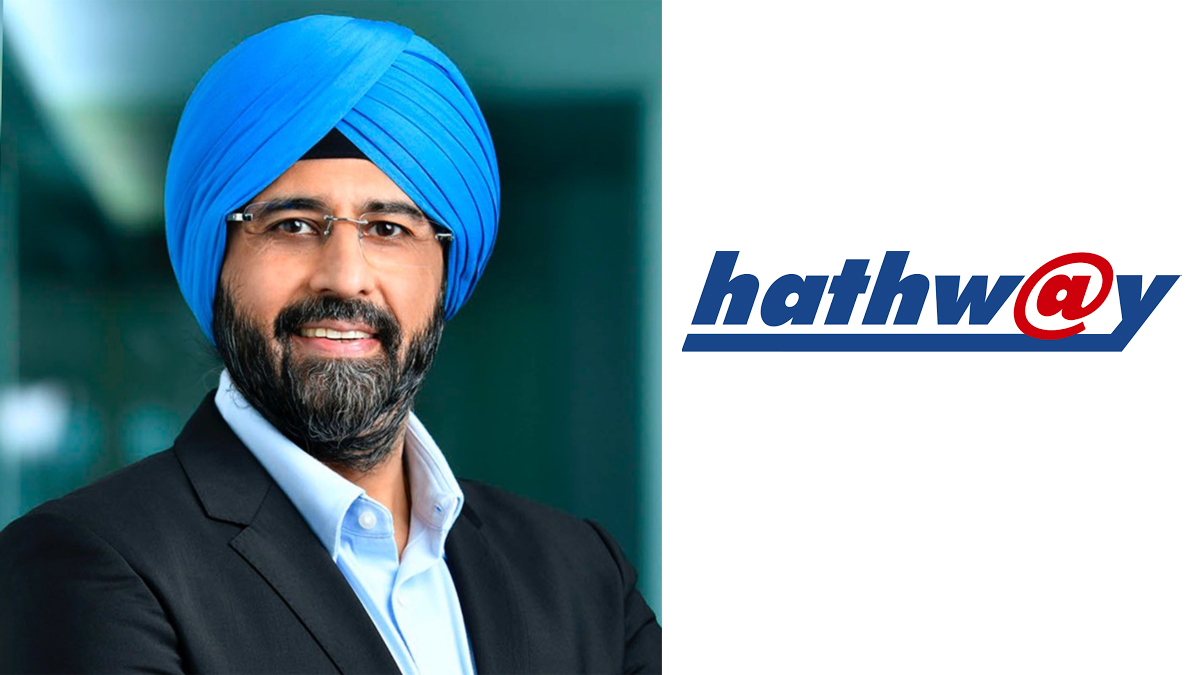
MUMBAI: Hathway Cable and Datacom has tapped industry veteran Gurjeev Singh Kapoor as chief executive officer, marking a leadership pivot at a time when India’s cable television business is under mounting strain.
Kapoor will take over from Tavinderjit Singh Panesar, who is set to retire in August after a long innings with the company. Panesar, chief executive since 2023, has held multiple leadership roles at Hathway, including his latest stint beginning in 2022.
Kapoor brings more than three decades of experience in media and entertainment. He most recently led distribution at The Walt Disney Company’s Star India business, now part of JioStar. His career spans television distribution and affiliate partnerships, with stints at Sony Pictures Networks India, Discovery Communications and Zee Entertainment.
Panesar, with over three decades in the industry, has worked across strategic planning, distribution and business development in media, broadcasting and manufacturing. His past associations include ESPN Star Sports, Star India, Apollo Tyres and JK Industries.
The transition lands as the cable sector grapples with structural disruption. Traditional operators are losing ground to streaming platforms, while telecom and broadband players tighten the squeeze with bundled offerings.
An EY report estimates India’s pay-TV base could shrink by a further 30 to 40 million households by 2030, taking the total down to 71 to 81 million. The slide follows a loss of nearly 40 million homes between 2018 and 2024, a contraction that has already wiped out more than 37,000 jobs in the local cable operator ecosystem.
Hathway’s numbers reflect the strain. The company reported a consolidated net profit of Rs 93 crore for FY25, down from Rs 99 crore a year earlier. Revenue inched up to Rs 2,040 crore from Rs 1,981 crore. As of December 2025, it had about 4.7 million cable TV subscribers and roughly 1.02 million broadband users.
Kapoor steps in with a familiar brief but a shrinking playbook. In a market where viewers are cutting cords faster than companies can reinvent them, the new chief executive inherits a business fighting to stay plugged in.







