Hindi
Animated Mahabharat…this one is for kids

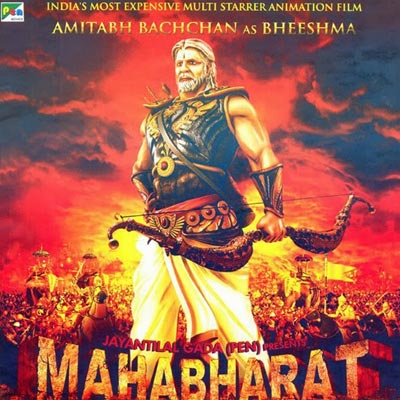
MUMBAI: Mahabharat is Jayantilal Gada’s ambitious effort and boasts of the greatest casting coup on Indian screen. In that, the film’s animated characters are modelled on the popular Hindi film stars. And, to complete the effect, the actors themselves have given voice to their screen images.
Mahabharat is said to be the greatest epic ever written and though proud of the tome, not many know how to make kids aware of it! Though in abridged version, a film like this helps. The story, which has inspired many an Indian film scripts, is about Kauravs’ greed, backed by their guile, to rid their cousin, the Pandavs, of their hierarchical right to inherit the kingdom of Hastinapur. The kingdom is ruled by Dhritrashtra, who is blind but the final word is always that of Bheeshma, referred to as Pitamah (Amitabh Bachchan). The villain of the piece is Duryodhan (Jackie Shroff), the eldest of the 100 strong Kaurav clan ably aided by his manipulative maternal uncle, Shakuni (Anupam Kher). Bheeshma is the wise one who loves Arjun and the Pandavs and can see through the devious Duryodhan and Shakuni.

 |
|
Producer: Dhaval Jayantilal Gada, Kaushal Kantilal Gada.
Director: Amaan Khan. |
The trouble starts when Bheeshma announces the appointment of Yudhishthir (Manoj Bajpayee) as the King in waiting by Bheeshma and endorsed by the Kind, Dhritrashtra, thus upsetting Duryodhan who felt he was the rightful heir to his father. Fuel is added to the fire when Arjun manages to win the contest of shooting an arrow at a fish’s eye looking at its image in water in which Duryodhan fails and win the hand of Draupadi (Vidya Balan) in marriage. Duryodhan not only wants to possess Hastinapur but also wants Draupadi for himself.
Draupad and Shakuni start plotting against Pandavs. One of the ploys is to exploit Yudhishthir’s weakness for gambling; he is lured into staking everything including his kingdom and, after losing it all, even Draupadi. What follows is the most dramatic scene Indian myth has ever told, that of disrobing Draupadi by Dushashan and Lord Krishna coming to her aid.
As things emerge, Pitamah decides to offer Pandavs a new territory which Shakuni says should be the Paradise of a land but, actually, is barren and rock laden. However, with the help of lord Indra, the Pandavs turn into heavenly!
However, Duryodhan would not let Pandavs rest in peace. Having tricked them in a gambling game with the help of Shakuni, the Pandavs are sent to 13 years of exile the last year of which being very conditional when they are not to be discovered.
Finally, the Pandavs overcome everything they are ordained to for the sake of principle in which Kauravs don’t believe. Yet, the Kauravs’ overreach finally leads to a war between both the clans with the ever supportive Lord Krishna being with the Pandavs.
Of course, there are side stories of how Draupadi was won and asked to be shared between the brothers, the story of Hidimba and Shakuntala and Abhimanyu. But, they are in passing.
The finale is about the war between Pandavs and Kauravs and Geetasaar by Krishna when Arjun is reluctant to fight his own mentors as well as near and dear ones like Bheeshma. The war scenes are not impressive.
There have been a few attempts before to tell Mahabharat but this one is better. This one has the advantage of impressive artiste participation with Amitabh Bachchan, Shatrughan Sinha, Sunny Deol, Anil Kapoor, Jackie Shroff, Ajay Devgn, Manoj Bajpayee, Anupam Kher, Vidya Balan.



Hindi
India’s telecom subscribers cross 1.32 billion in February 2026
Broadband base swells past 1.06 billion as Jio and Airtel tighten grip on the market.
MUMBAI: India’s telecom sector is ringing in steady growth once again adding millions of new connections every month while the race for broadband supremacy continues to heat up like a fiercely contested cricket match. According to the latest data released by the Telecom Regulatory Authority of India (TRAI) on 1 April 2026, the total telephone subscriber base in the country reached 1,321.31 million at the end of February 2026. This marked a net addition of 7.31 million subscribers during the month, translating into a monthly growth rate of 0.56 per cent.
Wireless subscribers (including mobile and Fixed Wireless Access) stood at 1,273.31 million, registering a net addition of 6.97 million and a growth rate of 0.55 per cent. Within this, urban wireless connections grew to 730.75 million (growth 0.70 per cent), while rural wireless subscribers reached 542.56 million (growth 0.35 per cent).
Wireline subscribers, though much smaller in scale, showed slightly faster growth. The total wireline base increased to 47.99 million, with a net addition of 0.34 million and a monthly growth rate of 0.70 per cent. Urban areas continued to dominate wireline connections with a share of 89.41 per cent.
Overall tele-density in India improved to 92.66 per cent. Urban tele-density stood at 150.68 per cent, while rural tele-density edged up to 60.02 per cent.
The broadband subscriber base crossed a significant milestone, reaching 1,059.05 million at the end of February 2026. This reflected a healthy net addition of 6.33 million subscribers and a monthly growth rate of 0.60 per cent from January’s figure of 1,052.72 million.
Segment-wise, mobile wireless access continued to drive the majority of growth with 996.52 million subscribers. Fixed Wireless Access (including 5G FWA) added 16.51 million, while wired broadband stood at 46.02 million.
Reliance Jio Infocomm Ltd. maintained its commanding lead with 519.64 million broadband subscribers. Bharti Airtel Ltd. followed with 364.14 million, Vodafone Idea Ltd. with 129.36 million, Bharat Sanchar Nigam Ltd. with 28.70 million, and Atria Convergence Technologies Ltd. with 2.38 million.
Together, these top five players command a massive 98.60 per cent share of the total broadband market.
In the wireless (mobile) segment, private operators continued to dominate with 92.59 per cent market share, leaving public sector undertakings (BSNL and MTNL) with just 7.41 per cent.
Out of the total 1,257.29 million wireless (mobile) subscribers, 1,177.60 million were active on the peak Visitor Location Register (VLR) date, representing an impressive 93.66 per cent activity rate. Bharti Airtel led in this metric with 99.42 per cent of its subscribers active.
Meanwhile, 14.47 million subscribers submitted requests for Mobile Number Portability (MNP) in February, indicating healthy competition and customer churn across zones.
While urban areas still lead in absolute numbers, rural connectivity is slowly catching up. Rural wireless tele-density stood at 59.46 per cent, compared with the much higher urban figure of 142.32 per cent.
Fixed Wireless Access using 5G technology also showed promising traction, growing to 11.93 million subscribers. Reliance Jio and Bharti Airtel are the primary players driving this segment.
The data paints a picture of a maturing yet still rapidly expanding telecom ecosystem. With total telephone subscribers now well past the 1.32 billion mark and broadband users comfortably above 1.06 billion, India continues to solidify its position as one of the world’s largest and most dynamic digital markets.
From bustling city streets to remote villages, more Indians are staying connected than ever before proving that when it comes to telecom, the country’s appetite for growth shows no signs of hanging up anytime soon.






