iWorld
ALTBalaji looks at sachet pricing model to more than double the ARPU


MUMBAI: The ongoing streaming war across the world has seen OTT platforms investing aggressively in original content with high cash burn. But ALTBalaji, the digital venture of Ekta Kapoor-led Balaji Telefilms, is not taking the same path. With conservative rational investment, the company has seen a profit before tax level breakeven in the last quarter and is keeping a hawk-eye at achieving break-even targets before launching the second phase of its strategy possibly after two years using rich analytics data.
“We are focused on our breakeven targets, which we will achieve and therefore we are right-sizing our business to this. We are not a bottomless hole where you have to keep showing widening losses and keep acquiring consumers. We do not believe in this philosophy at this stage. We first want to have the proof of the pudding, we want to break even and then use our rich analytics data to launch phase two of our strategy possibly two years from now,” Balaji Telefilms management said in an earnings call after the Q2 2020 results.
Under phase two of planning, ALTBalaji is looking at producing enough hit content to be able to ‘sachetize’ its pricing two years from now. The company thinks if it can sell content at Rs 2 per day, its ARPU can rise up to Rs 730 a year, which currently stands at Rs 300 a year.

To enter the next step, the company thinks it has to be able to cater to two major target groups – the under-served male viewing audience, which lacks good quality TV shows, and individual female audience of the age group 20 to 40. Hence, it will look at developing a significant library there.
“Thirdly, we will have the richest data in terms of numbers and analytics and we need to build an efficient recommendation engine two years from now to be able to optimise retention. Right now, because of the massive inflow of new Internet users, retention is not a top priority also. We do not have more than 42 shows. Once we reach 100 shows, taking a recommendation engine, investing in more AI and ML to ensure that retention happens will bring down the cost of consumer acquisition and retention considerably,” the management said.
Moreover, the company will also evaluate one single regional language to go into as it learning has led to the belief that sporadically launching single shows in languages cannot attract the audience. Hence, the platform will explore a business plan of launching it in one of the south languages.
“The ZEE deal understanding is that we shift from a multi-partner system to a kind of pay-based single partner system. We are also kind of exiting the telco environment to partner with the broadcast environment. As part of our strategy, in our first two years, we had to use the widespread telco environment because we had a smaller library, which was growing every month but it still was small,” the management said on the rationale of its recent deal with homegrown OTT giant ZEE5.
The other reason for telco partnership was the high cost of consumer acquisition and marketing. "Now, we feel we are in phase two of our business where we will go with single-partner models. In two or three years, we will also be able to have enough library and add enough data to be able to acquire consumers efficiently,” it added.
However, the company is confident about achieving breakeven between 36 – 48 months of launching ALTBalaji while cash breakeven has already been achieved. After seeing a PBT level breakeven in the last quarter, the company hopes it will be improved in the Q3 and Q4 because of the ZEE deal. The management thinks that being a debt-free Rs 250 crore plus cash company, it is positioned much better than many debt-ridden companies. Moreover, having a library of 48 original shows, it has a significant lead to drive it going forward.






iWorld
Micro-Dramas Surge in India, Redefining Mobile Content Habits
Meta-Ormax study maps rapid rise of short-form storytelling among 18–44 audiences.
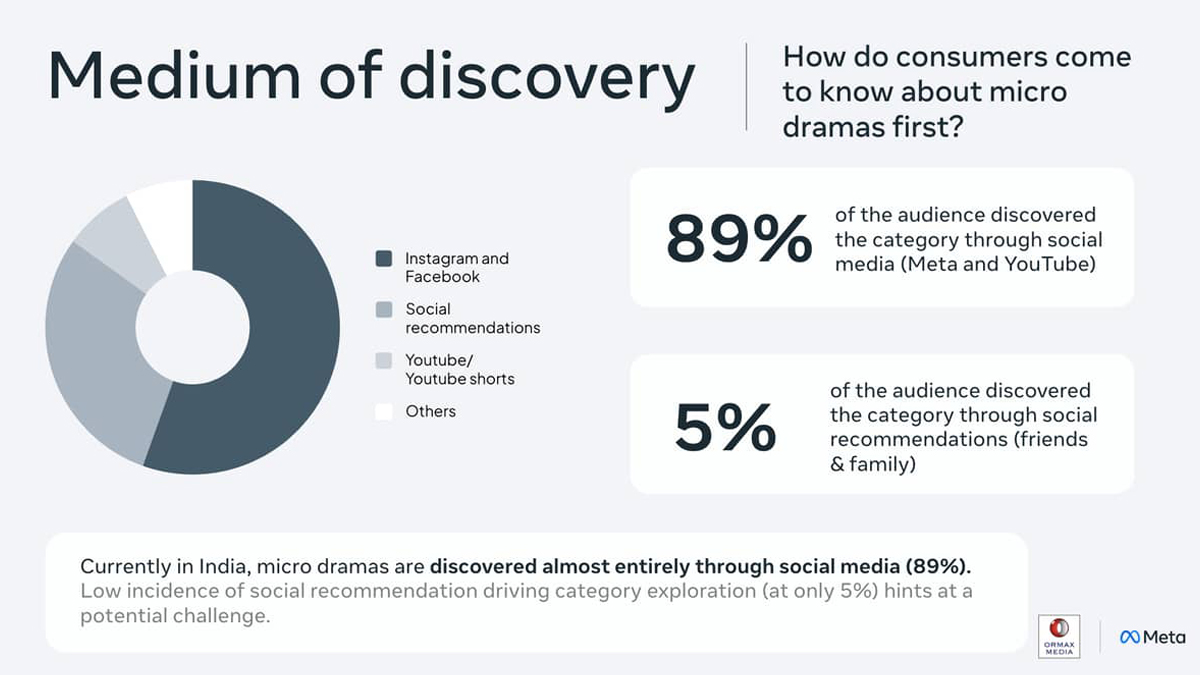
MUMBAI: Micro-dramas aren’t just short, they’re the snack that ate Indian entertainment, and now everyone’s bingeing between the sofa cushions. Meta, in partnership with Ormax Media, has released ‘Micro Dramas: The India Story’, a comprehensive study unveiled at the inaugural Meta Marketing Summit: Micro-Drama Edition. The report maps how the vertical, bite-sized format is reshaping content consumption for mobile-first audiences aged 18–44 across 14 states.
Conducted between November 2025 and January 2026 through 50 in-depth interviews and 2,000 personal surveys, the research reveals that 65 per cent of viewers discovered micro-dramas within the last year proof of explosive adoption. Nearly 89 per cent encounter the format through social feeds and recommendations, making algorithm-driven discovery the primary engine rather than active search.
Key viewing patterns show a median of 3.5 hours per week (about 30 minutes daily) spread across 7–8 short sessions. Consumption peaks between 8 pm and midnight, with additional spikes during commutes and work breaks classic “in-between moments” that the format fills perfectly. Around 57 per cent of viewing happens in ambient mode (while doing something else), and 90 per cent is solo, enabling more intimate, personal storytelling.
Romance, family drama and comedy lead genre preferences. Audiences show growing openness to AI-generated content, 47 per cent find it unique and creative, while only 6 per cent say they would avoid it entirely. Regional languages are surging after Hindi and English, Tamil, Telugu and Kannada dominate consumption.
Meta, director, media & entertainment (India) Shweta Bajpai said, “Micro-drama isn’t a passing trend, it’s rewriting the rules of Indian entertainment. In under a year, an entirely new category of platforms has emerged, built audience habits from scratch, and created a business vertical that is scaling fast.”
Ormax Media founder-CEO Shailesh Kapoor added, “Micro-dramas are beginning to show the early signs of becoming a distinct content category in India’s digital entertainment landscape. When a format aligns closely with how audiences naturally engage with their devices, it has the potential to scale very quickly.”
The study proposes ecosystem-wide responsibility, universal signposting of commercial intent, shared accountability among advertisers, platforms, creators, schools and parents, built-in safeguards, and formal media literacy in schools.
In a feed that never sleeps and a day that never stops, micro-dramas have slipped into the cracks of every spare minute turning 30-second stories into the new national pastime, one vertical swipe at a time.







