News Headline
Allow broadcast services by telcos: Trai


NEW DELHI: The telecom and broadcast and cable regulator is now pushing for convergence to happen. Any move in this direction would primarily serve to to enlarge its role.
The Telecom Regulatory Authority of India (Trai) has suggested that the rural telephony initiative should ride the entertainment bandwagon and, in this connection, has said broadcast services should be brought under the proposed unified licensing regime.
At the time of issuing a draft consultation paper on unified licensing regime a while back, Trai had clarified that for the moment broadcast and cable services did not fall within the ambit of this proposed legislation and remained very much a prerogative of the information and broadcasting ministry.

According to Trai chief Pradip Baijal, who was participating in a meeting yesterday of a Planning Commission committee (set up recently to undertake review of the information, communication and entertainment sectors) telecom companies should be allowed to provide broadcast services and vice versa to give a fillip to proliferation of such services in all segments of society, including rural India.
Baijal also pushed for an early introduction of the unified licensing regime, saying that unless this happens, penetration of rural telephony would remain slow.
Trai feels that even with tremendous growth in the information technology sector, overall usage and penetration of such services and products in the country has still lagged behind international averages.
The Authority has noted, in a consultation paper on spread of rural telephony, that for all-round development to occur, appropriate regulatory environment and policies need to be established so that the discrepancy in pricing, penetration and type and quality of telecom services between India and other countries can be eliminated. Once this happens, only then will there be successful growth and business models in video, broadband, Internet and telephony services.
Trai has further noted that despite several attempts over the last more than 10 years, the gap between penetration of telephony in rural (1.7 per cent) and urban (19.7 per cent) areas is widening and measures need to be taken to reduce this gap.
To achieve the goal of reduction in the urban-rural gap, Trai feels that more cost-effective technologies like broadband over Wi Max and Cordect, should be encouraged. Local content development will also help in generating more rural employment.
In this connection, Baijal also told the Plan panel meet that the government is likely to formalise the spectrum policy within a month, which would facilitate spread of broadband in the country.
Interestingly, according to Planning Commission sources, the official representing the information and broadcasting ministry kept quiet, allowing Baijal to hold forth on convergence.
Those who attended yesterday’s meeting included Prasar Bharati CEO KS Sarma and the secretary department of post, amongst others.
The Planning Commission, a government think-tank on economic policies had recently set up a co-ordination committee on information, communication and broadcasting technologies. The agenda: to identify broader areas for policy review.
This initiative is part of mid-term appraisal of the 10th Five-Year Plan (2002-07).
The terms of reference of the newly set-up committee include conditional access system and the use of SMS in the broadcasting sector, rural connectivity and deployment of wireless technologies in the last mile, broadband and its benefits for the masses and facilitating Internet penetration.






NEW DELHI: Hamdard Laboratories gathered a cross-section of India’s achievers in New Delhi on Friday, handing out the Hakeem Abdul Hameed Excellence Awards to figures who have left their mark across healthcare, education, sport, public service and the arts.
The ceremony, attended by minister of state for defence Sanjay Seth and senior officials from the ministry of Ayush, celebrated individuals whose work blends professional success with a sense of public purpose. It was as much a roll call of achievement as it was a reminder that influence is not measured only in profits or podiums, but in people reached and lives improved.
Among the headline awardees was Alakh Pandey, founder and chief executive of PhysicsWallah, recognised for turning affordable digital learning into a mass movement. On the sporting front, Arjuna Awardee and kabaddi player Sakshi Puniya was honoured for her contribution to the game and for pushing women’s participation onto bigger stages.
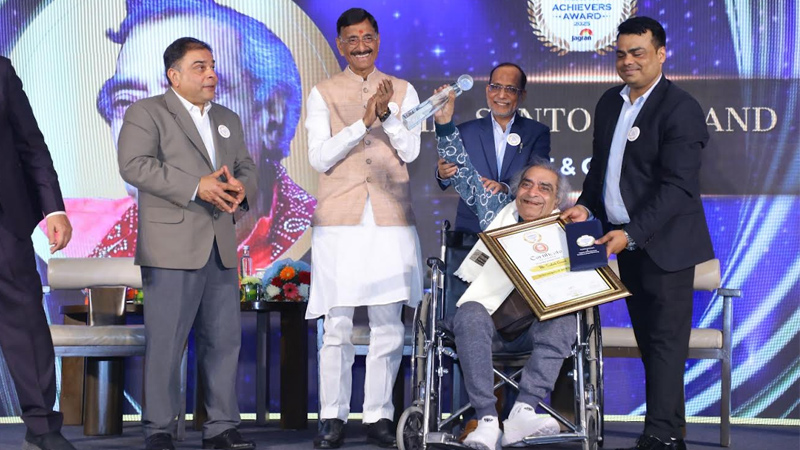
The cultural spotlight fell on veteran lyricist and poet Santosh Anand, whose songs have echoed across generations of Hindi cinema. At 97, Anand accepted the honour with characteristic humility, reflecting on a life shaped by perseverance and hope.
Healthcare honours spanned both modern and traditional systems. Manoj N. Nesari was recognised for strengthening Ayurveda’s place in national and global health frameworks. Padma shri Mohammed Abdul Waheed was honoured for his research-backed work in Unani medicine, while padma shri Mohsin Wali received recognition for his long-standing contribution to patient-centred care.
Education and social development also featured prominently. Padma shri Zahir Ishaq Kazi was honoured for decades of work in education, while former Meghalaya superintendent of Police T. C. Chacko was recognised for public service. Goonj founder Anshu Gupta received an award for his dignity-centred rural development initiatives, and the Hunar Shakti Foundation was honoured for empowering women and young girls through skill development.
The Lifetime Achievement Award went to former IAS officer Shailaja Chandra for her long career in public healthcare and governance, particularly in the traditional systems under Ayush.
Speaking at the event, Hamdard chairman Abdul Majeed said the awards were a tribute to those who combine excellence with empathy. “These awardees reflect Hakeem Sahib’s belief that healthcare, education and public service must ultimately serve humanity,” he said.
Minister Seth struck a forward-looking note, saying India’s young population gives the country a unique opportunity to become a global destination for learning, health and wellness by 2047.
The ceremony also featured the trailer launch of Unani Ki Kahaani, an upcoming documentary starring actor Jim Sarbh, set to premiere on Discovery on 11 February.
Instituted in memory of Unani scholar and educationist Hakeem Abdul Hameed, the awards have grown into a national platform that celebrates those building a more inclusive and resilient India. For one evening at least, the spotlight was not just on success, but on service with substance.







