iWorld
Airtel led broadband subscriber growth in Jan-19

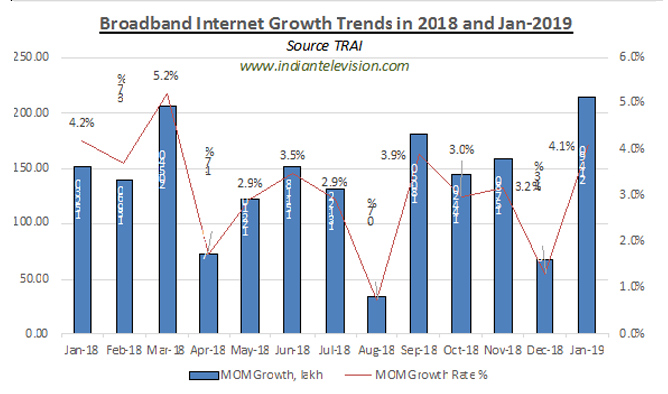
BENGALURU: The Sunil Mittal-promoted Bharti Airtel Ltd (Airtel) led broadband subscriber growth, both wired as well as wired internet, for the month ended 31 January 2019 (1 January 2019 to 31 January 2019, Jan-19) according to Telecom Regulatory Authority of India (TRAI) data for the period. In Jan-19, Airtel added 0.997 crore (9.97 million, 99.7 lakh) wireless subscribers, hence upstaging the Mukesh Ambani’s juggernaut Reliance JioInfocomm (Jio) which added 0.932 crore (9.32 crore, 93.2 lakh) subscribers in Jan-19. Airtel also added 30,000 or about 30 percent to the growth of 1,00,000 in wired broadband internet subscribers Jan-19.
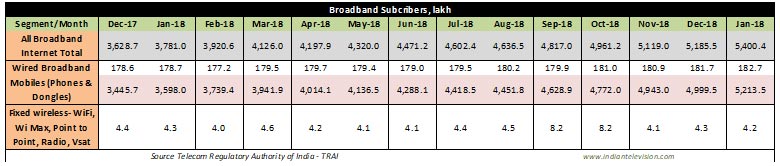
Overall, the number of broadband subscribers grew by 2.149 crore (21.49 million, 214.9 lakh) in Jan-19, much higher than the 1.532 crore (15.32 million, 153.2 lakh) subscribers that were added in Jan-18, and even higher than the 2.054 crore (20.54 million, 205.4 lakh) subscribers added in Mar-18, the month which saw the highest number of subscribers added in any month in 2018. In percentage terms, India’s broadband subscriber base grew by 4.1 percent in Jan-19 to reach 54.004 crore (540.04 million, 5,400.4 lakh) from 51.855 crore (518.55 million, 5185.5 lakh) in Dec-18.
In Jan-19, wireless broadband internet subscribers constituted about 96.5 percent of the broadband internet services base in India, followed by wired broadband internet services (3.4 percent) and Fixed Wireless subscribers (Wi-Fi, Wi-Max, Point-to- Point Radio & VSAT) at about 0.1 percent. While the subscriber base of the former two grew in Jan-19, in the case of Fixed Wireless subscribers (Wi-Fi, Wi-Max, Point-to- Point Radio & VSAT) the base declined by about 10,000 .

Please refer to the figures below:
In Jan-19, the top five service providers constituted 98.63 percent market share of the total broadband subscribers at the end of Jan-19. These service providers were Jio 28.994 crore (289.94 million, 2,899.4 lakh), Airtel 11.025 crore (110.25 million, 1,102.5 lakh), Vodafone Idea 10.986 crore (109.86 million, 1,098.6 lakh), BSNL 2.081 crore (20.81 million, 208.1 lakh) and Tata Tele group 0.226 crore (2.26 million, 22.6 lakh).
Wireless broadband internet – mobile device users (phones and dongles)
As mentioned above, India’s wireless broadband internet services have been leading broadband internet subscriber base as well as subscriber growth in the country – wireless broadband internet subscriber base grew 4.28 percent in Jan-19 to reach 52.135 crore (521.35 million, 5213.5 lakh) from 49.995 crore (499.95 million, 4999.5 lakh) at the end of Dec-18.
As on 31 January, 2019, the top five wireless broadband service providers were Jio 28.944 crore (289.44 million, 2,894.4 lakh), Vodafone Idea 10.984 crore (109.84 million, 1,098.4 lakh), Airtel 10.796 crore (107.96 million, 1,079.6 lakh), BSNL 1.164 crore (11.64 million, 116.4 lakh) and Tata Teleservices 0.179 crore (1.79 million, 17.9 lakh).
Wired broadband internet
Also, as mentioned above, India’s wired broadband internet subscribers grew by 1,00,000 (0.56 percent) in Jan-19. There were 1.827 crore (18.27 million, 182.7 lakh) wired broadband internet subscribers in the period under consideration as compared to 1.817 crore 18.17 million, 181.7 lakh) in the previous month, Dec-18.
As on 31 January, 2019, the top five wired broadband service providers were BSNL 0.917 crore (9.17 million), 91.7 lakh, Bharti Airtel 0.23 crore (2.30 million, 23 lakh), Atria Convergence Technologies (ACT) 0.14 crore (1.40 million, 14 lakh), Hathway Cable & Datacom (Hathway) 0.079 crore (0.79 million, 7.9 lakh) and MTNL 0.077 crore (0.77 million, 7.7 lakh).
While the public sector BSNL’s subscriber base remained stagnant, its smaller public sector sibling MTNL lost 10,000 subscribers, as well its fourth rank in terms of number of wired broadband subscribers in Jan-19 to Hathway which had added 10,000 subscribers in the same period. The other player – ACT also added 10,000 subscribers in Jan-19.







iWorld
Bill Ackman’s Pershing Square makes $64 billion bid to acquire Universal Music Group
Ackman pitches NYSE relisting plan as UMG board weighs unsolicited offer

The hedge fund has proposed a business combination that values UMG at €30.40 per share, representing a hefty 78 per cent premium to its current trading price. The offer includes €9.4 billion in cash alongside stock in a newly formed entity, with shareholders set to receive €5.05 per share in cash and 0.77 shares in the new company for each UMG share they hold.
Under the proposal, UMG would merge with Pershing Square SPARC Holdings Ltd and re-emerge as a Nevada-based entity listed on the New York Stock Exchange. The move is designed to boost investor visibility and potentially secure inclusion in major indices such as the S&P 500.
Pershing Square Capital Management ceo Bill Ackman argued that while UMG’s operational performance remains strong, its market valuation has lagged due to external factors. “UMG’s stock price has languished due to a combination of issues that are unrelated to the performance of its music business,” Ackman said, pointing to concerns ranging from shareholder overhang to delayed US listing plans.
Ackman also flagged what he sees as untapped potential in UMG’s balance sheet and a lack of clear capital allocation strategy. He added that the market has not fully recognised the value of UMG’s €2.7 billion stake in Spotify, alongside gaps in investor communication.
The proposed transaction would also result in the cancellation of around 17 per cent of UMG’s outstanding shares, while maintaining its investment-grade balance sheet. Pershing Square has said it will fully backstop the equity financing, with debt commitments secured at signing. The deal is targeted for completion by the end of the year.
UMG, however, has struck a measured tone. The company confirmed that its board has received the non-binding proposal and will review it with advisers. It reiterated confidence in its current strategy and leadership under Lucian Grainge, signalling no immediate shift in stance.
The proposal comes at a time when global music companies are navigating evolving investor expectations, streaming economics and capital allocation pressures. For Pershing Square, the bet is clear: sharpen the financial story, relist in the US, and let the music play louder in the markets.
Whether UMG’s board is ready to change the tune remains to be seen, but the spotlight on its valuation just got a lot brighter.






