News Headline
AI is rewiring media, just as smartphones reshaped telecom: Jiostar’s Kiran Mani

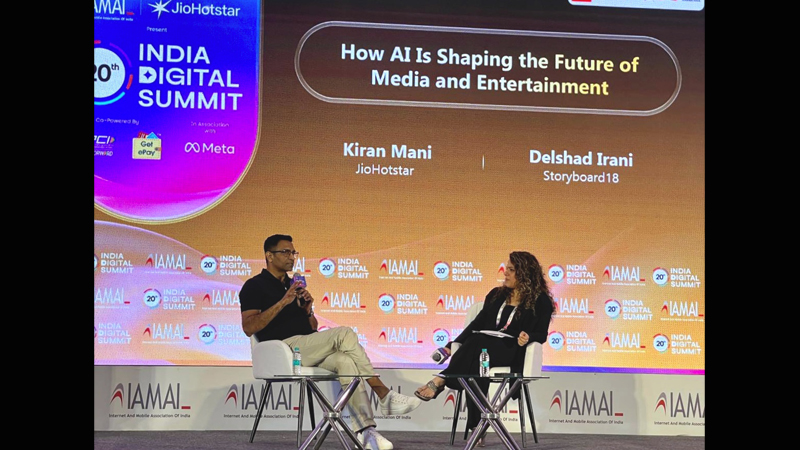
BENGALURU: Artificial intelligence is doing to media what smartphones once did to telecom—quietly, irreversibly and at scale.
That was the thrust of Kiran Mani, ceo – digital at Jiostar, speaking at the IAMAI India Digital Summit 2026 in Bengaluru on Thursday. AI, he argued, is transforming how audiences discover, consume and interact with content, shifting media from instruction-led to instinctive.
In a session moderated by Delshad Irani, Mani likened the current moment to the move from BlackBerry-era buttons to intuitive smartphones. “AI is doing to media what smartphones did to telecom,” he said, describing a shift where technology fades into the background and experiences become simpler, faster and more natural.

The biggest change, Mani said, is unfolding at the consumer level. AI is slashing the effort required to find something worth watching by responding to behaviour in real time. Instead of leaning on static markers such as age, geography or viewing history, platforms are increasingly reading live signals—pauses, skips, searches and questions—to surface content instantly. The result: shorter browsing loops and quicker decisions.
AI is also reshaping second-screen behaviour. What was once a distraction is becoming a seamless extension of viewing, allowing audiences to explore actors, characters, match statistics and key moments without leaving the primary screen. Curiosity, Mani said, is being woven directly into the experience.
India’s fragmented media ecosystem adds complexity. Mani noted that AI must perform across a vast spectrum—from connected televisions in urban homes to low-cost smartphones in smaller towns. The real challenge, he said, is not building intelligence for a privileged few, but making it work reliably across millions of screens.
On the creation side, AI is lowering long-standing barriers to entry. Stories that once demanded large budgets can now be visualised and produced far more efficiently, freeing creators to focus on ideas rather than constraints. As a result, the line between premium and short-format content is blurring.
“Good stories don’t need to be long to be impactful. A short format can be just as powerful if the idea connects,” Mani said.
Addressing fears around job losses and creative erosion, Mani argued that AI is reshaping roles rather than replacing them. By automating repetitive and execution-heavy tasks, it is allowing people to concentrate on higher-value creative work. Some of the most promising advances, he added, are emerging where technologists and creative teams work closely together.
From a platform standpoint, the focus is shifting from being everywhere to being intelligent everywhere. Once infrastructure is in place, AI enables platforms to understand intent and respond to it across screens. Content can now be analysed in real time, allowing relevant information, highlights and interactions to surface while viewers remain engaged.
Interactivity is becoming central to this evolution. Tools such as voting, meme creation and interactive features are pushing audiences from passive consumption to participation. Given the space, Mani noted, viewers often invent forms of engagement platforms they themselves did not anticipate.
Personalisation, too, is evolving. Rather than slotting users into fixed categories, AI is learning from moment-to-moment behaviour, making recommendations feel fresher and less repetitive—and discovery faster.
Looking ahead, Mani flagged conversational AI and voice as the next frontier. True conversational experiences, he said, go beyond voice search, enabling dialogue-driven interaction with content. As voice, text and video converge, media is set to become more immersive and personal.
Success, however, will not be measured by adoption alone. “If we can turn every screen into a meaningful interaction and help creators build more sustainable careers, we would have genuinely moved the industry forward,” Mani said.
In the AI era, the media’s future will not be defined by bigger libraries or louder platforms—but by quieter intelligence that knows exactly what the viewer wants, when they want it.







NEW DELHI: Hamdard Laboratories gathered a cross-section of India’s achievers in New Delhi on Friday, handing out the Hakeem Abdul Hameed Excellence Awards to figures who have left their mark across healthcare, education, sport, public service and the arts.
The ceremony, attended by minister of state for defence Sanjay Seth and senior officials from the ministry of Ayush, celebrated individuals whose work blends professional success with a sense of public purpose. It was as much a roll call of achievement as it was a reminder that influence is not measured only in profits or podiums, but in people reached and lives improved.
Among the headline awardees was Alakh Pandey, founder and chief executive of PhysicsWallah, recognised for turning affordable digital learning into a mass movement. On the sporting front, Arjuna Awardee and kabaddi player Sakshi Puniya was honoured for her contribution to the game and for pushing women’s participation onto bigger stages.
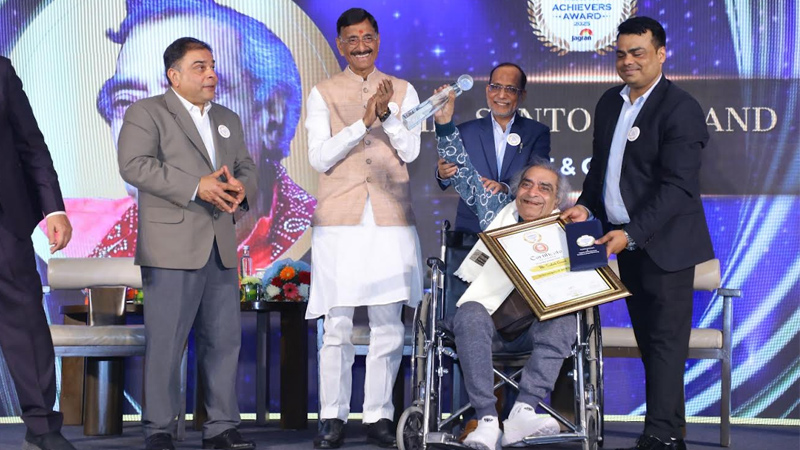
The cultural spotlight fell on veteran lyricist and poet Santosh Anand, whose songs have echoed across generations of Hindi cinema. At 97, Anand accepted the honour with characteristic humility, reflecting on a life shaped by perseverance and hope.
Healthcare honours spanned both modern and traditional systems. Manoj N. Nesari was recognised for strengthening Ayurveda’s place in national and global health frameworks. Padma shri Mohammed Abdul Waheed was honoured for his research-backed work in Unani medicine, while padma shri Mohsin Wali received recognition for his long-standing contribution to patient-centred care.
Education and social development also featured prominently. Padma shri Zahir Ishaq Kazi was honoured for decades of work in education, while former Meghalaya superintendent of Police T. C. Chacko was recognised for public service. Goonj founder Anshu Gupta received an award for his dignity-centred rural development initiatives, and the Hunar Shakti Foundation was honoured for empowering women and young girls through skill development.
The Lifetime Achievement Award went to former IAS officer Shailaja Chandra for her long career in public healthcare and governance, particularly in the traditional systems under Ayush.
Speaking at the event, Hamdard chairman Abdul Majeed said the awards were a tribute to those who combine excellence with empathy. “These awardees reflect Hakeem Sahib’s belief that healthcare, education and public service must ultimately serve humanity,” he said.
Minister Seth struck a forward-looking note, saying India’s young population gives the country a unique opportunity to become a global destination for learning, health and wellness by 2047.
The ceremony also featured the trailer launch of Unani Ki Kahaani, an upcoming documentary starring actor Jim Sarbh, set to premiere on Discovery on 11 February.
Instituted in memory of Unani scholar and educationist Hakeem Abdul Hameed, the awards have grown into a national platform that celebrates those building a more inclusive and resilient India. For one evening at least, the spotlight was not just on success, but on service with substance.






