Applications
Adobe unveils 2025 creative trends: Escapism meets reality in surreal visuals

Mumbai: Adobe’s 2025 Creative Trends Forecast explores how imagination and reality collide, highlighting top trends like surreal visuals, humour, and immersive experiences. This year’s trends reflect a growing desire for escapism and authentic connection in creative storytelling.
Here’s a closer look at the key trends set to define creativity in 2025.
Key 2025 creative trends

Fantastic frontiers
The Fantastic Frontiers trend invites audiences to explore magical, uncharted worlds where imaginative and unreal new visuals reflect our desire for escapism. Fantastic Frontiers merges technology and culture, signalling a future in which our imaginations are truly limitless. Years of digital world-building, especially in gaming, have prepared us for this shift, fueling consumer appetite for these dreamlike images. Generative AI is also revolutionising creativity, allowing artists to make the extraordinary possible. And we are seeing this trend now in traditionally produced commercial projects just as often as in AI-generated content.
Levity and laughter
Humour has long been the media’s secret sauce, with 90 per cent of consumers more likely to remember funny ads over serious ones. At the 2023 Cannes Film Festival, 52 per cent of category-winning films were comedies —up 43 per cent from 2022 — highlighting humour’s universal appeal.
Representing the next wave of comedic perspectives in brand messaging, the Levity and Laughter trend is characterized by the use of humour to make content more engaging and memorable. Brands are discovering that memes and other funny posts are shared more often than serious posts on social platforms, so they’re crafting humorous posts to reach larger audiences. By embracing the casual, playful tone we use online, companies are building more personal connections with consumers, making their brands feel more relatable and human.
This trend also allows creators to approach serious issues without being heavy-handed or divisive, boosting engagement with sharable experiences that are at once joyful and meaningful.
Time warp
As the space economy surges, reaching an estimated US $1 trillion in annual revenue by 2040, we’re seeing a similar rise in retrofuturism.
Turbocharged by AI, the Time Warp trend blends futuristic components with historical and vintage elements, pulling styles from ancient Rome, the roaring twenties, the groovy seventies and beyond, to create a nostalgic yet fresh aesthetic. Generative AI has played a key role in popularizing this style by making it easier to experiment and combine elements from different eras. But as this aesthetic has gained mainstream engagement, we are seeing a surge of traditionally produced (non-AI) commercial projects in this style as well.
This juxtaposition of past and future is even capturing the attention of Gen Zers, who are increasingly showing interest in, and even yearning for, a past they didn’t experience firsthand. The world is changing rapidly and Time Warp remixes eras and reimagines history for the future.
Immersive appeal
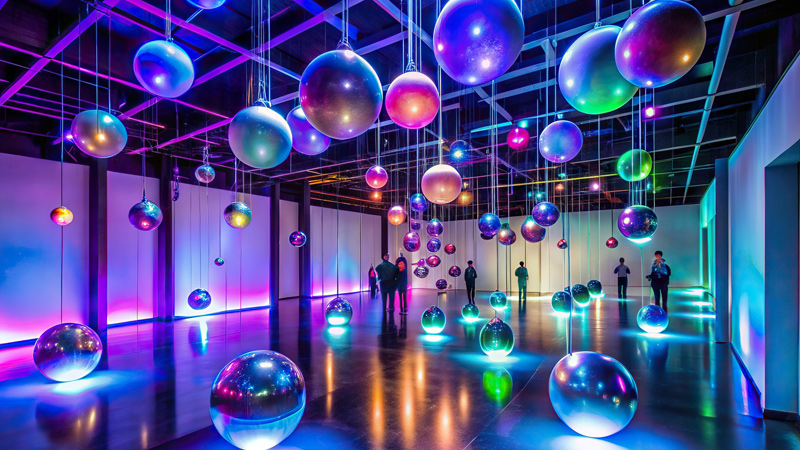
As we spend more time on screens, there’s been a corresponding demand for multisensorial experiences. The Immersive Appeal trend offers a powerful solution by creating interactions that spark joy and wonder. From immersive art installations and theme parks to experiential shopping, examples of this trend can go far beyond the visual to involve touch, sound, and even smell.
With consumers craving more sensory involvement and today’s technology making it possible, we’re seeing a rise in marketing campaigns that surround us. Brands are using a strategy known as ‘world-building’ to transport us into their fully realized universes. The best-known example of this is the Barbie marketing phenomenon, which encompassed a blockbuster movie, real-world events, and a variety of themed “Barbie-core” experiences.
Immersive Appeal cures screen fatigue by inviting audiences to enter fantastic interactive worlds and prioritizing profoundly felt experiences over passive consumption.




Applications
With 57 per cent single new users, Ashley Madison rebrands as discreet dating platform
Platform says majority of new members now identify as single

INDIA: Ashley Madison is shedding the “married-dating” label that defined it for two decades, repositioning itself as a platform for discreet dating in what it calls the post-social media age.
The rebrand, unveiled in India on 27 February, 2026, marks a structural shift in business model and identity. Once synonymous with married dating, the company now describes itself as the “premier destination for discreet dating” under a new tagline: Where Desire Meets Discretion.
The pivot is data-driven. Internal figures show that 57 per cent of global sign-ups between 1 January and 31 December, 2025 identified as single: a notable departure from the platform’s married core. The company argues that its community has already evolved beyond its original positioning.
“In an age where our lives have been constantly put on public display, privacy has become the new luxury,” said Ashley Madison chief strategy officer Paul Keable. He framed the platform’s offering as “ethical discretion” for singles, separated, divorced and non-monogamous users seeking private connections.
The shift also taps into wider digital fatigue. A global survey conducted by YouGov for Ashley Madison, covering 13,071 adults across Australia, Brazil, Canada, Germany, India, Italy, Mexico, Spain, Switzerland, the UK and the US, found mounting discomfort with hyper-public online lives.
Among dating app users, 30 per cent cited constant swiping and messaging as a source of fatigue, while 24 per cent pointed to pressure to curate public-facing profiles and early personal disclosure. Some 27 per cent said fears of screenshots or information being shared contributed to exhaustion; an equal share cited unwanted attention.
The retreat from oversharing appears broader. According to the survey, 46 per cent of adults actively try to keep most aspects of their life private online. Only 8 per cent feel comfortable sharing most aspects publicly, while 35 per cent say they are becoming more selective about what they disclose.
Ashley Madison is betting that this cultural recalibration towards controlled visibility can be monetised. By doubling down on privacy infrastructure and reframing itself around discretion rather than infidelity, the company is attempting to convert reputational baggage into a premium proposition.