News Broadcasting
Ad-Wise 2002 covers key issues on air time selling, buying


Ratings are important but there is a lot more to media planning and buying than just GRPs (gross rating points) and CPRPs (cost per rating points). That was one of the main strands of the discourse at Ad-Wise 2002, Indias first TV airtime forum organised by television services company indiantelevision.com, which was held in Mumbai today.
Improve the quality of data available; innovate; gut feel is important; use technologies to help leverage brand positioning. These were just some of the suggestions thrown up during the day-long proceedings whose theme was Future Shock: The Road Ahead was targeted at professionals from broadcasters who sell air time, media planners and buyers from ad agencies and media concessionaires, and at marketers.
A cross section of television, advertising, media, research and marketing professionals come and shared their views at Ad-Wise 2002. Among them: Raj Nayak, executive vice-president, Star India, Abraham Thomas, ad sales head Sony Entertainment, Sam Balsara, head of Madison India, TAM India CEO LV Krishnan, Initiative Media CEO Ashish Bhasin, Mindshare Fulcrum CEO Vikram Sakhuja, and Eureka Forbes COO SK Palekar, to name a few.

SET India CEO Kunal Dasgupta, who delivered the keynote address, gave an overview of how he saw the television business developing over the next five years.
Dasgupta said the television industry was poised for a great leap forward in the way the overall business was organised. Referring to the just released report put out by Anderssen, Dasgupta said TV ad spend was going to go from the current Rs 36 billion to Rs 81 billion by 2005. Again quoting from the report, Dasgupta said TV could garner 60 per cent of all ad spend by then.
Among the changes that were coming: 25 per cent of all TV revenues would be through subscriptions. Localisation of content but based more on language rather than just locality. Dasgupta gave the example of the Ramoji Rao promoted Eenadu Television network model, which was launching a string of regional channels.
According to Dasgupta, there would be no free to air channels as all would eventually have to go pay to survive. Dasgupta laid special emphasis on technology as a harbinger of change. The person who uses these technologies and leverages them well, will have the maximum by way of branding opportunities, Dasgupta said.
Looking at viewers, advertisers and broadcasters, Dasgupta had this to say: Viewers would access a small pool of channels that for which they would pay more.
As conditional access systems would be in place there would be no redundant channels (in the current dispensation, of the 100-odd channels that were available, only 10-15 are actually watched).
There would be a greater demand for quality as far as programming is concerned.
As with broadcasters, advertisers would also consolidate. With continuous improvement in database, research would become far more representative than is the norm today. This would mean a quantitative measurement of qualitative input becomes possible. Audience measurement systems for niche channels will become more refined. Advertisers would be willing to pay heavy premium for high image and high delivery properties. Niche channels with high loyalty will be able to charge more from advertisers.
As for the broadcasters, there will be a few national players, a few regional players and more of coalitions existing.
Channels will continuously provide cutting edge entertainment to drive viewers as both audiences and advertisers become more and more demanding.
In summation Dasgupta said the cost of effective advertising is going up. Therefore this would perforce mean that advertisers would be making considered choices as to the media vehicles they want to associate with.
In this Dasgupta saw a scenario where broadcasters would be making strategic alliances with specific groups of advertisers.
Raj Nayak in his presentation – What aids airtime sales? – stressed on the huge gap that existed between perception and reality among media buyers and planners and the channels themselves. Nayak’s was a call for better researching methodologies. By way of example he pointed out that when he approached six top agencies for data about the kind of ad spends that were currently available, all six threw up significantly different numbers. According to him, there was quite a bit of spin doctoring in the kind of numbers that were being thrown around.
Nayak said there had to be far more by way of investment into the data available. Nayak however, cautioned against relying too heavily on numbers. While asserting that he was all for ratings as a benchmark, what was needed was a more long term perspective. In the hunt for short term gains, media buying has been reduced to who can give the best deal rather than what might be effective as far as the brand fit is concerned, Nayak said. This “herd mentality” was leading to a scenario where executives were not at all bothered whether the brands they were promoting were benefiting from their campaigns or not as long as bottom lines were being shown.
“I believe in ratings. But media planning must go beyond GRPs and CPRPs,” Nayak said.
Sam Balsara: The value proposition in TV advertising was showing diminishing returns and there was much more innovation required was Balsara’s point in his presentation – “Innovation in Media”.
Too much clutter in the television advertising space was one of the reasons for this state of airs, Balsara said while giving out these figures:
There were 3.2 million ad spots on TV in 2001, up 34 per cent from the previous year while ad secondage was 65.7 million, up 26 per cent.
Balsara’s recipe: Invest in programming, maximise salience, create opportunities, push brand values, and take risks. “Never be afraid to try something new,” he concluded.
Vikram Sakhuja: How will media independents change TV buying.
Independents brought a whole lot more accountability into the equation was Sakhuja’s view. Sakhuja painted a bleak picture as to the future growth prospects of the industry saying there was nothing to suggest that there was gong to be any great expansion in the ad pie.
Sakhuja pointed out that of the Rs 36 billion ad pie 75 per cent of this was gobbled up by seven to eight players – essentially the mass language entertainment channels and one or two big regional players). And most of this spend was flowing into three hours of prime time, which left the rest of the channels really struggling.
While Sakhuja did say that TV should grow beyond the three prime time hours and the six-seven channels that are currently in the viewerscope of media planners and buyers he added the rider that there should be better rates negotiated as well as better benchmark data. This is bound to come as bad news to TV ad sales executives who are already being squeezed dry.
Sakhuja said the up side of this was that there will increasingly be seen a greater role of non prime time and non mainline channels in the media plans. “TV buying will not become more difficult, it will just become more accountable,” was Sakhuja’s comment.
Abraham Thomas: There is life beyond ratings. That was the main thrust of Abraham’s talk. While GRPs and CPRPs were certainly important and a good indicator of a show’s overall performance, there was a need of a major change in the mindset as far as how media buyers and planners dealt with broadcasters, Abraham said. He called for more transparency and clarity as far as the pitch that was being made was concerned as this would help broadcasters work better towards adding brand value to the whole exercise.
Sandeep Singh, VP – Marketing – Shri Adhikari Brothers Television Networks Ltd, echoed Abraham on the point of advertisers not giving enough information to the broadcasters which benefited no one.
And true to the subject of his presentation – “Let’s think anew”, Singh made a case for advertisers to look beyond the mainline channels when looking at effective brand positioning.
Singh gave the example of Aristocrat Premium Apple Juice which he said was a very successful campaign and one where spots were bought on the smaller channels like SABe TV, B4U and etc.







News Broadcasting
WITT Summit 2026 concludes in New Delhi
Babar Azam’s comical diving attempt goes viral as league introduces anti-dew measures.
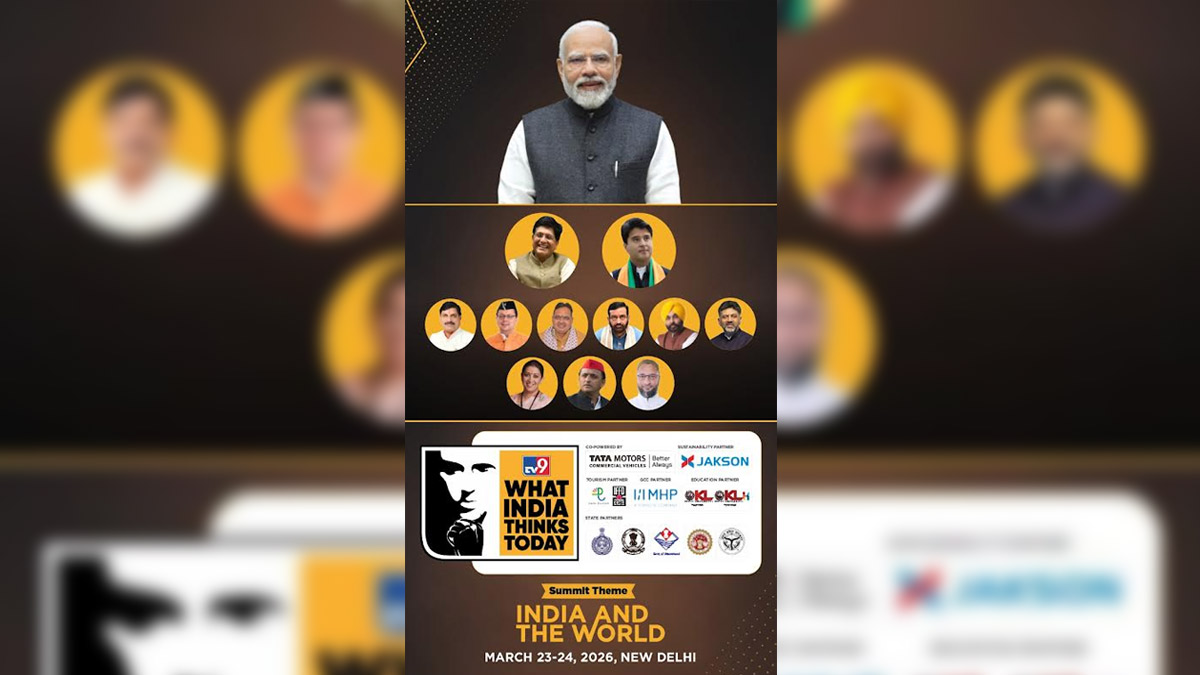
MUMBAI: The WITT Summit just wrapped up with enough big ideas to fill a policy playbook because when India’s leaders, thinkers and icons gather under one roof, even the conversations hit sixes. The eighth edition of TV9 Network’s flagship What India Thinks Today (WITT) Summit 2026 concluded on Saturday after two days of dynamic discussions at its New Delhi venue. India’s largest multi-domain public policy and culture summit brought together political leaders, policymakers, sports icons, artists and technology innovators to examine the forces shaping contemporary India and its global standing.
Prime minister Narendra Modi delivered the keynote address on the theme “India and the World” for the third consecutive year. In a wide-ranging speech, he addressed the ongoing conflict in West Asia, calling for restraint and compassion while highlighting India’s continued development trajectory despite global turmoil.
The summit featured candid conversations with state leaders. Telangana Chief Minister A. Revanth Reddy articulated a people-first governance model and contrasted it with other development approaches. Madhya Pradesh Chief Minister Mohan Yadav declared that Left-wing extremism had been effectively eliminated in his state and highlighted preparations for the upcoming Kumbh Mela. Punjab Chief Minister Bhagwant Mann defended his government’s record, citing the closure of 19 toll plazas and creation of the Sadak Suraksha Force. Karnataka Deputy Chief Minister D.K. Shivakumar expressed confidence in Congress prospects in Assam and addressed recent allegations against him.
On geopolitics and national security, Union Minister Jyotiraditya Scindia outlined India’s ambition to become a builder of trusted digital infrastructure for the world, citing the rapid 5G rollout and village-level 4G connectivity.
Cricket received significant attention. Former India captain Sourav Ganguly praised player freedom and trust as hallmarks of great leadership and named MS Dhoni as the greatest captain due to his World Cup successes. India women’s team bowling coach Aavishkar Salvi credited the BCCI and Women’s Premier League for building a pipeline of world-class talent behind the team’s recent ODI World Cup triumph.
The summit also hosted the inaugural AI² Awards 2026, celebrating the convergence of human creativity and machine intelligence in storytelling and content creation. Poet and kathavachak Kumar Vishwas delivered a nuanced take on India’s concept of Dharma and criticised the recent arrest of an 80-year-old Shankaracharya. Veteran lyricist Sameer Anjaan and storyteller Neelesh Misra reflected on changing music trends and artistic responsibility in the wake of a recent controversy involving Nora Fatehi.
In a country where conversations often run as deep as the Ganges, the WITT Summit proved once again that when leaders, thinkers and storytellers come together, the real winner is public discourse lively, layered and refreshingly unafraid to tackle the big questions shaping India’s tomorrow.








