News Broadcasting
ABP News-CVoter exit poll: Congress looking At 3 wins, BJP 1. close fight across 5 States


Mumbai: The exit poll survey conducted by ABP News and CVoter has thrown up mixed results for the two major parties, BJP and Congress, in the five states — Rajasthan, Chhattisgarh, Madhya Pradesh, Telangana and Mizoram — where Assembly elections were conducted this month. While Rajasthan is likely to stay true to its ‘revolving door’ trend and see a return of the BJP to power, the Congress may clinch Madhya Pradesh. According to the ABP News-CVoter exit poll, a neck-and-neck fight is predicted in Chhattisgarh, with the Congress placed marginally ahead. In Mizoram, the newly formed Zoram People’s Movement is likely to give the ruling Mizo National Front a run for its money, making it a really close contest.
The elections to five states took place on four dates between November 7 and 30, with Chhattisgarh going to polls in two phases and the rest in a single phase.
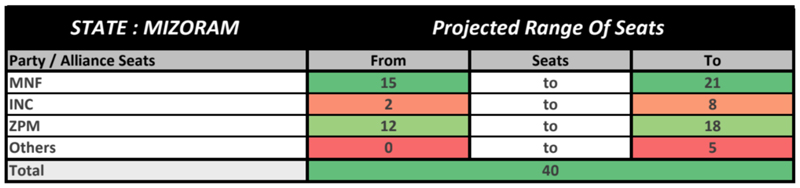
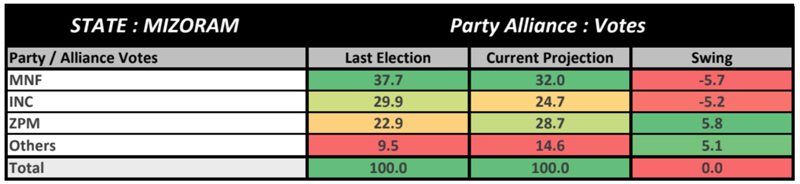
In Mizoram, which went to polls on 7 November, CM Zoramthanga-led MNF is predicted to win anywhere between 15 and 21 seats in the 40-member assembly, down from 26 in 2018. The ZPM may bag 12-18 seats. In terms of vote share, MNF is likely to have 32% voter support, against ZPM’s 28.7%, according to the ABP News-CVoter exit poll. The Congress could bag 2-8 seats with a vote share of 24.7%.

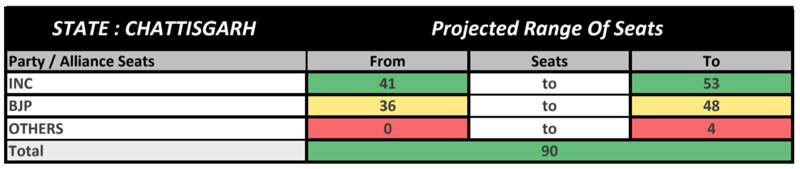
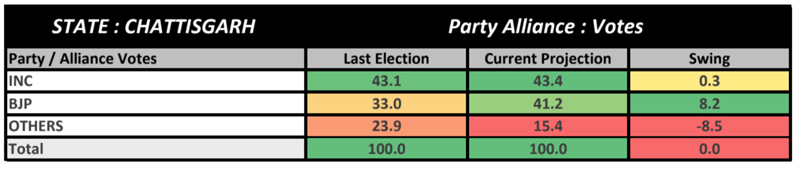
The ABP News-CVoter exit poll says Chhattisgarh, where the elections were held in two phases (on 7 November and 17 November), could stay with the Congress but the contest is very close. With the Congress predicted to win 41-53 seats, down from 68 in 2018, it finds the BJP breathing down its neck with a seat projection of 36-48. The magic number in the 90-member House is 46. The BJP, which won only 15 seats in 2018, appears to have increased its vote share from 33% in the last election to 41.2% this time, while the Congress vote share has gone up only marginally from 43.1% to 43.4%.
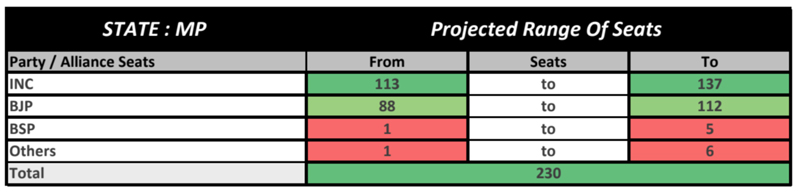
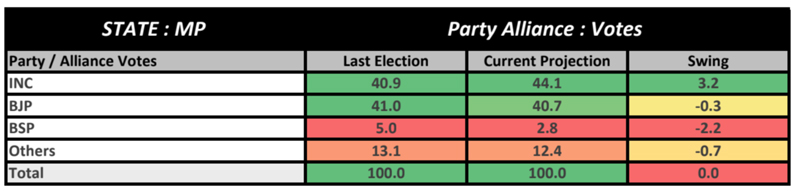
According to the ABP News-CVoter exit poll, Madhya Pradesh is predicted to go with the Congress, with a seat projection of 113-137 against the ruling BJP’s 88-112. BSP may get 1-5 seats. In terms of vote share, the Congress has a voter support of 44.1%, while the BJP is enjoying the backing of 40.7%.
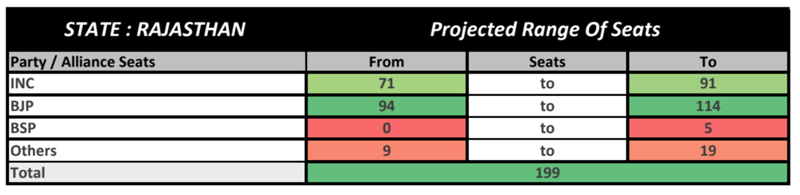
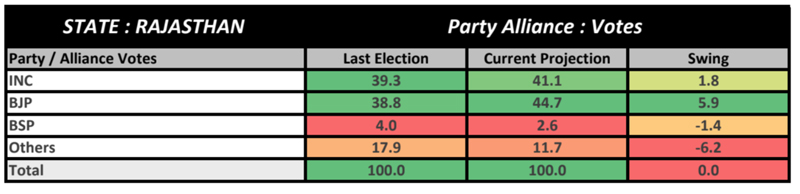
The ABP News-CVoter exit poll predicts that Rajasthan will bring back the BJP to power, giving it 94-114 seats, and foiling the Congress’ efforts to break the state’s historical pattern of alternating between BJP and Congress. The ruling Congress is likely to win only 71-91 seats, losing at least 19 seats from its 2018 tally. The majority mark in this election is 100 as polling was held for 199 seats, and not all 200, because of the demise of a candidate. Election to this seat will be conducted on a later date.
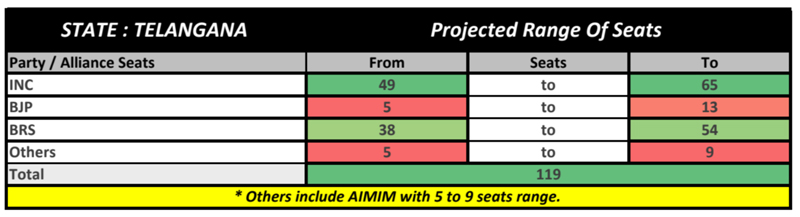
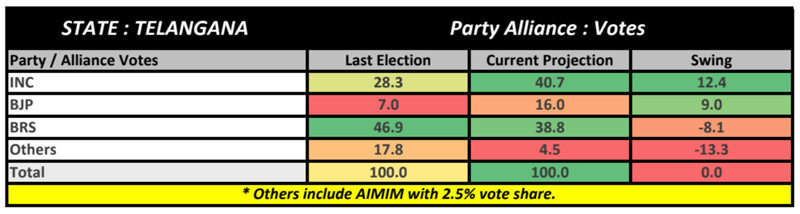
In Telangana, which went to polls on Thursday, 30 November, the ABP News-CVoter exit poll has predicted an upset for chief minister K Chandrashekar Rao who may not be able to hold on to power for a third term. His Bharat Rashtra Samithi (BRS) is projected to win only 38-54 seats this time, down from its 2018 tally of 88, paving the way for the Congress that is predicted to win 49-65 seats. The majority mark is 60 in the 119-member Assembly. The BJP, which put all its might during the campaigning, may get 5-13 seats. Others, including AIMIM, are likely to get 5-9 seats. At 40.7%, the Congress vote share is up 12.4 percentage points, while the BRS vote share is down from 46.9% to 38.8%.
The counting of votes will take place on 3 December. While the final verdict will only be known on Sunday, the ABP News-CVoter exit poll can give you a sense of which way the wind appears to be blowing.
Methodology:
The current survey findings and projections are based on CVoter Exit Poll / Post Poll personal interviews conducted on the polling day and after polling day among 18+ adults statewide, all
confirmed voters.
Survey date: November 7-30, 2023
Sample size – Rajasthan: 34,690; MP: 45,521; Chhattisgarh: 22,656; Telangana: 19,791; Mizoram: 8,781
LS Seats Covered: 25 in Rajasthan; 29 in MP; 11 in Chhattisgarh; 1 in Mizoram; 17 in Telangana
VS Seats Covered: 199 in Rajasthan; 230 in MP; 90 in Chhattisgarh; 40 in Mizoram; 119 in Telangana
Margin Of Error (macro level): +/- 3%
Margin Of Error (micro Level): .+_/_- 5%
Confidence Level: 95%





News Broadcasting
Network18 channels lead YouTube news viewership in March 2026
CNN-News18, News18 India and CNBC channels top categories with record views

MUMBAI: When the world hit refresh on breaking news, Network18’s channels were already streaming ahead. As geopolitical tensions and war-driven headlines fuelled a surge in global news consumption, the network’s digital playbook delivered big clocking record Youtube viewership across English, Hindi and business news categories in March 2026.
At the forefront was CNN-News18, which emerged as the clear leader in the English news segment with 130 million live and video-on-demand views. The channel edged past competitors such as Times of India (126.5 million), Times Now (101.1 million), India Today (88.2 million) and NDTV (77.5 million), according to Databeings data for March.
In the Hindi news arena, News18 India delivered a commanding performance, racking up a staggering 3,297 million views on YouTube. The channel comfortably outpaced NDTV India, which recorded 3,119 million views, underlining its deep reach and consistent engagement with mass audiences, as per Playboard data.
The network’s dominance wasn’t confined to general news. In the Hindi business segment, CNBC Awaaz topped the charts with 92 million views, narrowly ahead of Zee Business (90 million) and well ahead of ET Now Swadesh (57 million). Meanwhile, its English counterpart CNBC-TV18 posted a strong 58 million views, reinforcing the network’s cross-category strength.
The spike in viewership reflects a broader shift in audience behaviour, with viewers increasingly turning to digital platforms particularly Youtube for real-time updates and in-depth coverage during high-intensity news cycles. For Network18, the numbers signal more than just scale; they underline the effectiveness of a multi-platform strategy that blends speed, credibility and continuous coverage.
In a month where the news never paused, it seems viewers chose to stay tuned where the stream never stopped.






