Hindi
‘ABCD2’ in 3D will bring out the best in Indian dancing: Shraddha Kapoor


NEW DELHI: For Shraddha Kapoor, who had made a mark with Aashiqui 2, dancing in a film like ABCD2 did not come easy but she surprised her fellow cast members including Varun Dhawan when she attempted to match their energy.
Kapoor is particularly grateful to Remo Fernandes for training her for this sequel to the earlier ABCD, which came in 2013. The film also stars Lauren Gottlieb, Raghav Juyal and Dharmesh Yelande in supporting roles. The movie is directed by Remo D’Souza and produced by Siddharth Roy Kapoor under the banner of UTV-Disney Pictures.

The story explores the real life struggle of of four boys Rohit, Pavan, Suresh and Vernon who are part of a dance institute named Fictitious Dance Academy and take up the challenge to win the World Hip-Hop dance championship.
Belonging to a non-dancer background, Kapoor, who has earlier also acted in Ek Villain, said at a press meet here that she sweated it out really hard and proved that actually ‘Any Body Can Dance’.
Kapoor proved her dancing mettle in the song ‘Sun Sathiya,’ which was also there in the original film where Lauren Gottlieb danced to the tunes of this catchy number.
Asked about the challenges she faced, she said, “It was really hard for me to match the energy of other dancers as all of them had taken training somewhere. I did learn a bit of dancing at my school days but had never taken any proper training for the same. The film has changed my life and my body completely. Before this I use to dance in bathroom, in front of mirror, in my room or at birthday parties. I always wanted to dance openly on stage but somewhere I was under-confident or shy to dance in front of so many people. This is all because of Remo sir that he made me confident enough to give my best and whatever positive comments I am getting for my work will made Remo sir proud.”
The film also features the song ‘Bezubaan’ from the original film, which was a hit among the masses and is now titled as ‘Bezubaan Phirse,’ where the stars show the best of their dance moves.
Dhawan plays the character of Suresh in the film and features in the recently released song ‘Chunar.’ Asked why he agreed to star in the film, he said, “As an actor, you always listen to the script first, but Remo sir did a very unique thing. He showed me the documentary of ‘Fictitious Group’ who also participated in India’s Got Talent. He showed us footage of dancers from America, China and different countries. When it was announced that India was participating in the global talent series and made it to the finals, I felt so proud and patriotic. I got really emotional and that is why I said yes to it.”
Raghav Juyal who gave birth to the slow motion dance shared his knowledge of dance with the audience. He is often called as Crockroax, which is an amalgamation of being powerful like a crocodile and creepy like a cockroach. “Earlier people used to mock at the dancers and call them as ‘Nachaniya’ but now value is being attached with dancing as an art. This kind of revolution is shown in the film and I would just say that parents should support their children and as I always say Fame is a devil and art is an angel. Fame will come and go but art will always be within.”
Asked why is Disney was attached with ABCD2 as the story did not give any fairy tale kind of feeling, Disney India vice president and head, marketing & distribution – studios Amrita Pandey said, “It is a very inspiring story about an underdog dance troupe and has strong emotion of heart. When you’ll watch the film, you’ll see that it is not only about fun and dance. ABCD2 inspires you and Disney always promotes stories, which inspires you in a way or the other.”







In a music industry that often rewards speed, spectacle, and instant recall, Navjot Ahuja’s journey feels refreshingly different. His story is not built on noise. It is built on patience, discipline, emotional honesty, and a quiet commitment to becoming better with every passing year. After 14 years of struggle, learning, performing, and writing, Navjot stands today as an artist whose success has not changed his centre. If anything, it has only made his purpose clearer.
For Navjot, music has never been about chasing fame alone. It has always been about expression. It is about writing more truthfully, singing more skillfully, understanding himself more deeply, and becoming a kinder human being in the process. That rare clarity is what gives his journey its beauty.
Where It All Began: A Writer Before a Singer
Indian singer and songwriter Navjot Ahuja’s musical journey began in the most familiar of places: school assemblies. But even then, what was growing inside him was not only the desire to sing. It was the need to write.
Long before he saw himself as a performer, he had already discovered the emotional release that writing offered him. For Navjot, words became the first true channel for feeling. Songwriting came before singing because writing was the only way he could let emotions flow through him fully. That inner pull shaped his artistic identity early on.
Like many young musicians, he sharpened his craft by creating renditions of popular songs.
Those experiments became his training ground. But the turning point came in 2012, when he wrote his first original song. That moment did not just mark the beginning of songwriting. It marked the beginning of self-definition.
A Calling He Did Not Chase, But Accepted
What makes the latest Indian singer-songwriter Navjot’s story especially compelling is the way he describes his relationship with music. He does not frame it as a career he aggressively pursued. In his own understanding, music was not something he chose. It was something that chose him.
There was a time when he imagined a very different future for himself. He wanted to become a successful engineer, like many young people shaped by ambition and conventional expectations. But life had a different script waiting for him. During his college years, around 2021, music entered his life professionally and began taking a firmer shape.
That shift was not driven by image-building or industry ambition. It came from acceptance. Navjot embraced the fact that music had claimed him in a way no other path could. That sense of surrender continues to define the artist he is today.
An Artist Guided by Instinct, Not Influence
Unlike many singers who speak openly about idols, icons, and musical role models, Navjot’s creative world is built differently. He does not believe his music comes from imitation or inherited influence. He listens inward.
He has never considered himself shaped by ideals in the traditional sense. In fact, he admits that he does not particularly enjoy listening to songs, especially his own. His decisions as a songwriter and singer come from instinct. He writes what feels right. He trusts what his inner voice tells him. He positions his music according to what he honestly believes in, not what trends demand.
That creative independence gives his work a distinct emotional sincerity. His songs do not feel calculated. They feel alive.
The Long Years of Invisible Struggle
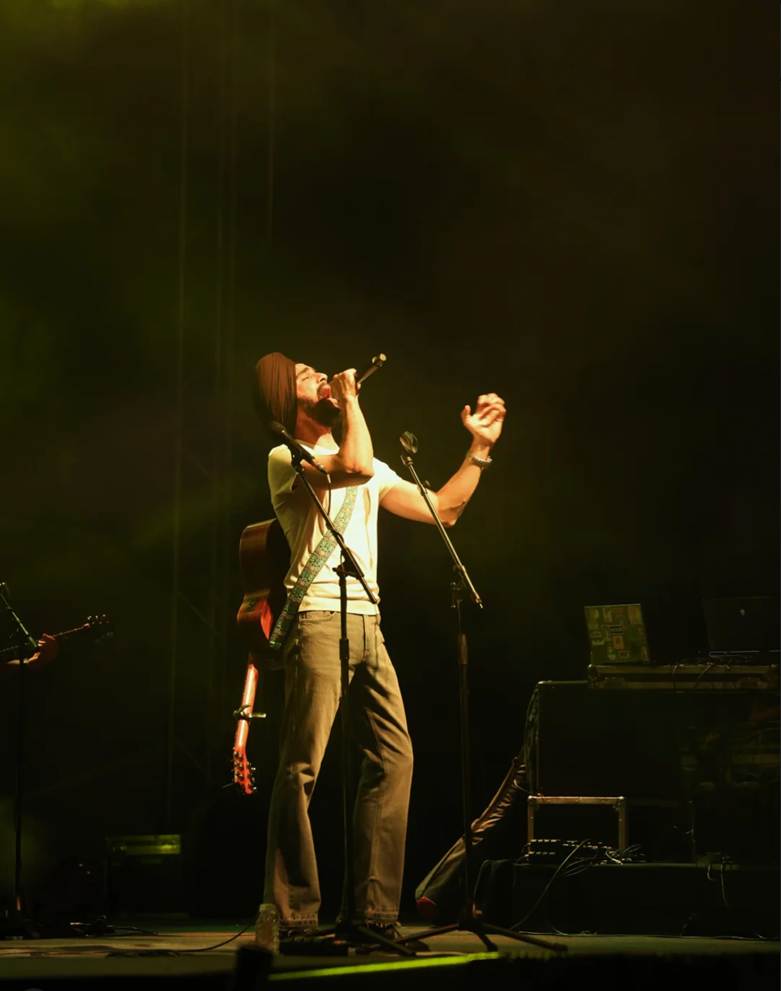
Every artist carries a chapter of struggle, and Navjot’s was long, demanding, and deeply formative. One of the biggest challenges he faced was building continuity as the best new indian singer songwriter in an era where musical collaboration is increasingly fluid.
For emerging singers, especially those trying to build with a band, consistency can be difficult. Instrumentalists today have more opportunities than ever to freelance and perform with multiple artists. While that growth is positive and well deserved, it can make things harder for singers who are still trying to establish a steady team and sound around their work.
For Navjot, one of the most difficult phases came during 2021 and 2022, when he was doing club shows almost every day. It was a period of relentless performance, but not always personal fulfillment. He was largely singing covers because clubs were not open to original songs that audiences did not yet know.
For a new Indian singer and songwriter, that can be a painful compromise. To perform constantly and still not have the freedom to share your own voice requires not just resilience, but restraint.
“Khat” and the Grace of Staying Unchanged
After 14 years of effort, Navjot’s new love song Khat became a defining milestone. Professionally, he acknowledges that the song changed how society viewed him as a musician. It strengthened his place in the public eye and altered his standing in meaningful ways.
Yet personally, he remains unchanged.
That is perhaps the most striking part of his story. Navjot says his routine is still the same. His calm is still the same. His writing process is still the same. He does not want success or failure to interfere with the purity of his art. For him, emotional detachment from public outcomes is essential because the moment an artist becomes too attached to validation, the writing begins to shift.
His joy comes not from numbers, but from the attempt. If he has tried to improve his skill today, if he has written his heart out more honestly than before, then he is at peace.
Growth, Not Glory, Remains the Real Goal
Even now, Navjot is not consumed by labels such as singles artist, performer, or digital success story. His focus remains deeply personal. He wants to sing better. He wants to play instruments better. He wants to understand himself more. And he wants to become a kinder person.
That is what makes Navjot Ahuja’s journey so moving. It is not simply the story of a musician finding recognition. It is the story of an artist who continues to grow inward, even as the world begins to look outward at him. In an age obsessed with applause, Navjot reminds us that the most meaningful success often begins in silence, honesty, and the courage to remain true to oneself.






