iWorld
5G revolution in India strikes the Indian Smart TV market


Mumbai: The fifth generation (5G) of cellular networks has given rise to a new era of high-performing connectivity in India. This telecommunications milestone is already revolutionizing several industries and how they function. Agriculture, education, manufacturing, farming, and healthcare have all been engulfed in the wave of innovations ushered by 5G.
As the 5G wave begins to reshape the digital landscape in India, entertainment, and media are not far behind. 5G has enabled high-quality, buffer-free streaming and interactive experiences like 360-degree live sports events. 5G-powered VR experiences have become commonplace, and this technology has truly widened the scope of entertainment. The consumer electronics sector, especially the modern household staple Smart TVs, has been influenced to a tremendous degree by this seismic advancement in connectivity.
Smart TVs have already transformed at-home viewing by merging streaming, apps, and internet browsing – all into one single platform. This advancement was achieved on the backs of 4G networks, where speeds peak at 100 to 200 Mbps. 5G changes the game completely, with a hundredfold increase in speeds reaching up to about 10 Gbps. It provides improved latency and an increased range for holding up to 100 times more traffic. This further transforms Smart TVs and expands the scope of seamless entertainment. How fast the pace of this transformation would be now depends on the level of accessibility an average consumer has to this network.

5G’s rapid yet developing expansion not only meets the high-data demands of urban consumers but also manages to tap into the demands of rural and semi-urban consumers that previously faced connectivity challenges. As per Ericsson’s Mobility Report, 5G subscriptions in India are projected to increase from 119 million at the end of 2023 (representing 10% of all mobile subscriptions) to a staggering 840 million by the end of 2029, constituting 65 per cent of the total subscriptions. With leading Indian telecom players contributing to the country’s connectivity ecosystem, the deployment of 5G and its observed response has established India as a pivotal nation in the global telecom landscape.
Expanding the scope of smart TVs
With the advent of 5G, Smart TVs have become a Swiss Knife of sorts when it comes to entertainment. Think of it as technology on steroids. The new available high-speed connectivity allows Smart TVs in India to stream Ultra-HD and even 8K content without buffering. Global OTT platforms that offer services in India are already optimizing their services for 8K. The low-latency connections offered by 5G enable more efficient cloud gaming directly on Smart TVs without gaming consoles including multiplayer AR/VR games. During the last 2023 World Cup, the mix of 5G connectivity and Smart TVs made it possible for viewers to enjoy buffer-free live sports streaming, with features like multi-angle viewing and instant replay.
Integration of AI and IoT devices into Smart TVs has been possible because of 5G. This allows for tailored recommendations based on consumers’ viewing habits. 5G-enabled Smart TVs use AI-driven personalized content suggestions, and a large segment of viewers prefer to engage with personalized content recommendations on streaming platforms, increasing watch time.
Beyond entertainment, 5G-enabled Smart TVs have transformed homes into hubs for connectivity where users can control home appliances, lighting, and security cameras from their TV interface.
Expansion of IoT-driven electronics
India also proves to be an emerging IoT (Internet of Things) market for multiple industries primarily due to the rise in integration and creation of IoT-enabled products and services. The arrival of 5G comes at a time when its implementation delivers remarkable response times when coupled with IoT applications. Thus, making smart devices even smarter and more efficient by enhancing their performance in real-time.
As per iLounge’s article on The Impact of 5G on IoT Adoption and Implementation, “The improved features of 5G can also empower the creation and activation of more advanced IoT devices. Such devices will run faster, respond quicker, have longer battery life, and carry more complex tasks. This not only will enhance the efficiency and reliability of current IoT devices but will also create new possibilities for use cases and business models.” For instance, 5G networks reduce response times in IoT applications from 50 milliseconds to 1 millisecond, a boost particularly beneficial for real-time applications like autonomous vehicles and remote healthcare. This growth not only expands IoT’s reach but also reinforces India’s position as a leading market for IoT innovation for the years ahead.
The convergence of 5G connectivity and Smart TV will be the backbone of intelligent entertainment systems. The day is already upon us when TV isn’t just a device for viewing, but a portal to more immersive experiences that cater to our needs in real time. This future is fast, incredible where innovations are endless, and the best part is that this amazing new journey has just begun.





iWorld
Asha Bhosle, the unforgettable voice that sang a thousand emotions
The melody that defined generations has fallen silent, but her songs will echo forever.
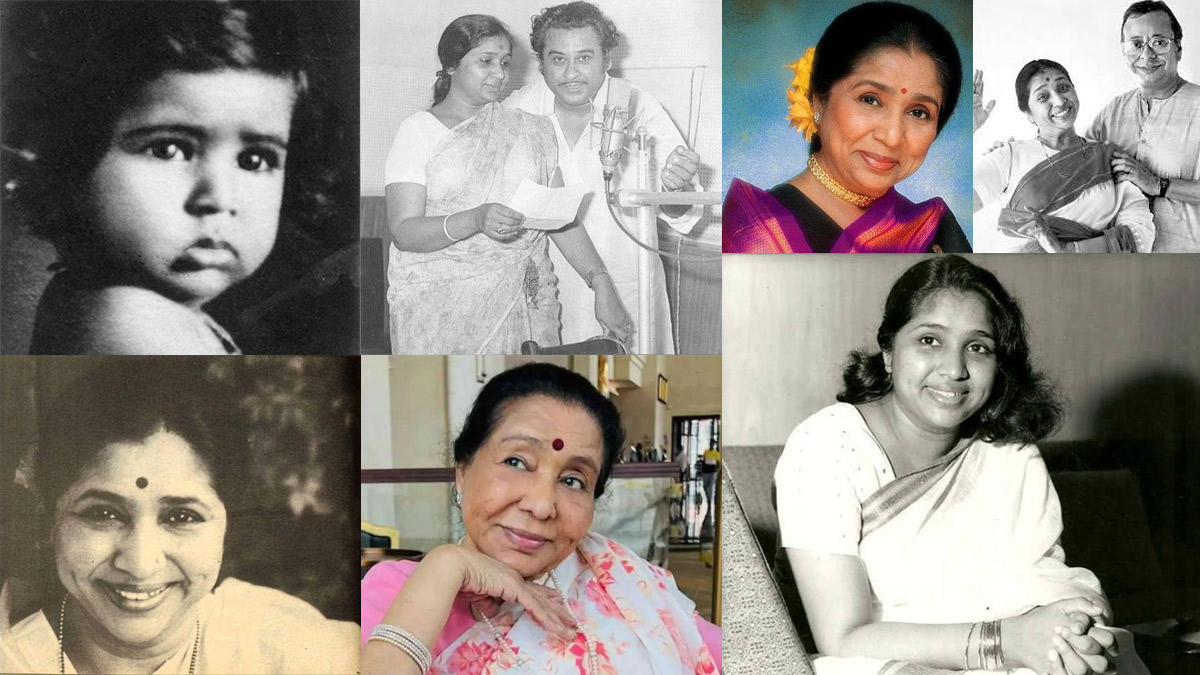
MUMBAI: The voice that once lit up countless silver screens and brought rhythm to millions of hearts has stilled. Legendary singer Asha Bhosle, one of the most versatile and prolific vocalists in Indian film music, passed away at the age of 92 in Mumbai on Sunday. She was admitted to Breach Candy Hospital on Saturday night after suffering cardiac and respiratory issues and had reportedly been unwell for several months.
Her son, Anand Bhosle, confirmed the news on Sunday afternoon. The last rites will be performed on Monday.
Born in 1933 into the illustrious Mangeshkar musical family, Asha began her journey in the golden era of Hindi cinema. She recorded her first film song at the age of nine in 1943 and, by the 1950s, had already carved a distinct space for herself in Bollywood. While her elder sister Lata Mangeshkar often took the more melodic, heroine-centric numbers, Asha quickly became the go-to voice for energetic cabaret tracks, dance numbers, and later, the full spectrum of emotional expression.
The 1950s–60s: Rise of the Cabaret Queen In the early decades, Asha was frequently typecast for “item songs” and Western-style numbers. Yet even within those constraints, she delivered unforgettable hits such as “Aaja Aaja” from Teesri Manzil and “O Haseena Zulfon Wali” from the same film. Her playful, sassy delivery gave these tracks a magnetic energy that still feels fresh today.
The 1970s: Peak Versatility This was the decade that cemented her legendary status. Songs like “Dum Maro Dum” (Hare Rama Hare Krishna), “Piya Tu Ab To Aaja” (Caravan), “Chura Liya Hai Tumne” (Yaadon Ki Baaraat), and “Yeh Mera Dil” (Don) became cultural touchstones. Asha proved she could swing from seductive to soulful with equal ease, working with almost every major composer of the era.
The 1980s: Emotional Depth and Ghazals After marrying composer R.D. Burman in 1980, Asha explored more nuanced, introspective territory. Her National Award-winning performances in Umrao Jaan (“Dil Cheez Kya Hai”) and Ijaazat (“Mera Kuch Saamaan”) showcased a matured, velvety voice capable of profound emotion. These tracks remain among the most cherished ghazals in Indian cinema.
The 1990s–2000s: Global Collaborations and Reinvention Even as newer voices emerged, Asha refused to fade. She collaborated internationally with the Kronos Quartet and released experimental albums. Later in her career, she lent her voice to younger composers and continued performing live, often sharing the stage with her granddaughter Zanai Bhosle.
A Life Beyond the Microphone Asha’s personal journey was as dramatic as her filmography. At 16, she eloped with Ganpatrao Bhosle, her personal secretary. The marriage ended in separation in 1960 after they had three children. In 1980, she married R.D. Burman in a union that faced family opposition but brought creative synergy. RD passed away in 1994.
Throughout her life, Asha remained grounded, often crediting classical music and ghazals for keeping her voice sharp. In a 2023 interview, she admitted she rarely listened to contemporary film songs, preferring the timeless works of Bhimsen Joshi and classic ghazals to stay inspired.
Her seven Filmfare Awards and two National Film Awards are merely numbers; the true measure of her legacy lies in the thousands of songs that still play in homes, cars, and hearts across generations. From the foot-tapping energy of “Dum Maro Dum” to the haunting beauty of “Mera Kuch Saamaan”, Asha Bhosle gave Indian cinema a voice that was simultaneously bold, tender, playful, and profound.
The golden era has lost one of its brightest stars, but the music she created will continue to refresh souls for decades to come. As the final notes of her extraordinary journey fade, India bids farewell to a voice that truly defined an era.







