I&B Ministry
100 days of the I&B Ministry


NEW DELHI: The Narendra Modi led NDA government has completed 100 successful days in power. And in these days, the Information & Broadcasting (I&B) Ministry has done its bit to woo the Media and Entertainment industry.
Listing the achievements was I&B Minister Prakash Javadekar, through a press meet in Delhi.

The government is launching a new 24×7 channel for the northeast called Arun Prabha in order to provide a strong platform for expression of cultural identities and for creating greater awareness regarding the region.
Even as a Task Force has been constituted to steer the remaining two phases i.e. phase III and phase IV of digitisation in India, the government has made efforts towards fulfilling the long pending demand of domestic manufacturers of Set Top Boxes to get tax concession (C Form benefit) in order to compete with imported STBs.
He said this will pave the way for implementation of digitisation initiative in India and see digitisation of about 80 million Cable TV homes in India. It is also a step towards the Prime Minister’s dream of a Digital India as digitisation will enable quick penetration of broadband connectivity in India.
The Minister talked of initiatives taken in different sectors aimed at enhancing the outreach of policies and programmes across platforms. Some of the initiatives undertaken have been innovative involving people’s participation, enhancing government’s presence on the social media platforms and strengthening communication at the grassroots.
He said Rs 100 crore had been allocated to Kisan Channel, which will disseminate real time information to the farmers regarding new farming techniques, water conservation, organic farming etc.
In order to facilitate Ministries/Departments in registering their presence on social media the Ministry had organised a half day training workshop on 11 July.
The Telecom Regulatory Authority of India (TRAI) has on the request of the Ministry given recommendations on migration of FM Radio Broadcasters from phase-II to phase-III which is under examination.
Goa has been declared the permanent destination for the International Films Festival of India to develop the “Brand IFFI” on the lines of other International Film Festivals. Although the decision to move IFFI to Goa was taken in 2004 when the National Democratic Alliance was in power, a fresh Memorandum of Understanding was being signed year-to-year for the Festival.
The three-day North East Film Festival held in Delhi recently will henceforth be an annual feature organised by the Directorate of Film Festivals.
The Film and Television Institute of India and the Satyajit Ray Film and TV Institute are to be institutes of National Importance and an Act of Parliament will be passed for this. The proposed Bill would enable both the Institutes to award its own degrees and diplomas and start new activities on the lines of IITs and IIMs.
The office of the Registrar of Newspapers for India (RNI) has streamlined its Single Window Public dealing mechanism at its office. RNI has achieved 100 per cent success in online e-filing of annual statements by publishers for 2013-14.
Under the Rs 100 crore set aside for “Supporting Community Radio Movement in India,” 600 community radio stations will be set up across the country in the 12th Five Year Plan. This major initiative of the new government will strengthen the link with the population living in rural and marginalized areas.
The Home Ministry has agreed to the proposal of the Ministry for not seeking security clearance for such channels whose security clearance have already been sought earlier along with the Board of Directors. This decision has paved the way for speedy clearance of additional television channel permissions, which will benefit the broadcast industry in a big way. After the decision was taken, 23 TV channels have already been permitted by the Ministry.
The proposal has been cleared for Rs.600 crore National Film Heritage Mission (NFHM) to preserve India’s film legacy by the Expenditure Finance Committee in the Finance Ministry. The draft Cabinet Note has been circulated to the concerned Ministries and the Note will shortly be submitted for approval of the Cabinet.
To ensure people’s participation in Government Advertising through Crowd-Sourcing of Advertisements, the advertisement for important events are to be designed by the people. The Independence Day advertisement designed on these lines and DAVP has invited suggestions for the proposed advertisement to be brought out on 5 September to observe “Teachers Day”.
For Independence Day, the advertisements were crowd sourced for the first time and Independence Day coverage was extended to all media platforms. Similarly, a series of press conferences being organised to highlight the initiatives of the Government and the same approach is being adopted to ensure information dissemination across all platforms.





I&B Ministry
IT Rules tweaks are clarificatory, not expansion of powers: MeitY
Govt signals flexibility as platforms push for clarity on user content rules
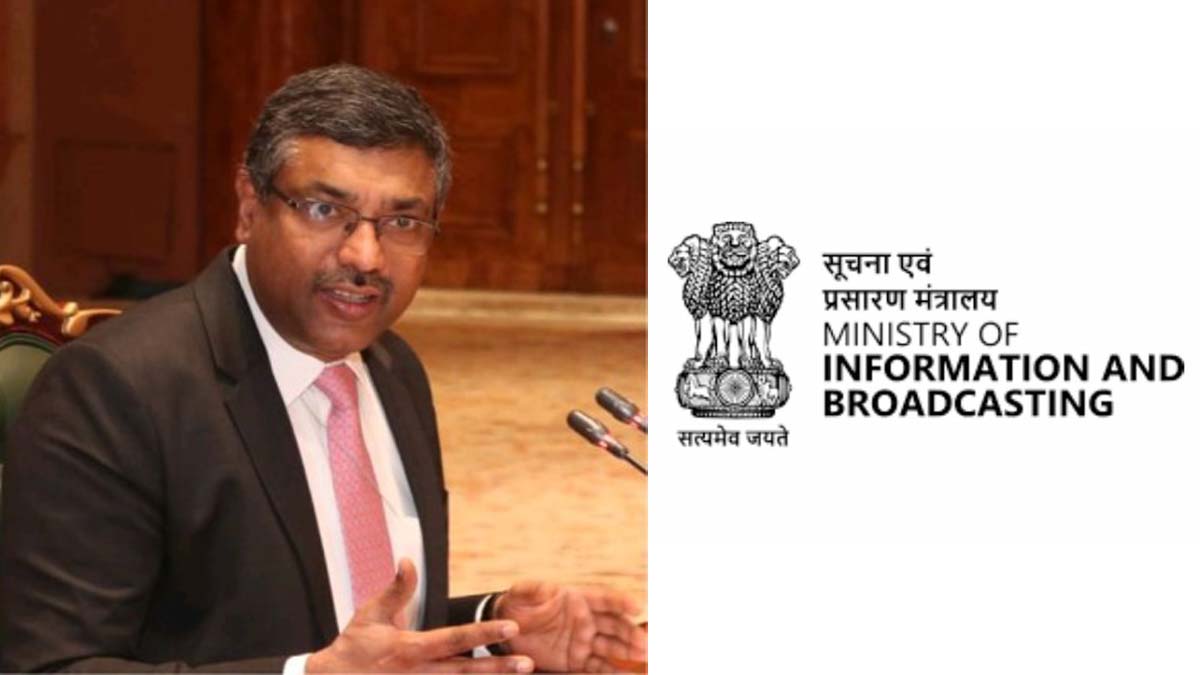
NEW DELHI: The Centre has sought to dial down concerns over its proposed amendments to the IT Rules, with Ministry of Electronics and Information Technology secretary S Krishnan asserting that the changes are intended as clarifications rather than an expansion of regulatory powers.
Pushing back against criticism from platforms and civil society, S Krishnan said the amendments “do not in any way actually give us wider powers” and are meant to remove ambiguity in how existing provisions are applied. He added that the trigger came largely from within the ecosystem, with intermediaries themselves seeking clearer guidance on compliance, takedowns and record preservation.
At the heart of the debate is the growing friction between platforms and policymakers over responsibility for user-generated content. Intermediaries have argued that they should not be treated on par with publishers, particularly when content is created and uploaded by users. Krishnan acknowledged this concern, noting that “a sharper distinction” between user content and publisher content is needed and is currently under examination.
The issue becomes more complex in enforcement scenarios. While registered publishers can be directly asked to modify or remove content, intermediaries often lack control over the original creator. “In such cases, the intermediary cannot direct those changes,” Krishnan explained, underlining the need for procedural nuance.
Another key proposal under discussion is to bring user-generated news and current affairs content within a more unified regulatory ambit, potentially under the Ministry of Information and Broadcasting. The move follows suggestions that a single authority should handle such content, regardless of whether it originates from a publisher or an individual user.
Even as the government frames the amendments as a tidy-up exercise, fault lines remain. Industry players have flagged concerns over compliance burdens, especially for smaller businesses, and questioned whether advisories could effectively become binding without explicit legislative backing. Krishnan said the government is mindful of these risks and is exploring ways to ease obligations, including possible relaxations under certain provisions.
The ministry is also considering consolidating multiple advisories and guidelines into a more structured framework, a step widely seen as addressing long-standing confusion over what platforms are expected to follow.
On takedowns, the government has reiterated that due process will remain unchanged. Krishnan stressed that actions will continue to be governed by established procedures, with reasons recorded and review mechanisms in place. He also pointed to the surge in deepfakes and synthetic media as a factor behind rising content disputes, calling it a “scale challenge” for regulators.
Interestingly, Krishnan also framed social media platforms as commercial entities rather than pure vehicles of free expression, hinting at a broader shift in regulatory thinking as platform economics come into sharper focus.
With stakeholders seeking more time and, in some cases, a rollback of the proposals, the government has kept the consultation process open-ended. Krishnan said further revisions remain on the table, signalling a willingness to adapt the draft based on feedback.
For now, the message from MeitY is clear: the rules may not be tightening in intent, but the effort to define them more clearly is well underway.






