English Entertainment
10 veterans to share Lifetime Achievement honours at Daytime Emmys

MUMBAI: Ten veteran television personalities will this year share the 2004 Lifetime Achievement Award given during the 31st Annual Daytime Emmy Awards. The National Television Academy has for the first time decided to split the award, usually conferred on one person, between the ten veteran actors who have devoted a major portion of their careers to daytime drama – Rachel Ames, John Clarke, Jeanne Cooper, Eileen Fulton, Don Hastings, Anna Lee, Ray MacDonnell, Frances Reid, Helen Wagner, and Ruth Warrick.
The presentations will be made during the Daytime Emmy Awards which are to be held on 21 May at the Radio City Music Hall in New York City. The Daytime Emmys honour excellence in all fields of daytime television production and are judged and administered in cooperation with the Academy of Television Arts and Sciences. This year’s ceremony is scheduled to be broadcast live on NBC.
The criteria for the award include the actor’s position as an original cast member of his or her current show; 35 or more years on the show; and/or significant lifetime experience in Daytime Drama, according to an official release.

Rachel Ames has been with General Hospital since the first year of the programme’s air date in 1964 and has the honour of being the longest running performer on ABC’s longest running daytime drama. John Clarke is one of the original cast members of Days of our Lives and has played the role of Mickey Horton for 38 years. Jeanne Cooper celebrated her 30th anniversary as Katherine Chancellor, the grande dame of Genoa City, on The Young and the Restless and has been nominated for five Emmy Awards as Outstanding Leading Actress. Eileen Fulton originated the role of Lisa on As The World Turns in 1960 with such aplomb that by 1965 she found herself in her own spin-off series on primetime television. In 1996, Fulton received the Silver Circle Award from the National Academy of Television Arts and Sciences. Today she continues working on World Turns and performing her cabaret act at venues across the country.
Don Hastings has played Dr Bob Hughes on As The World Turns for over 40 years. He has written scripts for both As The World Turns and Guiding Light. Prior to joining World Turns, Hastings starred as the Ranger on the children’s series Captain Video from 1949 – 1955. In 1993 he was recognized by the National Academy of Television Arts and Sciences and received the Silver Circle Award for his more than 25 years of work in television.
Anna Lee has graced General Hospital with her performance of Lila Quartermaine since 1978. She appeared in more than a dozen films in England and then came to the United States in 1939 where she worked with John Ford in the Academy Award winning How Green Was My Valley, the beginning of a 25 year, eight movie collaboration.
Ray MacDonnell joined the original cast of All My Children in 1970 and has since been playing one of Pine Valley’s most honored and upstanding characters, Dr Joe Martin. He has several Broadway and off-Broadway credits to his name and spent nearly eight years portraying Philip Capice on The Edge of Night. Frances Reid has played Alice Horton on Days of our Lives for 38 years and is the only remaining cast member. Prior to her longstanding run on television, Reid appeared in several Broadway performances including Hamlet, Cyrano de Bergerac and Twelfth Night.
Helen Wagner continues to play the longest-running continuous character in television history, appearing in As The World Turns since 1956. She has several Broadway performances to her credit and has played alongside Rex Harrison, Jeanne Pierre Aumont and Lilli Palmer. Ruth Warrick joined the cast of All My Children in 1970 and has been playing Phoebe Tyler ever since.
Art Linkletter was last year’s recipient of the National Television Academy’s Lifetime Achievement Award.




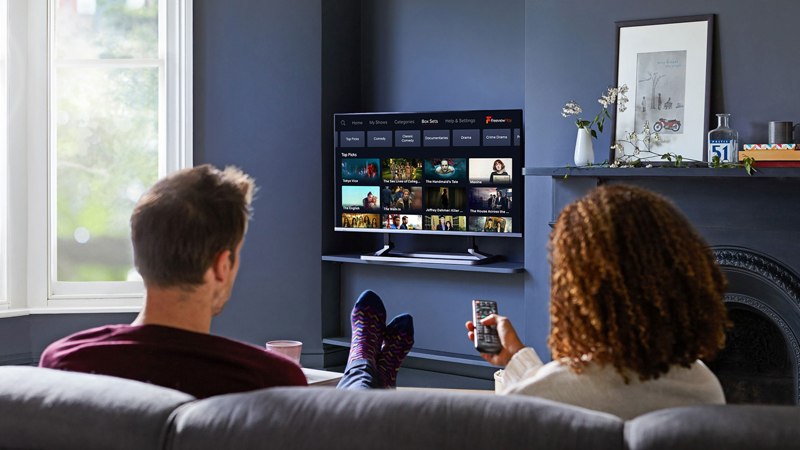
UK: The aerial is losing its grip. As broadband becomes the default way Britons watch television, the UK is edging towards a decisive, and divisive, question: should Freeview be switched off by 2034? The issue, highlighted in reporting by The Guardian, has exposed deep fault lines over access, affordability and the future of public service broadcasting.
For nearly 25 years, Freeview has delivered free-to-air television from the BBC, ITV, Channel 4 and Channel 5 to almost every corner of the country. Even now, it remains the UK’s largest TV platform, used in more than 16m homes and on around 10m main household sets. Yet the same broadcasters that built it are now pressing for its closure within eight years.
Their case rests on a structural shift in viewing. Smart TVs, superfast broadband and the Netflix-led streaming boom have pulled audiences online. Advertising economics have followed. By 2034, the number of homes using Freeview as their main TV set is forecast to fall from a peak of almost 12m in 2012 to fewer than 2m, making digital terrestrial television, or DTT, increasingly costly to sustain.
But critics say the rush to switch off risks abandoning those least able, or least willing, to move online.
“I don’t want to be choosing apps and making new accounts,” says Lynette, 80, from Kent. “It is time-consuming and irritating trying to work out where I want to be, to remember the sequence of clicks, with hieroglyphics instead of words. If I make a mistake I have to start again.”
Lynette is among nearly 100,000 people who have signed a “save Freeview” petition launched by campaign group Silver Voices. She fears the government is about to “take [Freeview] away from me and others who either don’t like, can’t afford, or can’t use online versions”.
Official figures underline the fault lines. A report commissioned by the Department for Culture, Media and Sport estimates that by 2035, 1.8m homes will still depend on Freeview. Ofcom’s analysis shows those households are more likely to be disabled, older, living alone, female, and based in the north of England, Wales, Scotland and Northern Ireland.
Freeview is owned by the public service broadcasters through Everyone TV, which also operates Freesat and the newer streaming platform Freely. After two years of review, DCMS is expected to set out its position soon, drawing on three options proposed by Ofcom: a costly upgrade of Freeview’s ageing technology; maintaining a bare-bones service with only core PSB channels; or a full switch-off during the 2030s.
The broadcasters have rallied behind the third option. They argue that 2034 is the logical cut-off, when transmission contracts with network operator Arqiva expire. By then, they say, the cost of broadcasting to a dwindling audience will far outweigh the returns from TV advertising.
Ofcom agrees a crunch point is approaching. In July, the regulator warned of a “tipping point” within the next few years, after which it will no longer be commercially viable for broadcasters to carry the costs of DTT.
Others see risks beyond economics. Questions remain over whether internet TV can reliably deliver emergency broadcasts, such as the daily Covid updates, in the way that universally available DTT can. The UK radio industry has also warned that an internet-only future for TV could push up distribution costs and force some radio stations off air if PSBs no longer share Arqiva’s mast network.
“It is a political hot potato,” says Dennis Reed, founder of Silver Voices, who says he has “dissociated” his organisation from the government’s stakeholder forum, which he believes is “heavily biased” towards streaming.
The Future TV Taskforce, representing the PSBs, counters that moving online could “close the digital divide once and for all”. “We want to be able to plan to ensure that no one is left behind,” a spokesperson says, adding that rising DTT costs could otherwise mean cuts to programme budgets.
The numbers show the scale of the challenge. Of the 1.8m Freeview-dependent homes projected for 2035, around 1.1m are expected to have broadband but not use it for TV. The remaining 700,000 are forecast to lack a broadband connection altogether.
Veterans of the analogue switch-off, completed in 2012 after 76 years, recall similar fears of “TV blackout chaos”. Around 6 per cent of households were labelled “digital refuseniks”, yet a targeted help scheme and a national campaign, fronted by a robot called Digit Al voiced by Matt Lucas, delivered a largely smooth transition.
This time, the BBC is less keen to foot the bill. Tim Davie, the outgoing director general, has said the corporation should not fund a comparable support programme for a Freeview switch-off.
Research for Sky by Oliver & Ohlbaum suggests that with early awareness campaigns and digital inclusion measures, only about 330,000 households would ultimately need hands-on help ahead of a 2034 shutdown.
Meanwhile, viewing habits continue to fragment. Audience body Barb says 7 per cent of UK households no longer own a TV set, choosing to watch on other devices. In December, YouTube overtook the BBC’s combined channels in total UK viewing across TVs, smartphones and tablets, albeit measured at a minimum of three minutes.
That shift may accelerate. YouTube has recently blocked Barb and its partner Kantar from accessing viewing session data, limiting transparency just as online platforms consolidate power.
“When the government chose British Satellite Broadcasting as the ‘winner’ in satellite TV it was Rupert Murdoch’s Sky instead that came out on top,” says a senior TV executive quoted by The Guardian. “There already is such an outsider ready to be the winner in the transition to internet TV; it is YouTube.”
Freeview’s future now hangs on a familiar British dilemma: modernise fast and risk exclusion, or protect universality and pay the price. Either way, the aerial’s days as king of the living room look numbered.






