Hindi
Single window service for film shooting to become operational shortly: Tewari

NEW DELHI: A single window service for promoting cinema tourism is all set to become operational shortly.
Speaking at the Cinemascape 2013 conclave in Mumbai today, Information and Broadcasting Minister Manish Tewari observed that India with its rich heritage and diverse geography has great potential as a destination for film shooting but the current system of multiple clearances at various levels made it an unattractive destination for filming.
“Increasingly therefore, most Indian filmmakers have gravitated towards foreign destinations for outdoor shoots. Any lost opportunity is a revenue loss for the country,” he remarked.

 |
|
India has a great potential to become a destination for film shooting but the current system of multiple clearances at various levels make it an unattractive destination for filming, says Manish Tewari
|
Tewari said the government has now decided to address the issue by establishing a single window service for granting clearances for film shootings in India. He informed that a Committee on Promotion and Facilitation of Film Production in India has been set up. It is chaired by the secretary in the ministry, with senior representatives from the Ministries of External Affairs, Home Affairs; Tourism; Culture; Railways; Civil Aviation; Defence and Department of Revenue etc.
The state governments have been asked to nominate the nodal officers for film clearance. The minister said Standard Operating Procedures are being developed to accord clearances for film shooting by domestic and foreign producers in India.
Tewari stressed on the need for a sound legal architecture for promoting cinema as a form of creative expression. While conceding that law and order is a state subject, he said film certification falls in the central domain. He said, “There is an urgent need to update laws relating to film certification and exhibition and I am happy to inform that the committee headed by Justice Mukul Mudgal has submitted its recommendation along with a model bill to replace the existing Cinematograph Act 1952.”
He said the recommendations of the committee as well as the model bill will be published on the website of the ministry to seek wider public consultation. The minister assured the film fraternity that by the middle of 2014, India would have a contemporary law to deal with cinema.
Dwelling on the issue of taxation and fiscal incentives for the film and entertainment sector, the minister called upon the industry representatives to set up a committee of experts to draw a comprehensive strategy, which could then be submitted to the Finance Minister on behalf of his ministry.
Participating in a panel discussion, noted film maker Mukesh Bhatt said 76 different permissions have to be obtained for film shooting in India, while Indian producers are given a red carpet welcome in some of the cine-tourism nations like Switzerland, New Zealand, South Africa, Thailand, Malaysia and Singapore. Bhatt acknowledged that the Ministry’s effort is a welcome first step.






Hindi
Remembering Gyan Sahay, the lens behind film, television and advertising
From a puppet rabbit selling poppadums to Hindi cinema, he framed it all.
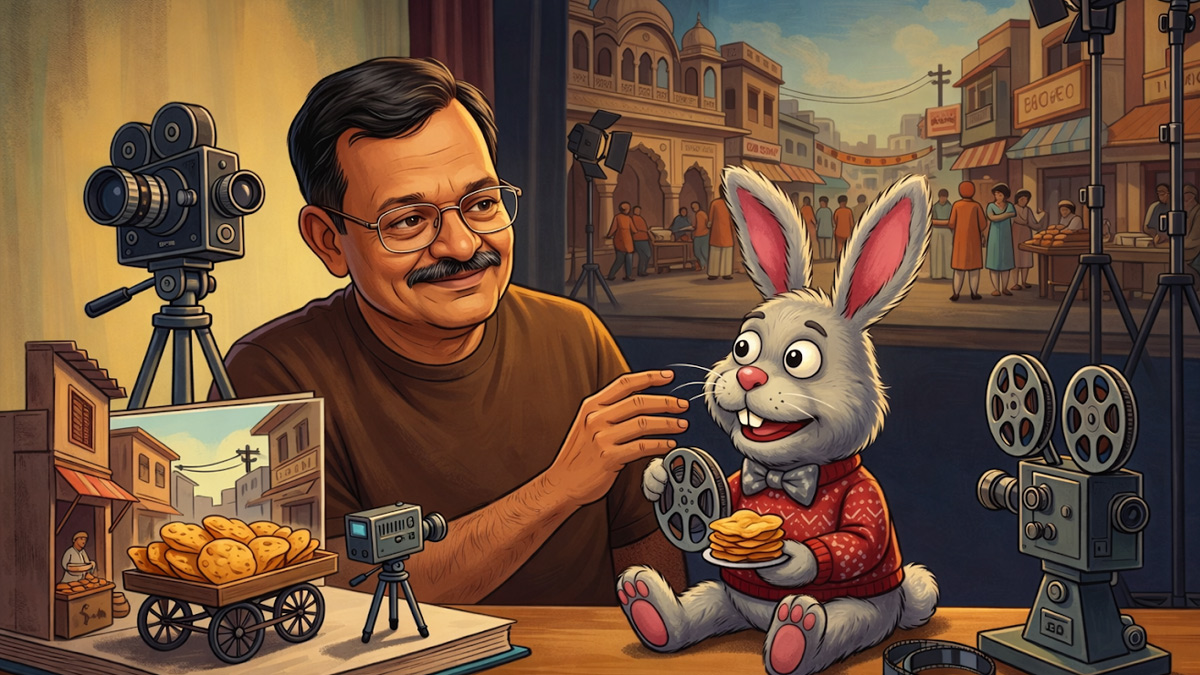
MUMBAI: There are careers, and then there are canvases. Gyan Sahay, the veteran cinematographer, director, and producer who passed away on 10 March 2026 in Mumbai, had one of the latter. Over several decades in the Indian film and television industry, he turned lenses, lights, and the occasional puppet rabbit into something approaching art.
A graduate of the Film and Television Institute of India (FTII) in Pune, Sahay built his reputation as a director of photography across a career that stretched from the early 1970s all the way to the digital age. He was the kind of craftsman who understood that a well-composed shot is not merely a technical achievement but a quiet act of storytelling.
For most Indians of a certain age, however, Sahay will forever be the man behind the rabbit. His direction of the iconic long-running television commercial for Lijjat Papad, featuring its now-legendary puppet bunny, gave the country one of its most cheerfully persistent advertising images. It was the sort of work that sneaks into the national subconscious and takes up permanent residence.
His big-screen credits as cinematographer include Anokhi Pehchan (1972), Pagli (1974), Pas de Deux (1981), and Hum Farishte Nahin (1988). In 1999, he stepped behind a different kind of camera altogether, making his directorial debut with Sar Ankhon Par, a drama that featured Vikas Bhalla and Shruti Ulfat, with a cameo by Shah Rukh Khan for good measure.
On television, Sahay was particularly prized for his command of multi-camera production setups, a skill that made him a go-to technician for large-scale shows and reality programmes. In an industry that has never been especially patient with complexity, he was the calm hand on the rig.
In later life, Sahay turned teacher. He participated regularly in masterclasses and Digi-Talks, often hosted by organisations such as Bharatiya Chitra Sadhna, sharing hard-won wisdom on cinematography, the comedy of timing in a shot, and the sweeping changes brought by the shift from celluloid to digital. He was also said to have been involved in a project concerning a biographical film on Infosys co-founder N.R. Narayana Murthy.
Tributes from the film industry poured in following the news of his passing, with colleagues remembering him as a senior cameraman who served as a rare bridge between two entirely different eras of Indian cinema. That is, perhaps, the finest thing one can say of any craftsman: he kept up, and he brought others along with him.







