Hindi
Panorama Studios Q3 standalone net at Rs 0.79 crore
Consolidated swings to Rs 1.52 crore loss in quarter; nine months profit Rs 2.82 crore.

Panorama Studios has released their latest quarterly script delivers a classic Bollywood mix standalone holds steady, but the consolidated version takes a dramatic tumble. The Mumbai film production and distribution house reported standalone net profit of Rs 0.79 crore for the quarter ended 31 December 2025, sharply down from Rs 3.05 crore in the same period last year, as revenue from operations dipped to Rs 26.75 crore from Rs 32.11 crore.
The nine-month standalone story tells a happier tale, revenue from operations surged to Rs 237.24 crore from Rs 144.45 crore, lifting net profit to Rs 10.79 crore (against Rs 15.05 crore previously). Total revenue reached Rs 243.70 crore, profit before tax stood at Rs 14.99 crore, though expenses rose operational costs Rs 205.94 crore, finance charges Rs 6.90 crore, depreciation Rs 4.37 crore.
Consolidated figures paint a tougher picture, Q3 swung to a net loss of Rs 1.52 crore versus a Rs 1.30 crore profit last year, with operations revenue at Rs 29.47 crore (down from Rs 33.88 crore). Profit before tax turned negative at Rs 1.92 crore deficit, weighed down by operational expenses Rs 23.54 crore, employee costs Rs 2.80 crore and finance Rs 2.69 crore. For the nine months, consolidated net profit came in at Rs 2.82 crore (down from Rs 8.73 crore), with operations revenue Rs 243.67 crore and total revenue Rs 249.41 crore.

Breaking it down further, profit attributable to owners in Q3 (post-acquisition) was a loss of Rs 0.40 crore, while non-controlling interests absorbed Rs 1.12 crore hit. Over nine months, owners took home Rs 6.76 crore, but non-controlling interests faced a Rs 3.93 crore loss.
The board, convening on 14 February 2026 from 4:00 pm to 6:00 pm, approved these unaudited results under SEBI norms, along with limited review reports from auditors Sigmac & Co. They also confirmed website compliance (Regulation 46(1)) and reviewed a stack of policies – insider trading, CSR, whistleblower, sexual harassment, risk management, dividend, and more, all found compliant and website-hosted.
Key footnotes, a 2:5 bonus issue on 2 December 2025 lifted paid-up equity to Rs 52.11 crore (face value Rs 2), resetting Q3 standalone EPS to Rs 0.03 basic/diluted. No interim dividend declared this quarter (last year’s final was Rs 0.20, 10%). New labour codes effective November 2025 had negligible impact, and investor complaints remained zero for the quarter.
In an industry where box-office fate swings wildly, Panorama’s numbers show resilience on one ledger and a stumble on the group stage, a reminder that even in filmdom, the real drama often unfolds in the fine print.




Hindi
Remembering Gyan Sahay, the lens behind film, television and advertising
From a puppet rabbit selling poppadums to Hindi cinema, he framed it all.
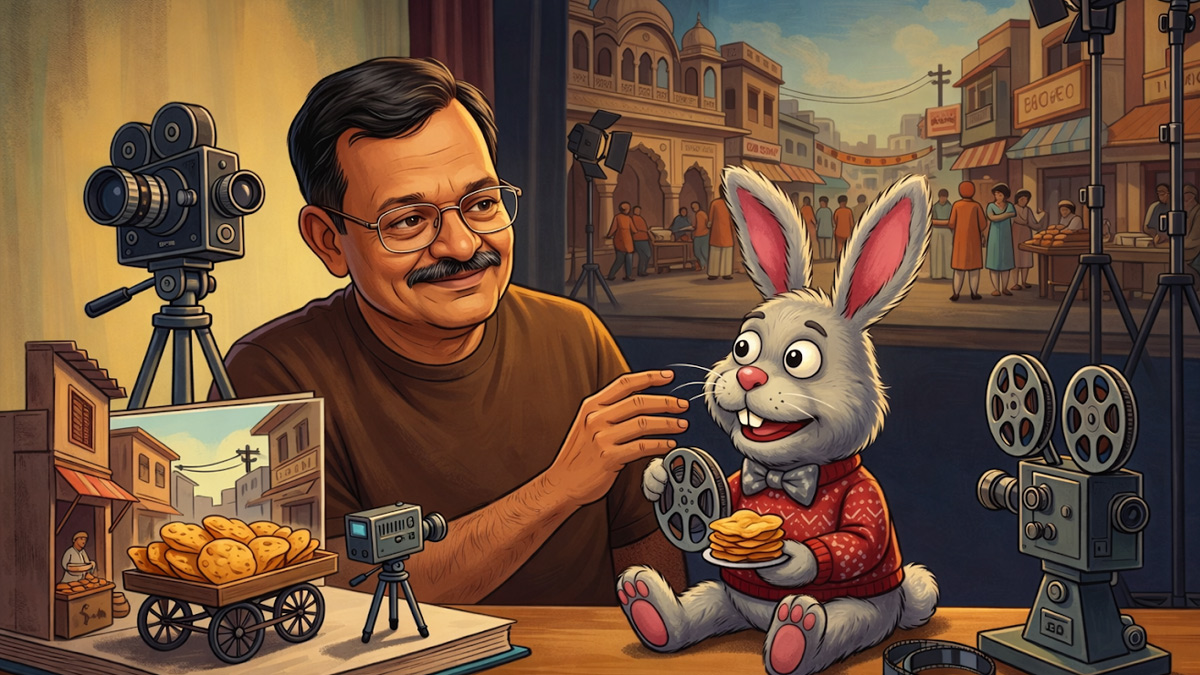
MUMBAI: There are careers, and then there are canvases. Gyan Sahay, the veteran cinematographer, director, and producer who passed away on 10 March 2026 in Mumbai, had one of the latter. Over several decades in the Indian film and television industry, he turned lenses, lights, and the occasional puppet rabbit into something approaching art.
A graduate of the Film and Television Institute of India (FTII) in Pune, Sahay built his reputation as a director of photography across a career that stretched from the early 1970s all the way to the digital age. He was the kind of craftsman who understood that a well-composed shot is not merely a technical achievement but a quiet act of storytelling.
For most Indians of a certain age, however, Sahay will forever be the man behind the rabbit. His direction of the iconic long-running television commercial for Lijjat Papad, featuring its now-legendary puppet bunny, gave the country one of its most cheerfully persistent advertising images. It was the sort of work that sneaks into the national subconscious and takes up permanent residence.
His big-screen credits as cinematographer include Anokhi Pehchan (1972), Pagli (1974), Pas de Deux (1981), and Hum Farishte Nahin (1988). In 1999, he stepped behind a different kind of camera altogether, making his directorial debut with Sar Ankhon Par, a drama that featured Vikas Bhalla and Shruti Ulfat, with a cameo by Shah Rukh Khan for good measure.
On television, Sahay was particularly prized for his command of multi-camera production setups, a skill that made him a go-to technician for large-scale shows and reality programmes. In an industry that has never been especially patient with complexity, he was the calm hand on the rig.
In later life, Sahay turned teacher. He participated regularly in masterclasses and Digi-Talks, often hosted by organisations such as Bharatiya Chitra Sadhna, sharing hard-won wisdom on cinematography, the comedy of timing in a shot, and the sweeping changes brought by the shift from celluloid to digital. He was also said to have been involved in a project concerning a biographical film on Infosys co-founder N.R. Narayana Murthy.
Tributes from the film industry poured in following the news of his passing, with colleagues remembering him as a senior cameraman who served as a rare bridge between two entirely different eras of Indian cinema. That is, perhaps, the finest thing one can say of any craftsman: he kept up, and he brought others along with him.