Hindi
Mirza Juuliet….Poor rehash

MUMBAI: Mirza Juuliet is one more spin-off on the legendary Punjabi folk tale of Mirza Sahiban, the love story of Mirza and Sahiban. A film was made on the same story in 2016 in a modern context as Mirzya. Mirza Juuliet is just another feebler attempt.
The character of Sudarshan Kumar comes back to his maternal uncle’s home where he was brought after he was orphaned. But, he runs away. His father and mother were killed by the gun wielding goons in UP. He was restless to seek revenge. Having run away from his uncle’s care, Kumar seeks a job at a dhaba where, one day, he spots the killers responsible for his parents’ death. He kills them with their own gun.
Sent to a juvenile home, one wonders how Kumar did emerges a grown up man when he is released! The film then goes on to chart a script of will.

Kumar ran away even while his uncle was bringing him home to care for him as he was an orphan and he has been in some sort of custody ever since. But, after being released, he already has a backstory about his childhood love with the character of Piaa Bajpai, his uncle’s neighbour! It seems she was his companion in school as well as life around the mohalla.
This Mirzya Sahibaan story is based in UP and, as if mandatory, involves political background. Piaa’s three brothers are gun totting bahubalis, her fiancé is the son of a politician with plans to become the next chief minister. There are family intrigues and killings.
What irks Piaa is her fiancé’s sexual advances even before marriage. In one such attempts by him, she realises that what her fiancé wants to do with her, she would rather she did it with Kumar. She realises she loves him.
Having finished with its UP style friendships, relationships, enmities and intrigues, the film now resorts to the legend of Mirza Saahiban. If you watched Mirzya, you are watching a rehash, albeit more convoluted, in this film.
The film looks dated, has a poor script, poorer execution and nothing working for it. Viewer does not care for regional politics or bahubali stories, especially the UP, Bihar kind.
Producers: Neeraj Kumar Burman, Ketan Maru, Amit Singh.
Director: Rajesh Ram Singh.
Cast: Piaa Bajpai, Darshan Kummar, Priyanshu Chatterjee and Chandan Roy Sanyal.



Hindi
Remembering Gyan Sahay, the lens behind film, television and advertising
From a puppet rabbit selling poppadums to Hindi cinema, he framed it all.
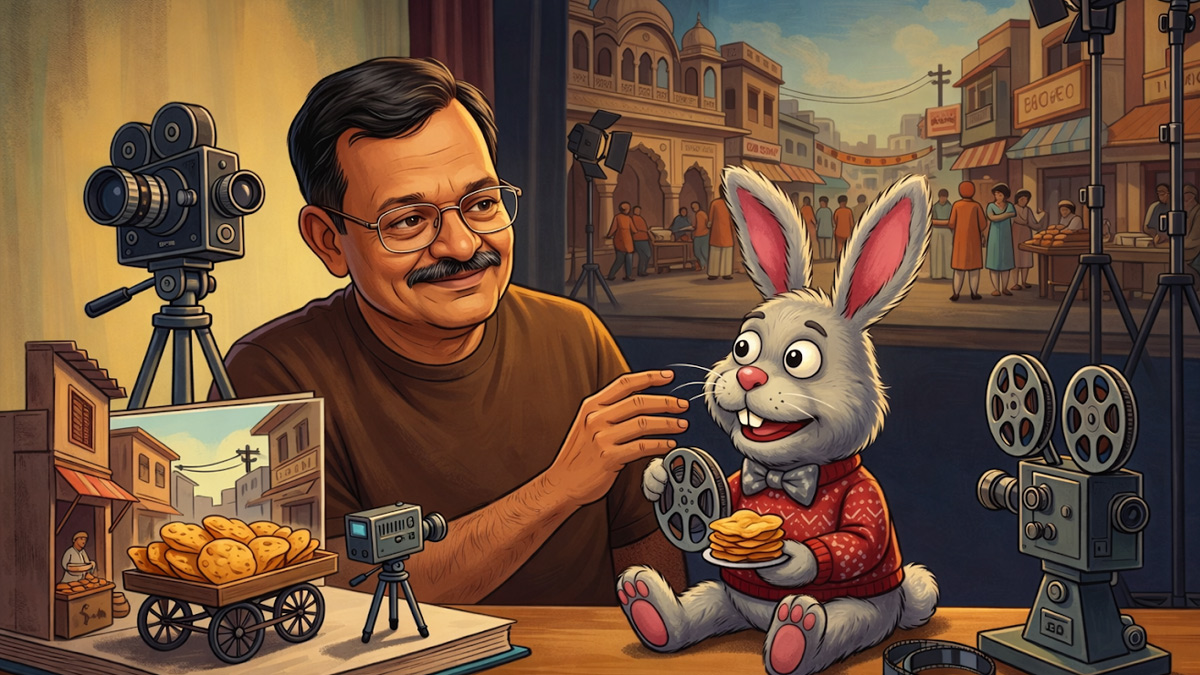
MUMBAI: There are careers, and then there are canvases. Gyan Sahay, the veteran cinematographer, director, and producer who passed away on 10 March 2026 in Mumbai, had one of the latter. Over several decades in the Indian film and television industry, he turned lenses, lights, and the occasional puppet rabbit into something approaching art.
A graduate of the Film and Television Institute of India (FTII) in Pune, Sahay built his reputation as a director of photography across a career that stretched from the early 1970s all the way to the digital age. He was the kind of craftsman who understood that a well-composed shot is not merely a technical achievement but a quiet act of storytelling.
For most Indians of a certain age, however, Sahay will forever be the man behind the rabbit. His direction of the iconic long-running television commercial for Lijjat Papad, featuring its now-legendary puppet bunny, gave the country one of its most cheerfully persistent advertising images. It was the sort of work that sneaks into the national subconscious and takes up permanent residence.
His big-screen credits as cinematographer include Anokhi Pehchan (1972), Pagli (1974), Pas de Deux (1981), and Hum Farishte Nahin (1988). In 1999, he stepped behind a different kind of camera altogether, making his directorial debut with Sar Ankhon Par, a drama that featured Vikas Bhalla and Shruti Ulfat, with a cameo by Shah Rukh Khan for good measure.
On television, Sahay was particularly prized for his command of multi-camera production setups, a skill that made him a go-to technician for large-scale shows and reality programmes. In an industry that has never been especially patient with complexity, he was the calm hand on the rig.
In later life, Sahay turned teacher. He participated regularly in masterclasses and Digi-Talks, often hosted by organisations such as Bharatiya Chitra Sadhna, sharing hard-won wisdom on cinematography, the comedy of timing in a shot, and the sweeping changes brought by the shift from celluloid to digital. He was also said to have been involved in a project concerning a biographical film on Infosys co-founder N.R. Narayana Murthy.
Tributes from the film industry poured in following the news of his passing, with colleagues remembering him as a senior cameraman who served as a rare bridge between two entirely different eras of Indian cinema. That is, perhaps, the finest thing one can say of any craftsman: he kept up, and he brought others along with him.