Hindi
Krrish Kross Konnection

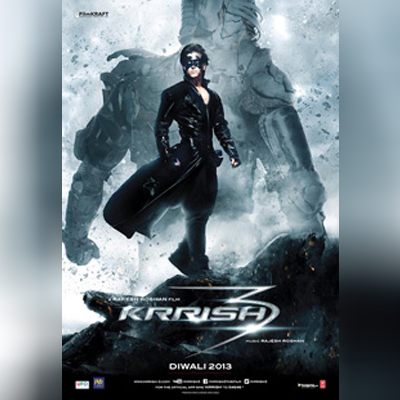
MUMBAI: With Krrish, Rakesh Roshan, the most original grass root filmmaker in Hindi cinema, turned contemporary when he blended his old school emotion-romance-music formula into a superhero film. While he maintained all the necessary ingredients of Indian cinema, he gave his hero, Hrithik Roshan, extra ordinary powers which he uses generally to help people till his situation is challenged. In Krrish 3, Roshan decides to pit his superhero, Hrithik, with another such power, a super villain, Vivek Oberoi. In the process, Roshan compromises on things he most cherished that is Indian sentiments of mother’s love, romance, music which has been his forte and a strong script. Here it is a script of convenience. For example, his hero, who could not fly, starts doing so when the villain flies!!
Producer: Rakesh Roshan.

Director: Rakesh Roshan.
Cast: Hrithik Roshan, Priyanka Chopra, Kangna Ranaut, Vivek Oberoi, Arif Zakaria, Rajpal Yadav, Rakhee Tandon.
In short, what Roshan has done is to take an age old family story and tried to fit it into a sci-fi superhero movie where, even holding the hero’s family captive by the villain is straight out of last century melodramas. The film is a virtual yellow pages of endorsements as, soon as the film starts you see a number of products being plugged.
Hrithik continues with his stint as the saviour superhero as Krrish 3 opens. But his sudden absence from his work costs him his job as he is presumed to be goldbricking. That is when the villain, Vivek decides to make his presence felt. He uses his genius for all the bad purposes. He is wheelchair bound with only his face and two index fingers functioning but which are enough to cause heavy damage or hurt someone. To cure his condition, Vivek needs a bone marrow from a person matching his own DNA. Having failed to find it in a human being, he mixes his DNA with various animals to create what he calls ‘maanvar’ a mix of maanav and janwar. To finance his experiments, he needs huge sums and to raise which he spreads dangerous viruses which kill thousands in a matter of minutes then cash in on it by marketing its antidote. He starts with an African country and looking at its success, decides to attack India next.
The deadly virus is spread using public transport, waterlines etc. The doctor who had found an antidote for the virus after learning of the plight of the African country has been killed by one of Vivek’s maanvars, Kangna Ranaut who is made mixing human and chameleon DNAs and, hence, can change forms.
When the virus spreads in Mumbai and people drop dead every minute, Hrithik Sr (father of Krrish) observes that neither he, Krrish nor Priyanka Chopra, pregnant with Krrish’s baby, have been affected by the deadly virus. He realises that the family’s superpower makes them immune and their DNA can be used to devise an antidote. That is achieved and the city is saved. This makes Oberoi a very, very angry man but also makes him think that there has to be a connection between him and Hrithik Sr since only one kind of DNA would be able to kill the virus and in some way they both must share the same DNA! It is midway through the film and the tone is set for confrontations as Oberoi wants Hrithik Sr in his custody, for in him lies his own cure.
Oberoi lets loose his variety of maanvars on Krrish household to kidnap Hrithik Sr which demonstrates their strength. The attempt is foiled by Krrish but in the process of doing so, Priyanka is hurt. Admitted to a hospital, she is whisked away from there and Kangna takes her form and takes her place. Her job is to find out how the antidote for the virus was invented. While she fails to do that and only ends up falling in love with Krrish and also imagines a love duet with him.
Hrithik Sr thinks that there is something curious about the events and feels its answer lies in Singapore where (in the earlier version of the film) Naseeruddin Shah had held him captive for long in a comatose condition. He does find out the secret behind Oberoi’s birth but is kidnapped by Oberoi’s goons. Oberoi needs his bone marrow to cure himself; because he has to be on his feet for the final showdown with Krrish.
The long drawn dual between Oberoi and Krrish, spread over instalments, starts in the former’s den and moves out to various streets, skies and rooftops with a lot of destruction and a generous dose of special effects. The film ends with a promise of the next instalment of Krrish series as Priyanka delivers a baby boy with superpowers.
Rakesh Roshan is handicapped by a solid script and an interesting story to tell. The scene where Krrish races over buildings to save an airplane with locked front wheels as he jumps on to them and forces them open to make a safe landing possible promises a lot. But, the film moves only on predictable lines. With other ingredients like romance and music missing, the director has to count mainly on special effect sequences which, of course, are very well executed. The film has just three songs of which Raghupati Raghav is well choreographed while Dil tuhi bata… has some melody element. Background score is effective. Dialogue could have provided some one-liner exchanges between good and evil but are a letdown being of mediocre kind. The film has few characters of which Hrithik excels in both the roles he plays. Kangna shines in a negative role. Priyanka has limited scope and is good. Vivek Oberoi makes an impact in certain scenes till wheelchair bound but turned into an ironman in the climax restricts him.
Krrish 3 does not in any way better its earlier version, Krrish; on the contrary it disappoints on some counts. However, due to solo Diwali release and a long gap for a Hrithik film to hit the screens will benefit as the film’s brand equity assures at least one time view for most cine-goers.








In a music industry that often rewards speed, spectacle, and instant recall, Navjot Ahuja’s journey feels refreshingly different. His story is not built on noise. It is built on patience, discipline, emotional honesty, and a quiet commitment to becoming better with every passing year. After 14 years of struggle, learning, performing, and writing, Navjot stands today as an artist whose success has not changed his centre. If anything, it has only made his purpose clearer.
For Navjot, music has never been about chasing fame alone. It has always been about expression. It is about writing more truthfully, singing more skillfully, understanding himself more deeply, and becoming a kinder human being in the process. That rare clarity is what gives his journey its beauty.
Where It All Began: A Writer Before a Singer
Indian singer and songwriter Navjot Ahuja’s musical journey began in the most familiar of places: school assemblies. But even then, what was growing inside him was not only the desire to sing. It was the need to write.
Long before he saw himself as a performer, he had already discovered the emotional release that writing offered him. For Navjot, words became the first true channel for feeling. Songwriting came before singing because writing was the only way he could let emotions flow through him fully. That inner pull shaped his artistic identity early on.
Like many young musicians, he sharpened his craft by creating renditions of popular songs.
Those experiments became his training ground. But the turning point came in 2012, when he wrote his first original song. That moment did not just mark the beginning of songwriting. It marked the beginning of self-definition.
A Calling He Did Not Chase, But Accepted
What makes the latest Indian singer-songwriter Navjot’s story especially compelling is the way he describes his relationship with music. He does not frame it as a career he aggressively pursued. In his own understanding, music was not something he chose. It was something that chose him.
There was a time when he imagined a very different future for himself. He wanted to become a successful engineer, like many young people shaped by ambition and conventional expectations. But life had a different script waiting for him. During his college years, around 2021, music entered his life professionally and began taking a firmer shape.
That shift was not driven by image-building or industry ambition. It came from acceptance. Navjot embraced the fact that music had claimed him in a way no other path could. That sense of surrender continues to define the artist he is today.
An Artist Guided by Instinct, Not Influence
Unlike many singers who speak openly about idols, icons, and musical role models, Navjot’s creative world is built differently. He does not believe his music comes from imitation or inherited influence. He listens inward.
He has never considered himself shaped by ideals in the traditional sense. In fact, he admits that he does not particularly enjoy listening to songs, especially his own. His decisions as a songwriter and singer come from instinct. He writes what feels right. He trusts what his inner voice tells him. He positions his music according to what he honestly believes in, not what trends demand.
That creative independence gives his work a distinct emotional sincerity. His songs do not feel calculated. They feel alive.
The Long Years of Invisible Struggle

Every artist carries a chapter of struggle, and Navjot’s was long, demanding, and deeply formative. One of the biggest challenges he faced was building continuity as the best new indian singer songwriter in an era where musical collaboration is increasingly fluid.
For emerging singers, especially those trying to build with a band, consistency can be difficult. Instrumentalists today have more opportunities than ever to freelance and perform with multiple artists. While that growth is positive and well deserved, it can make things harder for singers who are still trying to establish a steady team and sound around their work.
For Navjot, one of the most difficult phases came during 2021 and 2022, when he was doing club shows almost every day. It was a period of relentless performance, but not always personal fulfillment. He was largely singing covers because clubs were not open to original songs that audiences did not yet know.
For a new Indian singer and songwriter, that can be a painful compromise. To perform constantly and still not have the freedom to share your own voice requires not just resilience, but restraint.
“Khat” and the Grace of Staying Unchanged
After 14 years of effort, Navjot’s new love song Khat became a defining milestone. Professionally, he acknowledges that the song changed how society viewed him as a musician. It strengthened his place in the public eye and altered his standing in meaningful ways.
Yet personally, he remains unchanged.
That is perhaps the most striking part of his story. Navjot says his routine is still the same. His calm is still the same. His writing process is still the same. He does not want success or failure to interfere with the purity of his art. For him, emotional detachment from public outcomes is essential because the moment an artist becomes too attached to validation, the writing begins to shift.
His joy comes not from numbers, but from the attempt. If he has tried to improve his skill today, if he has written his heart out more honestly than before, then he is at peace.
Growth, Not Glory, Remains the Real Goal
Even now, Navjot is not consumed by labels such as singles artist, performer, or digital success story. His focus remains deeply personal. He wants to sing better. He wants to play instruments better. He wants to understand himself more. And he wants to become a kinder person.
That is what makes Navjot Ahuja’s journey so moving. It is not simply the story of a musician finding recognition. It is the story of an artist who continues to grow inward, even as the world begins to look outward at him. In an age obsessed with applause, Navjot reminds us that the most meaningful success often begins in silence, honesty, and the courage to remain true to oneself.






