Hindi
‘Action Jackson’…Twin torture


MUMBAI: The trend of action has crossed the satiation point and has reached the point of immediate return. Time to stop these super human action scenes, where just one blow can cause a guy to fall or make a speeding car do summersaults. This film is one more addition to a single screen theme made for multiplexes where, only Salman Khan has been able to carry them through.
Ajay Devgn is a Superman in his both roles, that of Vishi and AJ, though he does not wear a cape with his underwear outside. While Ajay in India is a small time crook partnered by his sidekick, Kunaal Roy Kapoor. Sonakshi Sinha is an unlucky girl whose luck changes when she opens a mall dressing room door and happens to watch Devgn in his birthday suit. After that, things stop going wrong with her. She thinks her luck has changed after watching Devgn’s lower body sans pants or underclothes. The makers’ idea of comedy is that, all her four female friends also want to watch Devgn to change their luck. The humour is totally lost on the viewer.
For most of the first half, the Devgn in India monopolises the screen, generally romancing Sonakshi and doing nothing important. He is supposed to be a mandavli king in Mumbai, the guy who is an unofficial arbitrator of disputes who is available at a price. You are shown him hitting someor continuity of events.

|
Producers: Gordhan Tanwani, Sunil Lulla. Director: Prabhu Dheva. Cast: Ajay Devgn, Sonakshi Sinha, Yami Gautam, Manasni Mamgai, Kunaal Roy Kapoor. |

As if one Devgn was not trying your nerves with his personal video games where he destroys innumerable uniformed red suit guys armed with guns and Ninja-to, the Ninja swords, the other can do even better. He is the trouble-shooter cum shooter for an Indian don operating from Bangkok. The don here is a caricature, probably drawn by a cartoonist, inspired by the villains from Farz (1967) or Dr No (1962) or Shaan (1980).
The villain is sinister, his sister, Manasvi Mamgai, is even more so. She displays a bust line any man would be attracted to which the Bangkok Ajay Devgn is not for whom she has developed the hots. Because this lad is committed to the love of his life, Yami Gautam. Manasvi wants Devgn at all costs and orders to kill Yami who is already pregnant though not married to Devgn yet. But, Yami has this strength to survive all assaults which could prove fatal for any normal being.
As if the first part was not bad enough, the two Devgns meet to share the burden of the second half. And, if the film was not going anywhere so far, now it does; it goes haywire! You don’t know which Devgn is which and you are also convinced, nor does the director!
This film has no script nor a definite track. The direction by Prabhu Dheva is pits, most amateur. Actually, the film is grossly directionless; there is no continuity from a sequence to another one. Even choreography, which is Prabhu’s forte, is pathetic. As for performances, Devgn is poor, Sonakshi is rank bad, Yami tries to match her and the villain is comic. The only good portrayal comes from Manasvi, playing a maniacal lover. Kunaal Roy Kapoor is a liability.
The film is poor on all counts including music, continuity, editing, photography and dialogue.
Action Jackson is the worst film of the year and may even win the worst film of the decade status!
‘Bhopal: A Prayer For Rain’…Miniaturised version?
|
Producers: Sumanto Roy, Ravi Walia. Director: Ravi Kumar. Cast: Rajpal Yadav, Tannishtha Chatterjee, Martin Sheen, Mischa Barton, Kal Penn, Fagun Ivy Thakrar, Manoj Joshi, Joy Sengupta, Martin Brambach, David Brooks. |

December 2014 marks 30 years since the world’s worst disaster, The Bhopal Gas Leak tragedy took place. The incident is reported to have killed over 3500 people, blinded many, led to deformed new-borns and has survivors who live with handicaps and all suffered because of the lethal MIC (Methyl Isocyanate) gas leak from the pesticide maker giant Union Carbide Plant in Bhopal.
To make it a human interest story and avoid documentary approach, the film involves a settlement of poor labourers who have built their jhoogi jhopdis around the Carbide plant because most of them work for the company. The film keeps in centre the protagonist, Raghuvir Yadav, and his family to make it a story instead of a documentary.
Yadav gets his first entry into the Carbide plant as a sweeper and soon graduates to look after the safety division. Now, he controls the release of MIC, its temperatures and controls he knows nothing about. This responsibility is thanks to the death of his neighbour who died because of a cyanide leak on his body.
Meanwhile, the manager at the plant is worried about the plant closing down due to a famine which has left the Carbide product unsold and gathering at the factory following failure of crops.
There are a couple of guys who are aware of the risk factor of the Carbide unit; one of them is the company’s Safety Officer while the other is the publisher of the local rag, a two page newspaper, Motwani, played by Kal Penn.
It is the day Yadav is getting his 17 year old sister married in his basti next to the plant and the negligence and cutting corners leads to the lethal MIC gas leak where thousands die.
The film has excellent performances by Yadav, Tanishta and, of course, Martin Sheen, who plays Warren Anderson, the CEO of the plant at that time.
Bhopal: A Prayer For Rain is just about 29 years too late to touch today’s generation. Also, gas tragedy is trivialised with limited footage at the end.
‘Sulemani Keeda’….Of the makers!
|
Producers: Various. Director: Amit V Masurkar. Cast: Naveen Kasturia, Mayank Tiwari, Aditi Vasudev, Karan Mirchandani, Krishna Singh Bisht, Rukshana Tabassum, Razzak Khan |

Sulemani Keeda, I suppose, is a Mumbai slang for someone with adventurous instincts which, more often than not, are sure to backfire on him. As you go through this 90 minute film, you realize that almost half a dozen producers who invested their bit in the film, can claim to have the same Sulemani Keeda. The film has been in the tins for over two years and was also screened at the MAMI a couple of years back.
It is the story of two friends, Naveen Kasturia and Mayank Tewari, who are aspiring film writers and are struggling to get a foothold in the film industry. Most of the time, they don’t even get an entry into an actor’s or producers’ office who, otherwise, are a household name. They live on rent together and as they can’t always pay rent on time, they are exploited piecemeal by the landlord’s son, Krishna Singh Bisht. And, he too writes couplets and aspires to be part of this duo.
The pair gets to showcase their talent only among a bunch of friends and after one such occasion, Mayank is attracted to a girl, Aditi Vasudev, who is scheduled to leave for the US for further studies. However, Mayank and Aditi embark on a Mumbai Darshan mission over next few days and, as it happens in all film stories, it creates a divide between Mayank and Naveen. Mayank is totally distracted from his aim in life as he realises he has fallen in love with Aditi.
Aditi is ready to take off when Naveen urges Mayank to go stop her if he really loves her. But, as it invariably happens in all the films, Aditi is determined to go ahead with her plans. No last minute getting off plane scene here.
The friends have parted ways, Mayank takes off to Ladakh to pen his script while Naveen blends with the mainstream and becomes successful in film writing.
Sulemani Keeda falls in no definite genre and, hence, ambles around most of the time. The film’s treatment reminds one of 1970s NFDC films, slow moving and not going anywhere. There are some wise words of advice for aspirants through the duo by Mahesh Bhatt and Anil Sharma. Direction is fair. Naveen and Mayank put in a good performances. Aditi passes off a permanent pout for acting.
Despite 1970s touch, this is described as ‘Contemporary film making’ for want of definite genre slot. Not that a money-spending cine-goer cares.






Hindi
Remembering Gyan Sahay, the lens behind film, television and advertising
From a puppet rabbit selling poppadums to Hindi cinema, he framed it all.
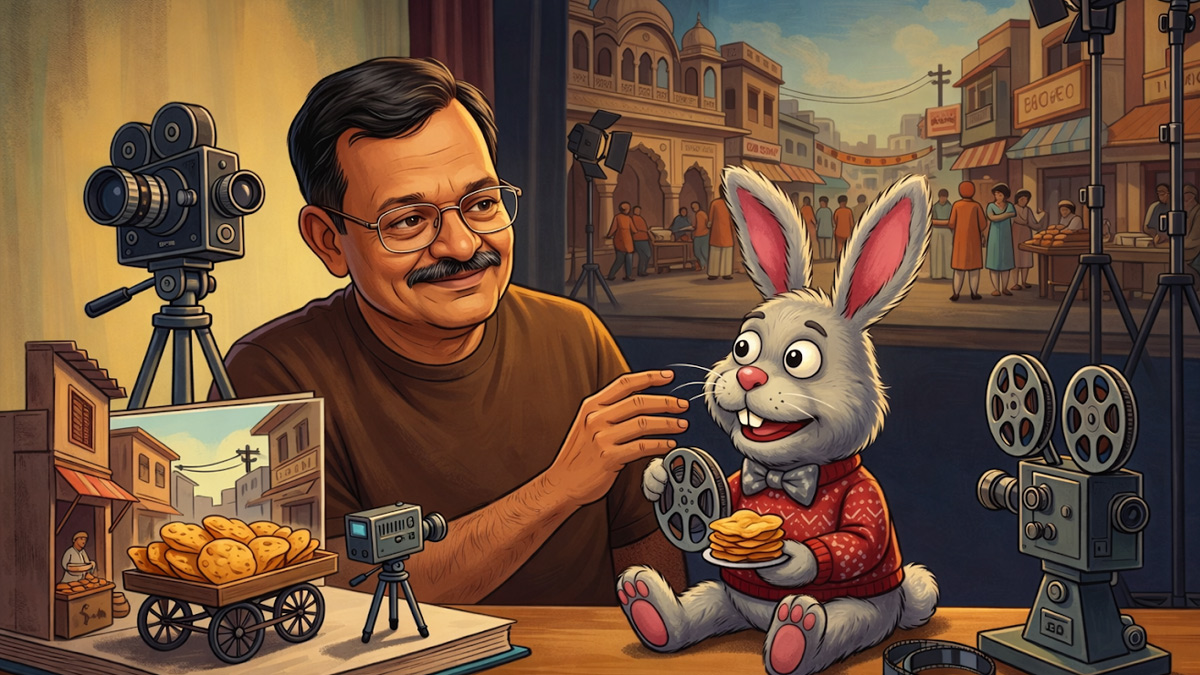
MUMBAI: There are careers, and then there are canvases. Gyan Sahay, the veteran cinematographer, director, and producer who passed away on 10 March 2026 in Mumbai, had one of the latter. Over several decades in the Indian film and television industry, he turned lenses, lights, and the occasional puppet rabbit into something approaching art.
A graduate of the Film and Television Institute of India (FTII) in Pune, Sahay built his reputation as a director of photography across a career that stretched from the early 1970s all the way to the digital age. He was the kind of craftsman who understood that a well-composed shot is not merely a technical achievement but a quiet act of storytelling.
For most Indians of a certain age, however, Sahay will forever be the man behind the rabbit. His direction of the iconic long-running television commercial for Lijjat Papad, featuring its now-legendary puppet bunny, gave the country one of its most cheerfully persistent advertising images. It was the sort of work that sneaks into the national subconscious and takes up permanent residence.
His big-screen credits as cinematographer include Anokhi Pehchan (1972), Pagli (1974), Pas de Deux (1981), and Hum Farishte Nahin (1988). In 1999, he stepped behind a different kind of camera altogether, making his directorial debut with Sar Ankhon Par, a drama that featured Vikas Bhalla and Shruti Ulfat, with a cameo by Shah Rukh Khan for good measure.
On television, Sahay was particularly prized for his command of multi-camera production setups, a skill that made him a go-to technician for large-scale shows and reality programmes. In an industry that has never been especially patient with complexity, he was the calm hand on the rig.
In later life, Sahay turned teacher. He participated regularly in masterclasses and Digi-Talks, often hosted by organisations such as Bharatiya Chitra Sadhna, sharing hard-won wisdom on cinematography, the comedy of timing in a shot, and the sweeping changes brought by the shift from celluloid to digital. He was also said to have been involved in a project concerning a biographical film on Infosys co-founder N.R. Narayana Murthy.
Tributes from the film industry poured in following the news of his passing, with colleagues remembering him as a senior cameraman who served as a rare bridge between two entirely different eras of Indian cinema. That is, perhaps, the finest thing one can say of any craftsman: he kept up, and he brought others along with him.