Brands
Zee TV’s ‘Ganga Mai Ki Betiyan’ celebrates strength of single motherhood


MUMBAI: Holding her daughters’ hands, she’s walking into prime time with courage, grit and grace. Zee TV is set to launch its new drama, Ganga Mai Ki Betiyan, a heartwarming tale of a single mother who rebuilds her life from scratch and raises her daughters to stand tall against society’s taunts.
Adapted from Zee Kannada’s hit show Puttakana Makkalu, the Hindi remake shines a light on women’s resilience in the face of abandonment and stigma. Set in the culturally vibrant backdrop of Varanasi, the series is produced by Ravie Dubey and Sargun Mehta’s Dreamiyata Dramaa.
The show follows Ganga Mai (played by Shubhangi Latkar), who raises her daughters Sneha (Amandeep Sidhu), Sahana (Srishti Jain) and Soni (Vaishnavi Prajapati) with dignity, self-respect and an unbreakable spirit. Each daughter brings a unique flavour to the story: Sneha, the fiery dreamer aiming to be a district collector; Sahana, the nurturer whose cooking and wisdom hold the family together; and Soni, the playful yet mature spark who keeps optimism alive at home.

Adding another layer to the drama is Sheizaan Khan as Siddhant, a feared yet soft-hearted moneylender whose life changes when he crosses paths with Sneha.
To mark the launch, Zee TV hosted an experiential set tour in Chandigarh, where media were treated to a soulful meal at the family’s on-screen dhaba, mirroring the warmth and simplicity of the characters.
Zee TV, chief channel officer, Mangesh Kulkarni said, “With shows like Saru, Tumm Se Tumm Tak, Chhoriyan Chali Gaon, and now Ganga Mai Ki Betiyan, we are bringing forth stories that are rooted in culture yet contemporary in their outlook.”
Zee Entertainment, chief content officer, Raghavendra Hunsur added, “What moves us most is not just Ganga Mai’s struggle, but the everyday grace with which she turns hardship into hope.”
For lead actor Shubhangi Latkar, the role has been transformative. “Ganga Mai is a symbol of every woman who chooses dignity over despair. Portraying her has been an emotionally enriching journey for me,” she added.
With its message that daughters are never a burden but a source of pride, Ganga Mai Ki Betiyan promises to strike an emotional chord with families across India.






Brands
Samsung certifies 1,000 Maharashtra students in AI and coding
The South Korean electronics giant marks its first large-scale skilling push in the state, with women making up nearly half the national programme’s enrolment
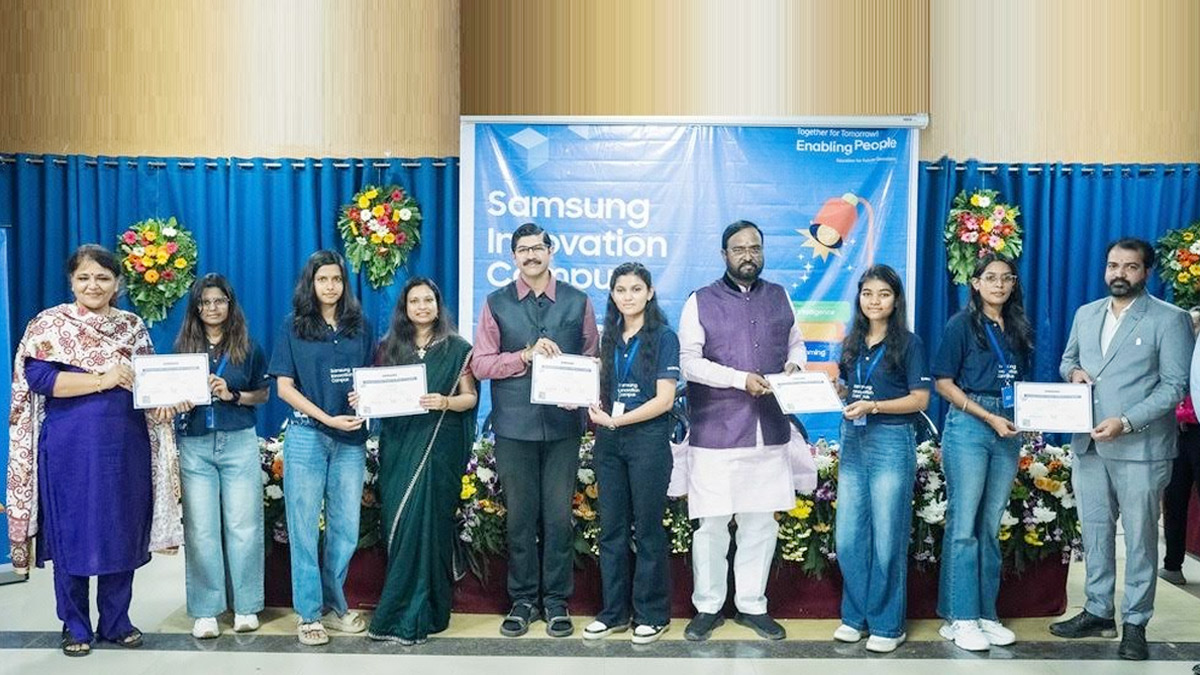
PUNE: Samsung has put 1,000 students in Maharashtra through a certified training programme in artificial intelligence and coding, the largest such drive the South Korean electronics company has run in the state and a signal that corporate India’s skilling ambitions are moving well beyond the boardroom brochure.
The certifications were awarded under Samsung Innovation Campus (SIC), the company’s flagship corporate social responsibility programme, which launched in India in 2022 with the stated aim of democratising access to future-technology education. The 1,000 graduates were drawn from four institutions: 127 from Savitribai Phule Pune University, 373 from Pimpri Chinchwad University, 250 from D.Y. Patil University’s Ramrao Adik Institute of Technology and 250 from Anjuman-I-Islam’s Kalsekar Technical Campus. All completed training in either AI or coding and programming, the two disciplines Samsung has identified as the critical pillars of the digital economy.
The programme does not stop at technical training. Soft-skills development and career-readiness modules are baked into the curriculum, a deliberate attempt to close the gap between what universities teach and what employers actually want.
“India’s digital growth story will ultimately be shaped by the quality of its talent pipeline,” said Shubham Mukherjee, head of CSR and corporate communications at Samsung Southwest Asia. “As technologies like AI move from the periphery to the core of industries, skilling must evolve from basic training to building real-world capability. This milestone in Maharashtra reflects how industry and academia can come together to create a future-ready workforce that is both globally competitive and locally relevant.”
The Maharashtra drive sits within a rapidly scaling national effort. Samsung Innovation Campus trained 20,000 young people across India in 2025, hitting its stated target for the year. Women account for 48 per cent of national enrolments, a figure the company cites as evidence of its push for an inclusive technology ecosystem. The programme is implemented in partnership with the Electronics Sector Skills Council of India and the Telecom Sector Skill Council.
Samsung, which is marking 30 years in India this year, runs SIC alongside two other initiatives, Samsung Solve for Tomorrow and Samsung DOST, as part of a broader effort to build what it calls a generation of innovators with both the technical depth and the problem-solving mindset to thrive in a fast-moving digital world.
A thousand certified students is a tidy headline. Whether they find jobs that match their new skills is the harder question, and the one that will ultimately determine whether corporate skilling programmes like this one are genuine pipelines or well-photographed gestures.






