MAM
Zee TV highest gainer in week 6 of 2013; Star Plus retains top spot

MUMBAI: Zee TV was the only Hindi GEC with significant gains in week six of 2013 at 243 gross rating points (GRPs), allowing it to narrow the gap with leader channel Star Plus.
Zee TV added 29 GRPs to week five’s 214 GRPs and maintained its No. 2 position in the Hindi general entertainment channel hierarchy. The jump is the combined result of all the regular shows (weekend and weekdays) gaining or maintaining the ratings and a fair performance of the weekend properties — English Vinglish 1.1 GRP for 12 noon airing and 1.6 GRP for 8.00 pm airing; Fear Files 1.2 GRP on Sunday and 2.3 on Saturday; and the Valentines Event that raked in 3.2 GRPs.
Star India’s Hindi GEC Star Plus continued to lead the ratings race at 264 GRPs, though it did suffer a loss of 17 GRPs from the trailing week.

There has been no change in the pecking order of GECs since last week as Colors takes the third spot with 206 GRPs (week five – 210 GRPs).
Sony Entertainment Television gained one GRP to reach 160 GRPs and maintained its position at number four, according to TAM data (HSM including 5 new LC1 markets, C&S, 4+) for the week ended 9 February, sourced from a Hindi GEC.
While last week saw Star Plus as a big leader with a lead of 67 GRPs, this week the gap between number one and number two narrowed to 21 GRPs. Consequently, the gap between the second and third place increased from four GRPs in week five to 37 GRPs in week six.
Zee gained seven GRPs for the weekday primetime slot (7.00 pm to 11.30 pm) to collect a total of 115 GRPs from this band. In the weekday afternoon slot too, Zee was the highest gainer (four GRPs) at 27 GRPs as was the case in the weekend primetime slot where it gained four GRPs to collect 36 GRPs in all.
Star Plus gained six GRPs in the weekday primetime slot (total 119 GRPs), two GRPs in the weekday afternoon slot (total 24 GRPS) and lost 16 GRPs in the weekend primetime slot (total 39 GRPs).
In the case of Colors, the channel lost 12 GRPs in the weekday primetime slot (total 98), gained two GRPs in the weekday afternoon slot (total 18 GRPs) and gained 11 GRPs in the weekend primetime slot (total 40 GRPs).
Sony remained more or less stable from week five to week six shedding just three GRPs in the weekday primetime band (total 45), gaining one GRP (total 13 GRP) and losing two GRPs (total 40 GRPs) in the weekday afternoon and weekend primetime segments respectively.
Zee’s show Sapne Suhane Ladakpan KE was the highest rated show for week six at 4.3 TVR (3.8 TVR), followed very closely by Star Plus’ Diya Aur Bati Hum at 4.2 TVR (4.3 TVR). Star’s Saathiya Saath Nibhaana raked in 3.6 TVR (3.9 TVR) while Zee’s daily soaps Qubool Hai (3.1 TVR) and Pavitra Rishta (3.3 TVR) both got ratings of 3.3 TVR. CID continued to be Sony’s top performing show with 2.8 TVR, unchanged from week five. Star Plus’ dancing reality show Nach Baliye raked in 3.0 TVR (3.5 TVR) while Sasural Simmar ka on Colors earned 3.1 TVR (4.0 TVR).
Star India’s second GEC Life OK gained three GRPs to reach 124 GRPs in week six (week five – 121 GRP) while Sab TV lost two GRPs to end up at 132 GRPs in week six.






MAM
Lego brings Messi, Ronaldo, Mbappé, Vinicius together
Campaign clocks 314 million views ahead of FIFA World Cup 2026 buzz.
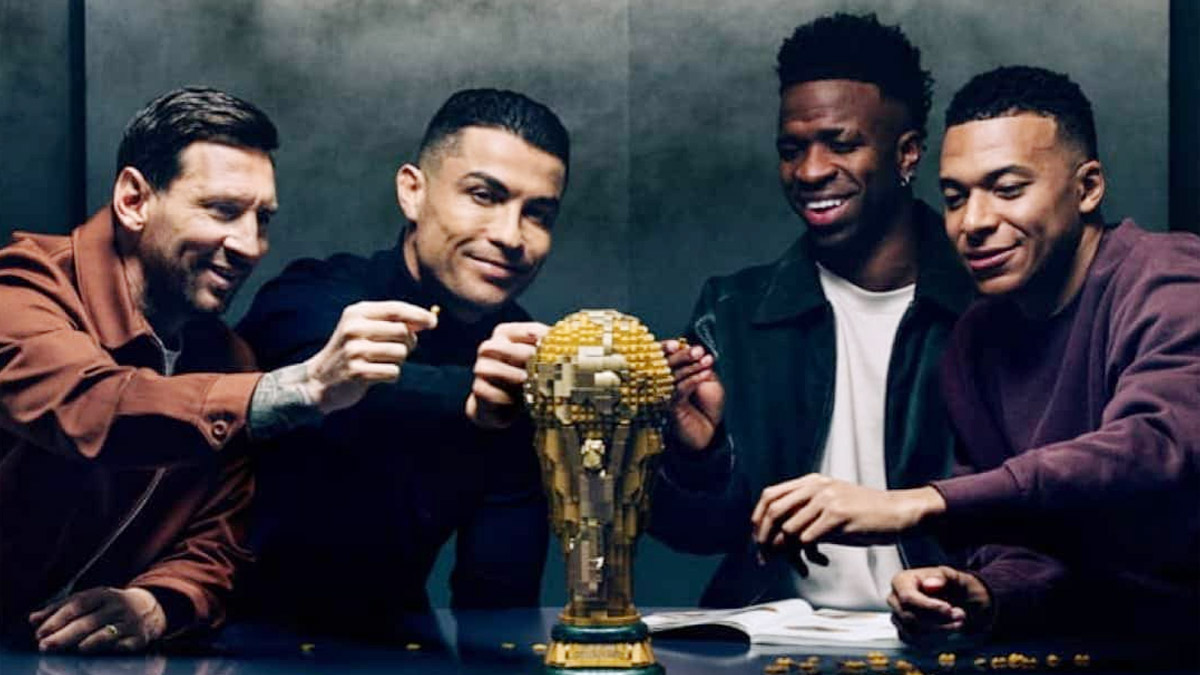
MUMBAI: Four legends, one frame and not a single tackle in sight. Lego has pulled off a crossover few thought possible, uniting Lionel Messi, Cristiano Ronaldo, Kylian Mbappé and Vinícius Júnior in a single campaign ahead of the FIFA World Cup 2026 only this time, they’re building dreams brick by brick.
Titled “Everyone wants a piece”, the campaign features the quartet assembling a Lego version of the World Cup trophy, before placing miniature versions of themselves atop it, a playful nod to football’s ultimate prize. Shared widely across social media, the ad carries a pointed disclaimer: it is not AI-generated, a subtle but telling signal in an era where even reality is often questioned.
The numbers tell their own story. The campaign has already crossed 314 million views on Instagram across the players’ accounts, with fans hailing it as a rare, almost nostalgic moment particularly for the reunion of Messi and Ronaldo, whose last shared campaign ahead of the 2022 World Cup became one of the platform’s most-liked posts.
Beyond the film, Lego is extending the play with exclusive, player-themed sets tied to each of the four stars, part of a broader football-led programme designed to ride the global momentum building towards 2026. The idea, as echoed by the players themselves, leans into the parallels between football and play experimentation, creativity, failure, and triumph.
Messi described the sets as a way to bring on-pitch moments into an imaginative, hands-on world, while Ronaldo called the transformation into a Lego figure a rare honour, blending sport with storytelling. Vinícius, meanwhile, struck a more personal note, recalling childhood moments of building with Lego and framing creativity as a universal language that transcends borders.
The timing is no accident. With the 2026 World Cup set to run from June 11 to July 19 across the United States, Canada and Mexico, and featuring an expanded 48-team format, global anticipation is already building. Argentina, led by Messi, will enter as defending champions, adding another layer of intrigue.
For Lego, the campaign does more than celebrate football, it taps into its mythology. Because when icons become figurines and rivalries turn into play, the beautiful game finds a new kind of pitch. one built, quite literally, by hand.






