MAM
WondrLab Network acquires Polish agency Webtalk, Launches European Hub


Mumbai: Wondrlab digital network, announces the acquisition of WebTalk. This strategic milestone marks Wondrlab’s fifth acquisition and its first international venture since its inception in 2020. The company has also announced the appointment of Jarek Ziebinski as chairman of the Supervisory Board of its European Hub in Poland.
Founded in 2010, WebTalk, led by Michal Dunin, is a results-driven B2C digital marketing agency known for delivering outstanding outcomes in the Central and Eastern European (CEE) region. With a decade of experience, WebTalk, comprising 100 specialists, serves 40 clients including Kia Motors, BNP Paribas, Heinz, Bosch, Volkswagen, Total, and Siemens among others, in Poland, CEE, and central Asia. It offers a comprehensive suite of services including digital strategy, social media management, content creation, paid media oversight, and innovative e-commerce support. Going forward Michal Dunin will be responsible for managing the newly created Wondrlab’s European Hub in Poland.
Jarek Zielinski, a renowned figure in the global advertising market comes with over three decades of experience in marketing, media, and advertising. His illustrious career includes significant roles at Leo Burnett, where he managed the agency’s network in Central and Eastern Europe and served as CEO and chairman of Leo Burnett Asia-Pacific. Jarek’s role as Global CEO of Publicis One at Publicis Groupe further underscores his proficiency in change management and large-scale business transformation.

With the launch of Wondrlab’s European hub, clients gain immediate access to services, products, and platforms across key pillars: Digital Video, Content & Community, Digital Media & Data, and Digital Business Transformation. This strategic move aligns with Wondrlab’s commitment to holistic solutions and global brand offshoring, integrating e-commerce, production, and content management, paving the way for expansion into hubs like Vietnam and the Middle East.
On the acquisition and Jarek’s appointment, Wondrlab Network founder & CEO Saurabh Varma said, “Historically, we have witnessed global companies acquiring Indian companies. The moment has arrived for Indian companies to acquire global companies. This is our time. Today signifies a crucial milestone in our journey towards establishing a world-class network that sets global standards from India. This is our fifth acquisition and in 36-48 months we’ll be looking at 21 more acquisitions. Our journey in Europe is just beginning. This is one of the many acquisitions we’ll be making in Poland. The way we are thinking about our global network is a function of not just products and services but also building strategic hubs based out of India, Poland, the Middle East, and Vietnam. Warsaw is one of the critical pillars toward building our global organization, and we couldn’t have found a better partner in Jarek and Michal to drive our global ambition. The WebTalk team will be deploying a lot of the tech created in India to create magic for clients in Poland, CEE, and across the world. It is an absolute pleasure that Jarek has chosen to be a part of Wondrlab’s growth journey. Jarek has been my mentor, boss, and friend for more than 15
years and I possibly could not find a better guru to supercharge our global ambition. He’s played a key role in helping us kick-start our European hub, based in Warsaw with the acquisition of WebTalk. And we will aggressively follow this with acquisitions across our key verticals – Digital Video Content & Community, Digital Media & Data and Digital Business Transformation.”
Sharing his thoughts on joining Wondrlab, Jarek Ziebinski, said, “I am genuinely thrilled by the dynamic synergy between Poland and India, two innovation hubs that perfectly align with our vision. I am particularly eager to contribute to Saurabh’s ambitious plan of building full-funnel agencies across our pillars. What this synergy offers our clients in Europe is immediate access to an abundance of exceptional talent and readily available technology – a resource that can be utilized instantaneously. This partnership provides us with a strategic advantage, offering our clients ready-made tech solutions that would have otherwise taken us years to develop. With our new partner in India, we have access to scalable resources and expertise in crucial areas of marketing technology. We now possess ready-made products that can be swiftly deployed across our European clients, marking a significant leap forward. I look forward to being an integral part of Wondrlab’s growth story and contributing to its transformative journey in redefining the digital marketing landscape.”
WebTalk founder & managing director Michal Dunin said, “Becoming part of Wondrlab is an exhilarating new chapter for WebTalk. Wondrlab’s focus on platforms, product innovation, and leveraging tech provided by Wondrlab will greatly benefit our clients in the broader CEE region. Our focus remains on delivering exceptional value to our clients ensuring that they have immediate access to the fantastic platforms built by Wondrlab such as Wisr, Hector (a performance marketing tool to win on Amazon), and the Salesforce talent in Cymetrix, from the get-go. My immediate priority is enabling our clients to leverage innovative solutions right from the start, propelling their success in the dynamic digital landscape. I look forward to working with Jarek to identify and acquire companies in Poland which can help us become a compelling hub out of Warsaw.”






MAM
India’s financial sector spent less on TV ads in 2025 but flooded the internet
Banks, insurers and lenders cut tv ads as digital jumps, LIC and Muthoot lead tv and Axis Bank tops online
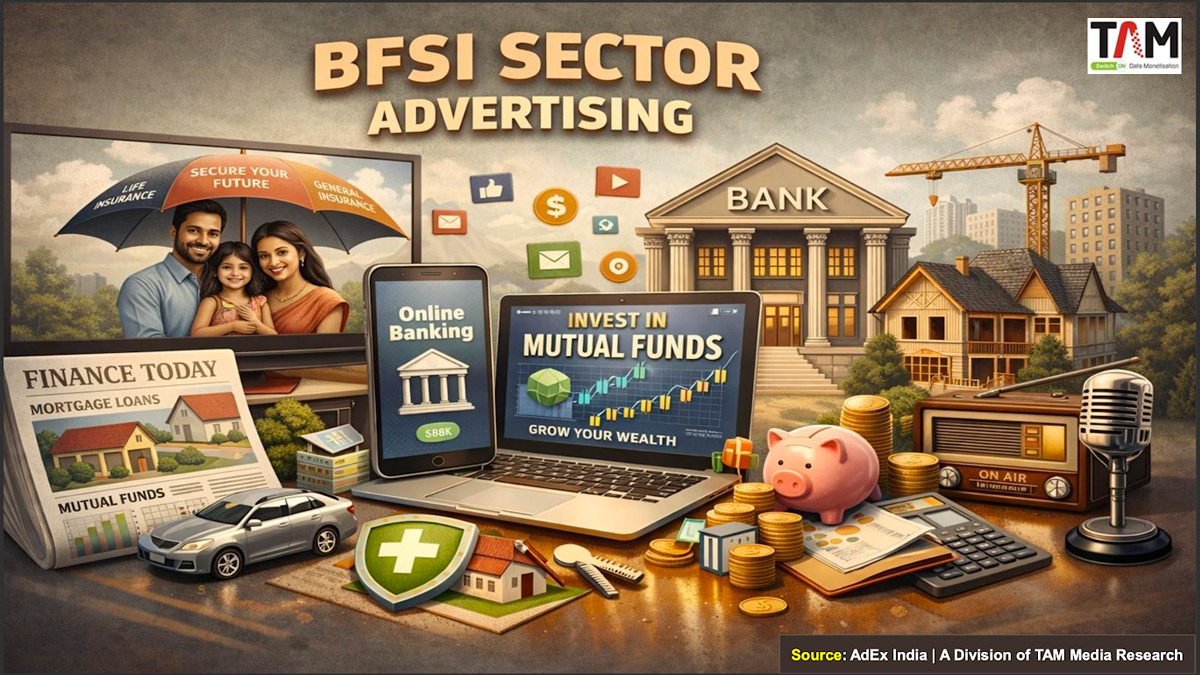
MUMBAI: India’s banking, financial services and insurance sector, one of the most prolific advertisers in the country, delivered a split verdict on media in 2025. It spent less on television, held its nerve in print, turned up the volume on radio and deluged the internet with a ferocity that left every other medium looking pedestrian. The picture that emerges from TAM AdEx’s cross-media report for the BFSI sector is of an industry in transition, still wedded to the news bulletin but increasingly seduced by the algorithm.
Television: a retreat with caveats
TV ad volumes for the BFSI sector fell 16 per cent in 2025 compared with 2024, a sharp reversal after two years of consistent growth that had pushed volumes 16 per cent above 2021 levels by 2023 and a further 7 per cent higher by 2024. Within 2025 itself, the drop was concentrated in the middle of the year: the second and third quarters saw ad volumes slide 35 per cent each against the first quarter, with a partial recovery of 13 per cent in the fourth.
The retreat did not reshuffle the deck. Life insurance retained first place among TV categories with 19 per cent of ad volumes, mortgage loans held second with 16 per cent, and the top ten categories together accounted for 82 per cent of all BFSI television advertising. The dominance of news channels was equally pronounced: news claimed 68 per cent of ad volumes, general entertainment channels a distant 14 per cent and movies 12 per cent. Together, news and GEC captured 82 per cent of the sector’s television spend. News bulletins alone took 48 per cent of programme-genre volumes, with feature films second at 12 per cent. Prime time, between 6pm and 11pm, drew 34 per cent of ad volumes, followed by afternoon at 22 per cent and morning at 20 per cent. A full 82 per cent of all ads ran between 20 and 40 seconds.
Life Insurance Corporation of India was the sector’s biggest TV spender with 11 per cent of ad volumes. Muthoot Financial Enterprises came second with 9 per cent, followed by National Payments Corporation of India at 6 per cent, Tata AIG General Insurance at 5 per cent and State Bank of India at 5 per cent. The top ten advertisers together accounted for 51 per cent of total TV volumes. Three names were new to the top ten in 2025: Tata AIG General Insurance, IIFL Finance and Tata Capital. At brand level, Muthoot Finance Loan Against Gold led with 9 per cent share, Tata AIG Health Insurance entered the top ten for the first time, and the top ten brands together contributed 35 per cent of ad volumes.
Print: the long climb continues
Print told a different story. Ad space for the BFSI sector has grown every year since 2021, rising 16 per cent in 2022, 30 per cent in 2023, 51 per cent in 2024 and 64 per cent in 2025, all measured against a 2021 baseline. Within 2025, ad space was flat in the second quarter but surged 46 per cent in the third and 33 per cent in the fourth compared with the first. Life insurance led print categories with 21 per cent of ad space, followed by mutual funds and banking services and products at 13 per cent each, and corporate financial institutes at 11 per cent. The top ten categories together took 82 per cent of print ad space. LIC led print advertisers with 6 per cent share, and the top ten together covered just 19 per cent of ad space, a reflection of how fragmented print spending remains. Three new entrants joined the top ten in 2025, with Billion Brains Garage Ventures the only exclusive presence not seen in 2024’s list. In the top ten brands, LIC dominated with a 2 per cent share, while Nippon India Mutual Fund rose to third position from fourth in 2024. English accounted for 62 per cent of print ad space, Hindi for 20 per cent. Business and finance publications took 59 per cent of the genre split. The south zone led regional spending with 33 per cent of print ad space, Bangalore topping that zone, while New Delhi and Mumbai were the leading cities nationally.
Radio: louder than ever
Radio ad volumes for the BFSI sector have climbed steadily, rising 12 per cent above 2021 levels in 2023, 36 per cent in 2024 and 45 per cent in 2025. The quarterly pattern within 2025 was volatile: a sharp drop of 43 per cent in the second quarter and 42 per cent in the third, followed by a near-full recovery in the fourth. Life insurance led radio categories with 22 per cent of volumes, banking services and products second at 14 per cent and corporate NBFCs third at 11 per cent. LIC of India held its position as the leading radio advertiser with 20 per cent of ad volumes; the top ten radio advertisers together covered 69 per cent. Muthoot Financial Enterprises led radio brands with 10 per cent share, five of the top ten brands belonged to LIC alone, and SBI Mutual Fund made a remarkable leap to fifth position from 272nd in 2024. Evening and morning time-bands together captured 84 per cent of radio ad volumes, with evenings at 44 per cent and mornings at 40 per cent. Maharashtra was the leading state for radio BFSI advertising with 18 per cent share; Maharashtra, Gujarat and Uttar Pradesh together accounted for 43 per cent.
Digital: the five-times surge
If one number defines the 2025 BFSI advertising story, it is five. Digital ad impressions for the sector multiplied fivefold between 2021 and 2025, having already doubled in 2023 and doubled again in 2024 before the 2025 leap. Within the year, impressions dipped 19 per cent in the second quarter and 12 per cent in the third before recovering 8 per cent above the first quarter by the fourth. Banking services and products led digital categories with 27 per cent of impressions, life insurance and credit cards tied at 19 per cent each, and securities and sharebroking organisations fell from first place in 2024 to fourth in 2025. Axis Bank was the runaway leader among digital advertisers with 12 per cent of impressions, followed by ICICI Bank at 9 per cent, IDFC First Bank at 7 per cent and Kotak Mahindra Bank at 6 per cent. The top ten digital advertisers covered 59 per cent of impressions, and seven of them were new entrants compared with 2024, signalling rapid churn in the digital spending hierarchy. At brand level, Axis Bank led with 9 per cent, ICICI HPCL Super Saver Credit Card vaulted to third place from 921st in 2024, and six of the top ten digital brands were new to the list. Programmatic buying accounted for 91 per cent of all digital BFSI transactions; combined with ad networks, it captured 96 per cent.
The data from TAM AdEx paints the portrait of a sector that still believes in the power of the television news bulletin to sell insurance to the masses, but increasingly knows that the next generation of borrowers, investors and cardholders is scrolling, not watching. The race is now on to reach them before the algorithm serves up someone else’s loan offer first.






