MAM
Will Hero be the saviour Harley-Davidson needs?

NEW DELHI: The world's largest two-wheeler manufacturing brand Hero MotoCorp earlier this week announced a distribution agreement with Harley-Davidson for the Indian market. As per the agreement, Hero will sell and service Harley motorcycles across the country.
The development comes closely after Harley-Davidson announced an exit from the Indian market in September this year. Harley Davidson has been present for over 11 years in India. The brand said it is discontinuing sales and production operations in India as part of a global restructuring plan.
As per the new deal Hero Motocorp will sell and service Harley bikes in India.

"Per a distribution agreement, Hero MotoCorp will sell and service Harley-Davidson motorcycles and sell parts and accessories and general merchandise riding gear and apparel through a network of brand-exclusive Harley-Davidson dealers and Hero’s existing dealership network in India. As part of a licensing agreement, Hero MotoCorp will develop and sell a range of premium motorcycles under the Harley-Davidson brand name," the Pawan Munjal-led company said in a regulatory filing.
Read more news on Harley Davidson
It must be noted that the two brands and their positioning in the market are completely different. Hero Motorbikes are largely in the daily use segment while Harley’s bikes cater to the leisure rider. Hero as a brand is known for its economy two-wheelers and it failed to capture the higher end market share even after having a product like Karizma. Customers aren't willing to part with a hefty sum just for a Hero motorcycle. It will be interesting to see how the deal will help both the brands in terms of their brand equity.
Business strategist Lloyd Mathias opined that Hero and Harley Davidson motorbikes are within the same category but they compete in totally different segments. “The association is a win-win for both companies as Harley-Davidson gets to ride Hero MotoCorp’s vast distribution network and extensive customer service, while Hero gets to develop and sell a range of premium motorcycles under the Harley-Davidson brand name and therefore make its way into the top end of the motorbike segment.”
Harley-Davidson had earlier hinted at exiting some tough markets as part of its strategic plan, which entails pulling out of loss-making markets and focusing on the US, Europe, and parts of Asia Pacific.
In spite of being an iconic brand worldwide, Harley-Davidson failed in India for various reasons – from a lack of understanding of the Indian consumer, to faulty product mix, pricing & distribution issues. Even the market strategies adopted by the brand in India did not help it in gaining ground.
Aashaar Marcom brand and communications consultant Amitava Mitra shared that even after the collab, Harley Davidson will remain the iconic brand it is. In this segment, customers will not be purchasing a Hero Motorcycle. They will be buying into the Harley experience. “Whatever Harley-Davidson brand’s relaunch in India in association with Hero MotoCorp, it will maintain the image, value, experience, and other brand traits. What will get added to it is the trust associated with Hero.”
Hero acquired US-based Erik Buell Racing in the year 2015 in order to expand its operation in the premium bike segment. However, the company was not able to successfully capitalise on its move, and as a result, we haven't seen any major growth in Hero's portfolio till now. Only time will tell what is the company's road map to roll out Harley products in India but, is it a well-played move by Hero to establish itself as a premium bike company?
Mathias held the view that it’s a good strategy by Hero MotoCorp. "The passion biking segment is small but lucrative and growing. It is difficult for a global company to set up and run full-fledged operations to cater to this tiny segment and stay profitable. For Hero MotoCorp there is perfect synergy in operations and huge leverage. In effect, it will now have a strong presence in all segments of the motorbike category.”
Would it be right for Hero to cannibalize the brand equity it has created in the lighter bikes segment? According to independent communication and marketing consultant Karthik Srinivasan, a single brand having two different sub-brands meant for two different prices and audience segments is quite normal. “For instance, Toyota owns Lexus at the premium end, while also producing entry, mid-level cars under its brand. In this case, Hero simply needs to retain and build on Harley's existing premium value and perception.”
Mitra also believes it’s a brilliant move to get in an established and iconic premium brand into its fold. “Worldwide, there are mass and popular brands that have not managed the same levels of success in their premium, luxury ranges. Two brands that immediately come to mind are Toyota and Maruti Suzuki. Toyota used the Lexus and Maruti the Nexa as independent premium and luxury brands to garner market share in their respective premium categories.”
He went on to note that Hero has always struggled in the premium motorcycle segment and this approach will certainly create a huge positive impact on the homegrown company’s overall market share. It will also ensure a strong presence in the higher CC category, premium two-wheeler segment.
Harley as a brand doesn't need overt publicity and it relies solely on the hallmark it has created for so many years. But now being a Hero brand, how will the advertising model differ, and what will be the go-to strategy in the market?
Srinivasan explained that given the price Harleys usually sell at, even Hero would realize that they are not meant to be mass-market products and would target the range appropriately. To be sure, “Harleys won't be a Hero-brand. And Hero would ensure that this stays so, to ensure that the brand value of both the brands remains intact.”




MAM
Lego brings Messi, Ronaldo, Mbappé, Vinicius together
Campaign clocks 314 million views ahead of FIFA World Cup 2026 buzz.
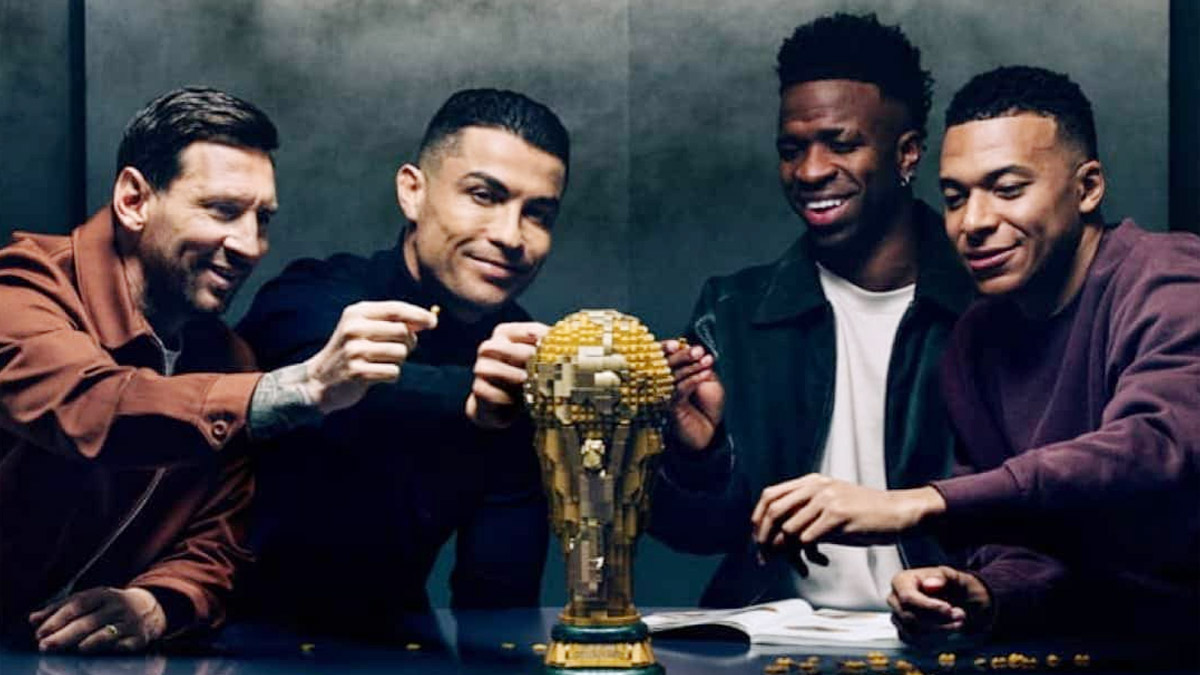
MUMBAI: Four legends, one frame and not a single tackle in sight. Lego has pulled off a crossover few thought possible, uniting Lionel Messi, Cristiano Ronaldo, Kylian Mbappé and Vinícius Júnior in a single campaign ahead of the FIFA World Cup 2026 only this time, they’re building dreams brick by brick.
Titled “Everyone wants a piece”, the campaign features the quartet assembling a Lego version of the World Cup trophy, before placing miniature versions of themselves atop it, a playful nod to football’s ultimate prize. Shared widely across social media, the ad carries a pointed disclaimer: it is not AI-generated, a subtle but telling signal in an era where even reality is often questioned.
The numbers tell their own story. The campaign has already crossed 314 million views on Instagram across the players’ accounts, with fans hailing it as a rare, almost nostalgic moment particularly for the reunion of Messi and Ronaldo, whose last shared campaign ahead of the 2022 World Cup became one of the platform’s most-liked posts.
Beyond the film, Lego is extending the play with exclusive, player-themed sets tied to each of the four stars, part of a broader football-led programme designed to ride the global momentum building towards 2026. The idea, as echoed by the players themselves, leans into the parallels between football and play experimentation, creativity, failure, and triumph.
Messi described the sets as a way to bring on-pitch moments into an imaginative, hands-on world, while Ronaldo called the transformation into a Lego figure a rare honour, blending sport with storytelling. Vinícius, meanwhile, struck a more personal note, recalling childhood moments of building with Lego and framing creativity as a universal language that transcends borders.
The timing is no accident. With the 2026 World Cup set to run from June 11 to July 19 across the United States, Canada and Mexico, and featuring an expanded 48-team format, global anticipation is already building. Argentina, led by Messi, will enter as defending champions, adding another layer of intrigue.
For Lego, the campaign does more than celebrate football, it taps into its mythology. Because when icons become figurines and rivalries turn into play, the beautiful game finds a new kind of pitch. one built, quite literally, by hand.






