AD Agencies
Welspun appoints dentsu X as its partner for integrated media solutions


Mumbai: Welspun – a global leader in home textiles, has awarded its media duties to dentsu X – the data & tech-driven agency from dentsu India. The account was won following a multi-agency pitch and will be serviced from the agency’s Mumbai office.
As per the mandate, dentsu X’s robust talent pool will intrinsically focus on offering pioneering solutions to enhance the brand’s business outcomes. It will cater to the entire gamut of integrated media services in the Bed & Bath and flooring categories, overseeing media strategy, planning, and buying for Digital and traditional media. The agency’s purpose-driven media expertise combined with the network’s strategic foray into practices like Martech (big data, analytics, CRM, CDP) gaming, Omni Channel commerce, and content is certain to empower the brand to further build upon revenues.
It is pertinent to note here that Welspun’s brands have been highly active on digital and traditional media platforms, engaging with consumers across multiple touchpoints. ‘SPACES,’ known for its premium home textile offerings, has gained recognition for its exceptional quality and innovations, while Welspun, the mass Home textile brand, has consistently provided value-driven solutions that address real consumer pain points through innovative products.

Welspun Global Brands, domestic business CEO Manjari Upadhye added, “The competition among the agencies was fierce, and each one presented fantastic ideas, strategies, and data, which made our decision quite challenging. However, dentsu X stood out with its innovative approach, comprehensive understanding of our brand, and compelling vision for our consumer-centric marketing strategy. Bed and bath categories are traditionally considered commodity-driven. Our challenge lies in differentiating ourselves and elevating the brand value within this segment. As the largest spender in the Bed & Bath category over the past 2-3 years, we understand the importance of a robust media strategy to drive our growth. We have chosen to partner with dentsu X due to their exceptional track record in handling similar categories, which will undoubtedly play a pivotal role in shaping our strategies moving forward.”
Speaking on the win, dentsu media CEO, South Asia Anita Kotwani said, “Adding Welspun India to our clientele is a remarkable win. The network believes in going from pillar to post, fostering our strengths, and redefining practices for brands to supersede their targeted outcomes in the India market. I am proud of the team that has relentlessly worked on the pitch. Their innovative approach to catering to Welspun’s business objectives has led to this victory. This is much in line with dentsu X’s proposition of ‘experience beyond exposure’ and I am certain of them achieving many new milestones with this partnership.”
dentsu X India CEO Jose Leon added, “Relationships don’t just come from precise media exposures or stalking people programmatically. Relationships come from valuable experiences that all connect to tell amazing stories and this is what we would bring to foray at Welspun too. We aim to be laser-focused towards ensuring long-term & sustainable growth for the brand. Super excited to be part of this next phase of transformation with the team at Welspun.”






AD Agencies
Kevin Vaz opens FICCI-EY report with a declaration: India’s M&E industry set to breach Rs 3 trillion mark by 2027
In a keynote address at the FICCI-EY report launch, Kevin Vaz says sport, AI and the connected TV boom are driving a multi-screen revolution with no signs of slowing
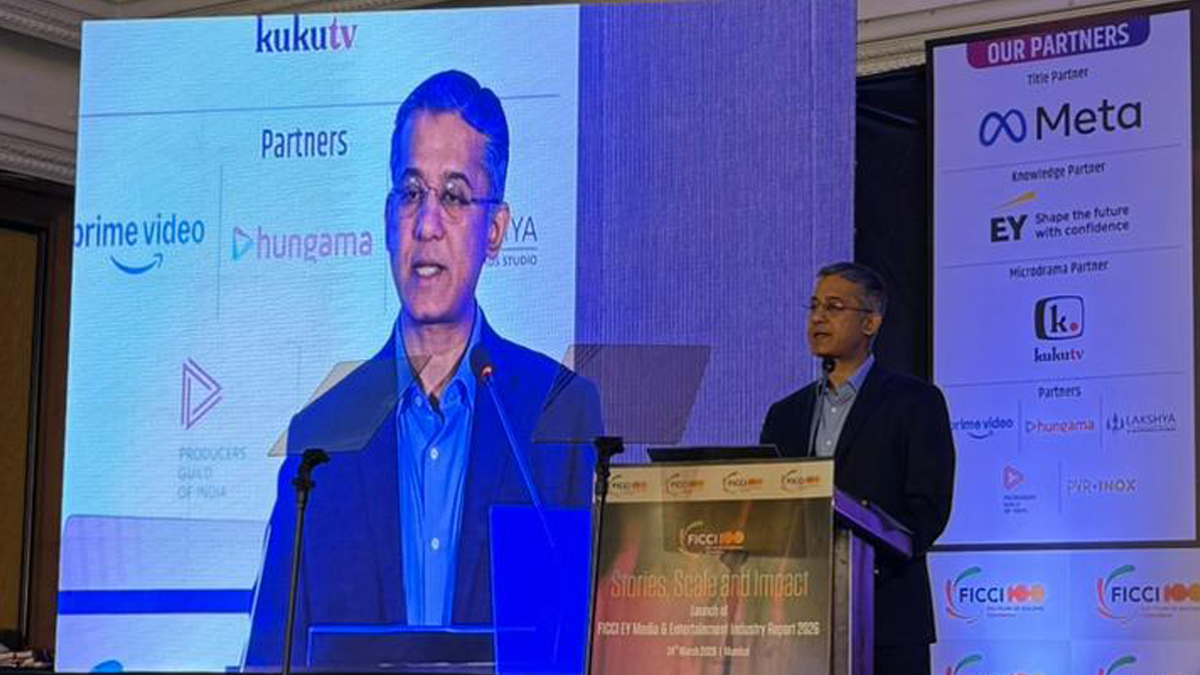
MUMBAI: India’s media and entertainment industry is growing faster than the economy, reshaping global benchmarks and is on course to blow past Rs 3 trillion by 2027. That was the headline message from Kevin Vaz, chairman of the FICCI Media and Entertainment Committee and chief executive of entertainment at JioStar, who delivered the opening keynote at the launch of the FICCI-EY Media and Entertainment Report 2026 in Mumbai on Monday. He did not waste much time on caveats.
The industry hit Rs 2.78 trillion in 2025, outpacing GDP per capita growth and surpassing even last year’s bullish forecasts. Vaz described the year in three words: scale, convergence, transformation. The numbers, he suggested, were only half the story. The other half was how that growth was happening.
Digital has become the industry’s largest segment, driven by advertising, subscriptions and commerce. But Vaz was quick to puncture the familiar narrative of digital killing everything else. India, he argued, is not an either-or market. It is an AND market. Connected TV is surging. Linear television, mobile, films and print are all still expanding. AVGC, the animation, visual effects, gaming and comics sector, is emerging as a serious growth engine, opening new storytelling formats and new global revenue streams. Nothing, he said, is replacing anything. Everything is reinforcing everything else.
Nowhere is that more vivid than in sport. In an on-demand world where audiences can watch anything, anytime, Indians still show up live. “Sports don’t fragment audiences,” Vaz said. “They unite them, just on different screens.” The ICC Men’s T20 World Cup 2026 made the point emphatically. During the final, JioHotstar delivered 72.5 million concurrent streams, a global record. Group chats exploded. Families renegotiated control of the television. Advertisers, Vaz noted with undisguised relish, stopped asking where audiences were and started asking how fast they could get in.
Cinema had its own landmark year. More than 1,900 films were released, with several crossing the Rs 1 billion mark. Dhurandhar was singled out as proof that Indian audiences will still turn up in large numbers for content that grips them. Live experiences, too, are getting bigger and more immersive, though Vaz suggested the surface has barely been scratched.
Then there is artificial intelligence, which he described as quietly, and sometimes not so quietly, reshaping everything. AI is enabling personalisation, efficiency and scale, but Vaz argued its deeper significance lies in what it is doing to creativity itself. He pointed to Mahabharat: Ek Dharmayudh, billed as the world’s first AI-produced show, as evidence that the technology can amplify creative ambition rather than hollow it out. He also used the platform to call on Indian policymakers to engage seriously with the creative industry on AI and copyright, ensuring that creators are fairly compensated as the technology spreads.
The picture that emerges from the report, and from Vaz’s keynote, is of an industry that has stopped thinking of itself as a fast-growing emerging market and started thinking of itself as a global template. Scale, diversity and innovation, he said, are no longer in tension in India. They are coexisting, and the rest of the world is taking notes.
The Rs 3 trillion milestone is two years away. As the man who chairs the committee that shapes the industry’s policy agenda and runs the country’s most powerful entertainment platform, Vaz set the tone for the day with characteristic directness: India’s media business is not just chasing growth. It is deciding what the country talks about at dinner. That is a different kind of power altogether.








