Brands
“We remained dedicated to our core values”: Zouk’s Disha Singh and Pradeep Krishnakumar


Mumbai: The bags, footwear, and accessories category is an ever-evolving one. With sustainable, vegan, and cruelty-free products seeing an uptick and without it compromising their style statement, consumers are certain about what they want. A change in style and fashion every now and then is most welcoming; however, there are always some classics that never leave the shelf.
Zouk is one such modern Indian classic that seamlessly combines contemporary and traditional elements to infuse subtle elegance into your lifestyle. Handcrafted, cruelty-free, and proudly Indian, Zouk celebrates the vibrant Indian culture and presents it to the world. The brand offers products in the bags & wallets, footwear, and accessories categories.
Putting things into perspective, the bag and accessories direct-to-consumer (D2C) market in India is around one billion dollars and is growing at the speed of 50 per cent.

Founded by IIM Ahmedabad batchmates and husband-wife duo, Disha Singh and Pradeep Krishnakumar, Zouk’s journey began when Singh visited Kutch for an IIMA course. She observed that her friends appreciated the local handicrafts but refrained from buying them because they weren’t functional. This led Singh and Krishnakumar to build a modern lifestyle brand from India for the world.
Zouk’s product designs draw inspiration from Indian architecture, cultural diversity, and traditional handicraft techniques, making it a proudly Indian brand. All products are cruelty-free and responsible, with the brand being a PeTA approved vegan brand.
With over 400,000 happy customers who have purchased products from their D2C website and other marketplaces, Zouk’s proudly Indian and cruelty-free offerings have garnered immense love and support. The brand has raised $4.5 million so far, with marquee investors mentoring and supporting it at every step. In its last funding round, series A, Zouk raised three million where Stellaris Venture Partners led the round, with Sharrp Ventures, JJ Family Office, Deutsche Bank India CEO Dilip Khandelwal, Manoj Meena of Atomberg, and Vineeta Singh and Kaushik Mukherjee of Sugar Cosmetics participating.
Indiantelevision.com spoke to Zouk co-founders Disha Singh and Pradeep Krishnakumar at length about the journey of the brand, extending from being simply a bag brand to footwear and accessories, the D2C market, celebrity associations, and more.
After earning her MBA from IIM Ahmedabad, Singh launched Zouk in 2016 with a clear focus on designing high-quality products that blend Indian handicraft design with modern functionalities, all while using 100 per cent vegan materials.
Throughout her journey with Zouk, Singh has taken immense pride in upskilling and supporting over 400 expert artisans who help make Zouk’s proudly Indian products. As a woman in a traditionally male-dominated industry, she is proud to be supporting a diverse range of artisans and providing them with opportunities to grow and thrive.
Aside from production, Singh takes on a variety of roles at Zouk, including product design, brand building, and digital marketing. Her husband and IIM Ahmedabad batchmate, Krishnakumar, oversees other aspects of the business.
Under Krishnakumar’s leadership, Zouk has experienced remarkable growth, nearly 10x since the last fundraising round, the Pre-Series A round in mid-2021.
Before co-founding Zouk, Krishnakumar worked at various organizations like Deutsche Bank, McKinsey, Guild Capital, and BrowserStack, gaining valuable experience in operations, strategy, growth, and venture capital. He has expanded Zouk’s distribution from being a purely D2C website driven brand to becoming a bestseller on Amazon.
At Zouk, Krishnakumar takes care of operations, distribution, finance & investor relations, while Singh oversees other aspects of the product portfolio and brand building. Together with their team, they have recently conceptualized two successful events: Vegan Creator Day and Awards 2022, which celebrated content creators, and the Proudly Indian Fashion Show, which featured top content creators showcasing the brand’s heritage-inspired products in honor of India’s 74th Republic Day.
Krishnakumar believes that India is a brand-starved country, and hundreds of exciting brands will be created in the coming decade. He is passionate about promoting entrepreneurship and frequently speaks at events and webinars on this topic.
Zouk’s bags have appeared in the popular Bollywood movie Sherni and the celebrated OTT content, the Netflix series Little Things 3. The brand’s products have also been presented as gifts to Indian dignitaries visiting abroad.
Edited excerpts:
On the journey and evolution of Zouk since its inception
Singh: The journey of Zouk since its inception has been an exciting one. We started as a brand focused solely on bags, offering stylish and authentic alternatives. Over time, we noticed the growing demand for ethically made products, which encouraged us to expand our product category to include footwear and other accessories. As we progressed, we remained dedicated to our core values, which helped us connect with a community of conscious consumers who appreciated our offerings.
On witnessing the evolution of the D2C bag and accessory market in India, the kind of consumer trends that have shaped the industry, and upcoming innovations and trends
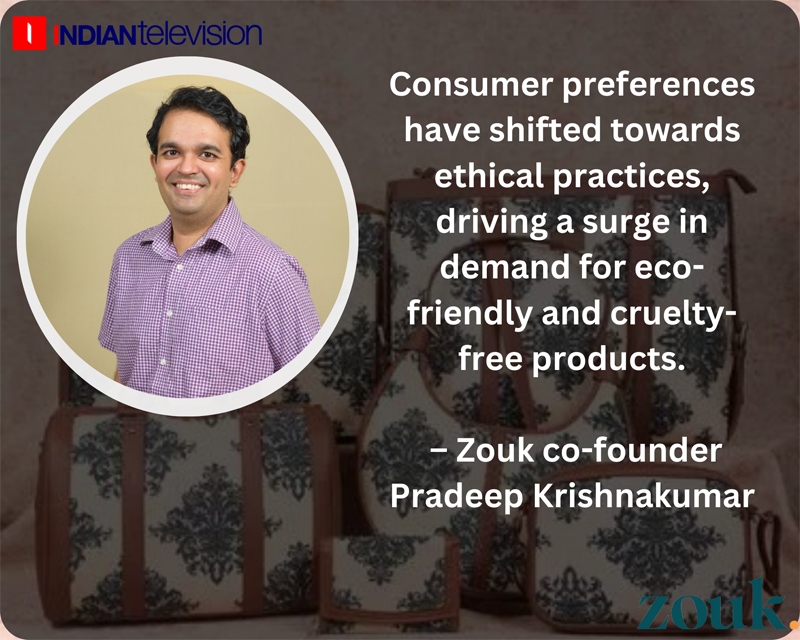
Krishnakumar: Throughout the years, we’ve closely tracked the remarkable evolution of India’s D2C bag and accessory market. Consumer preferences have shifted towards ethical practices, driving a surge in demand for eco-friendly and cruelty-free products. Today’s customers are increasingly mindful of their purchasing choices, actively seeking out brands that resonate with their values and proudly celebrate their Indian heritage while making positive contributions to being a member of the proudly Indian family.
Innovations and trends that are expected to disrupt the D2C bags, accessories, and footwear market might include advancements and manufacturing processes, the integration of technology for enhanced functionality, and the use of data-driven insights for personalized customer experiences.
On expanding into different categories
Singh: The motivation behind expanding into different categories like footwear and accessories was primarily driven by customer demand and market trends. As a brand, we wanted to offer a comprehensive range of cruelty-free products that catered to various lifestyle needs. We will continue to explore other relevant product categories in the future, always keeping in mind our core values and the preferences of our target audience.
On the advertising, marketing and media strategy that you have put in place for Zouk
Krishnakumar: Our advertising and marketing is focused towards reaching out to our customers in a way that they feel. The values that Luke is propagating is something that they associate with. So you will also see as you’re doing campaigns around Women’s Day and other festive times where they make their customers still the face of the brand. So everything that we do in our marketing and advertising is also centered around how we can project our products, in a way that that consumer understands their use cases, how useful it will be for them.
We have a strong focus on digital media and social media platforms. These channels allow us to connect with our target audience more effectively and engage with them through creative and impactful content. While we recognize the importance of traditional media like TV, print, and radio, our primary emphasis remains on the digital space, where we can build a more personalized and interactive relationship with our consumers.

On new-age brands aligning celebrity associations with their marketing strategies, brand ambassadors boosting sales and marketing efforts, and insights into specific collaborations such as the one with Sara Ali Khan
Singh: Aligning celebrity associations with marketing strategies for new-age brands involves finding the right balance between the celebrity’s image and the brand’s identity. The chosen ambassador should genuinely connect with the brand’s values and resonate with the target audience. Additionally, it is essential to ensure that the collaboration feels authentic and not forced, as consumers are quick to recognize inauthenticity.
As co-founders of Zouk, we believe that brand ambassadors can indeed have a significant impact on boosting sales and marketing efforts. They play a crucial role in increasing brand visibility, creating a positive image, and connecting with the target audience on a more personal level. Collaborations with the right brand ambassadors can help build trust and credibility, which, in turn, can positively influence consumer purchase decisions. One of the notable collaborations is with Sara Ali Khan, who is a well-known Bollywood celebrity also, well known for her social media presence. Her popularity and appeal to our target demographic helped us expand our reach and engagement on various platforms. Sara’s association with Zouk also aligned well with our brand’s values of cruelty-free practices, which further strengthened our brand identity.
On leveraging social media influencers alongside traditional celebrities to maximize the brand’s reach and engagement
Krishnakumar: To maximize our brand’s reach and engagement, we leverage both social media influencers and traditional celebrities. Social media influencers are excellent for creating authentic and relatable content that resonates with their followers. On the other hand, traditional celebrities can bring a sense of aspiration and glamor to our brand. By combining the two approaches, we can reach a broader audience and create a more diverse and engaging brand image.
On the criteria for choosing a celebrity ambassador to ensure a strong brand fit, your advice to other D2C brands looking to initiate celebrity associations as part of their marketing strategy, and key learnings
Singh: When choosing a celebrity ambassador for Zouk, we carefully consider several criteria to ensure a strong brand fit. Firstly, the celebrity’s values and image should align with our brand identity of being vegan, cruelty-free, and ethical. Their personality and lifestyle should complement our brand ethos. Additionally, we look for someone who genuinely resonates with our target audience and has a significant presence on social media platforms.
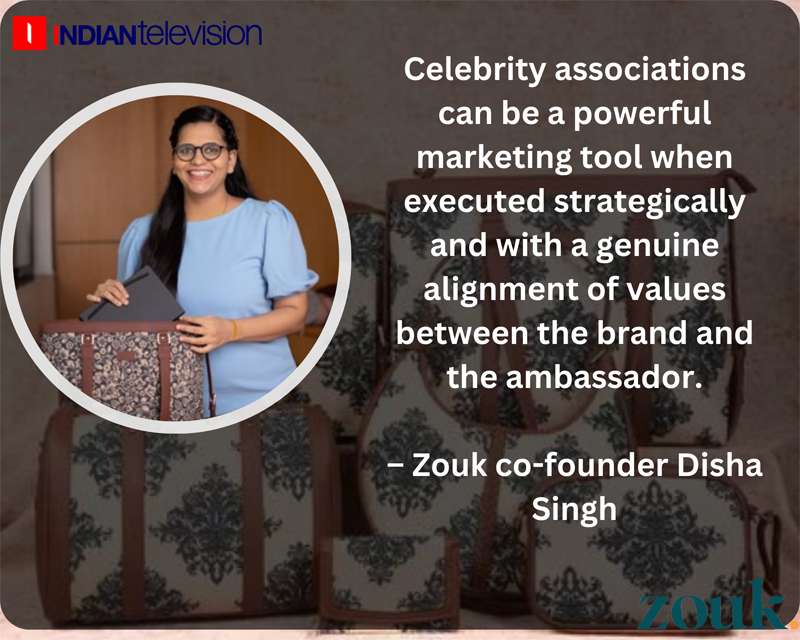
Celebrity associations can be a powerful marketing tool when executed strategically and with a genuine alignment of values between the brand and the ambassador.
Here are the points-
a) The brand needs to ensure that the chosen celebrity genuinely resonates with your brand values and aligns with your target audience’s preferences.
b)Look for a celebrity whose personality and lifestyle complement your brand ethos, creating a seamless fit between the ambassador and the brand.
c)Leverage social media influencers alongside traditional celebrities to maximize reach and engagement across different platforms.
d) Consider long-term partnerships with ambassadors who are genuinely invested in your brand’s mission, allowing for more impactful marketing efforts.

On the significant markets for the brand, and international expansion
Krishnakumar: The Indian market remains a significant focus for Zouk, and we are continuously looking to expand our presence in various regions across the country. Currently, the markets we are targeting include Mumbai, Bangalore, Chennai, Delhi, Pune, the Southern region, and the Western region. Regarding international expansion, it is indeed part of our long-term vision. We will carefully assess potential markets that align with our brand values and have a receptive audience for cruelty-free products.
On retail expansion plans
Singh: We are currently focused on expanding our retail presence both offline and online. For our offline expansion, we plan to open new stores in strategic locations. Additionally, we aim to establish exclusive brand outlets to offer an immersive experience. In the online realm, we’re expanding our product range and partnering with e-commerce platforms to reach a wider audience. Our omnichannel approach ensures a seamless shopping experience, integrating online and offline channels. With a commitment to customer satisfaction, we look forward to our continued growth and brand impact.
On the consumers’ tastes suddenly seeing a shift towards sustainable brands
Krishnakumar: The shift in consumer tastes towards sustainable brands can be attributed to increased awareness of environmental issues and the desire to make responsible choices. Consumers are becoming more conscious of the impact of their purchases on the environment and society, and they seek brands that share their values and contribute positively to the world.
On your vision and way forward for Zouk
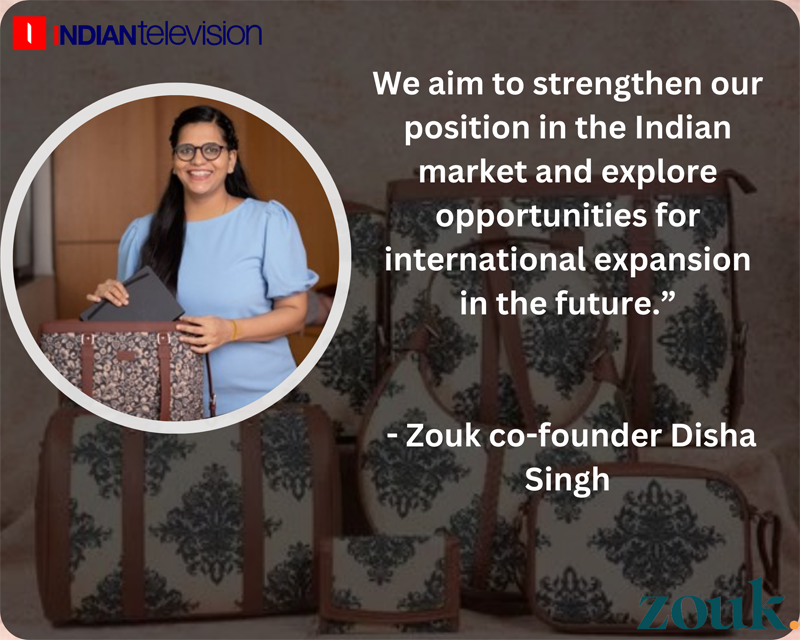
Singh: Our vision for Zouk is to continue being a leading brand in the cruelty-free space, offering a diverse range of high-quality products that cater to various lifestyle needs. We aim to strengthen our position in the Indian market and explore opportunities for international expansion in the future.




Brands
Microsoft faces worst quarter since 2008 financial crisis
Cloud giant battles soaring AI costs and fierce competition from nimble startups.

MUMBAI: When the tech titan starts looking a little wobbly, even the Magnificent Seven can feel the tremors because Microsoft is currently starring in its own sequel, “Clouds and Doubts.” Microsoft is on track for its worst quarterly performance since the 2008 global financial crisis, according to Bloomberg, as investors grow increasingly uneasy about rising capital expenditure and intensifying competition from nimble AI firms. The company has been pouring money into AI infrastructure, yet markets are questioning when these hefty investments will finally deliver stronger revenue growth.
At the same time, investors are shifting away from traditional software stocks amid fears that AI startups such as Anthropic and OpenAI are developing autonomous agents capable of replacing established products, including those from Microsoft. Jonathan Cofsky, portfolio manager at Janus Henderson Investors, noted growing concern that customers may bypass Microsoft and deal directly with AI vendors, potentially disrupting its core business and putting pressure on pricing and margins.
Microsoft’s stock has tumbled 25 per cent in the first quarter, putting it on course for its largest drop since a 27 per cent fall in the fourth quarter of 2008. It has also emerged as the weakest performer among the so-called Magnificent Seven technology stocks, while a broader index tracking the group has fallen 14 per cent over the same period. The shares slipped a further 1.7 per cent after markets opened on Friday, marking a potential fourth consecutive session of declines.
Cofsky pointed out that Microsoft has become more capital intensive and that improved investor confidence will hinge on assurances that software growth will not slow materially. Despite the sell-off, the stock is now trading at less than 20 times projected earnings over the next 12 months, its lowest valuation level since June 2016. Its valuation remains slightly above that of the S&P 500 Index, although it has recently traded at a discount to the broader benchmark for the first time since 2015.
Bloomberg data shows Microsoft’s capital expenditure, including leases, is expected to surge to $146 billion in fiscal 2026, up around 66 per cent from $88 billion in fiscal 2025. Spending is projected to climb further to $170 billion in fiscal 2027 and $191 billion in fiscal 2028, based on average estimates. Investors are growing cautious about such levels of spending without clearer signs of stronger growth.
Microsoft’s Azure cloud division has reported a slight slowdown in growth compared with the previous quarter, while its Copilot AI product has seen limited user traction, prompting internal changes aimed at improving performance. Ben Reitzes, an analyst at Melius Research, warned in a March note that Microsoft’s upside in Azure could be constrained as the company works to address challenges related to its AI models and Copilot offering, adding that these issues are unlikely to be resolved in the short term.
Of the 67 analysts covering Microsoft, 63 maintain buy ratings, three hold ratings and one a sell rating. The average 12-month price target of $592 implies a potential upside of more than 64 per cent, the highest on record based on data going back to 2009. The stock is also trading below its 200-day moving average by the widest margin since 2009.
Reitzes suggested the dominance of buy ratings may indicate complacency among analysts, while highlighting risks in Microsoft’s productivity and business processes segment as well as its More Personal Computing division. In contrast, Tal Liani of Bank of America reinstated coverage with a buy rating, citing durable multi-year growth prospects across cloud and AI. Jake Seltz, portfolio manager at Allspring Global Investments, maintained that Microsoft retains strong long-term value and that its AI strategy is likely to be validated over time, viewing near-term concerns as a potential opportunity for longer-term investors.
The report highlights a growing divergence in market sentiment, with optimism around long-term AI potential weighed against immediate execution risks and investor uncertainty. In the world of big tech, even the mightiest clouds can have silver linings but right now, Microsoft’s investors are scanning the horizon for clearer skies.








