Brands
Unilever to cut ties with digital influencers

MUMBAI: While brands continue to engage in paid promotions through influencer marketing, consumer goods giant Unilever’s had enough. The world’s second biggest advertiser has decided to stop this practice to promote its products. Companies tend to rely on influencers to generate a buzz around their products on social media. But more often than not, followers of these influencers aren’t real people but fake accounts and bots.
Hence, Unilever, maker of Sunsilk shampoo, Dove and Lipton tea, wants to help make advertising more transparent and will cut ties with all digital influencers. Unilever spent US $8.9 billion on marketing last year.
The company’s chief marketing officer Keith Weed is said to pledge today at the on-going Cannes Lions that Unilever will never buy followers or work with influencers who buy followers.

“Trust comes on foot and leaves on horseback, and we could very quickly see the whole influencer space be undermined. There are lots of great influencers out there, but there are a few bad apples spoiling the barrel and the trouble is, everyone goes down once the trust is undermined,” Weed told Reuters.
It was only recently that Unilever threatened Facebook and Google that it will withdraw its advertising on the social media platforms if they fail to remove content that creates division in the society and promotes hate. Weed had said at the time, “As one of the largest advertisers in the world, we cannot have an environment where our consumers don’t trust what they see online.”
The move also comes as Unilever and Procter & Gamble are in the process of auditing their ad spends and agency relationship to function more efficiently as the industry sale for consumer packed goods has witnessed a drop. To cut down on the advertising and marketing costs, these multinational brands are now working with fewer agencies while creating some of the campaigns in-house rather than spending millions on an ad agency.
According to a report by Rakuten Marketing, some UK advertisers were willing to pay US$100,000 to celebrity influencers for a single Facebook post whereas a micro influencer with followers as low as 10,0000 earns as much as 15000 pounds for a single post.
Also Read:
Unilever threatens to pull the plug on digital advertising
Sorrell pats Mukesh Ambani’s back for telecom explosion
HUL marketing spends up in third quarter






Brands
Samsung certifies 1,000 Maharashtra students in AI and coding
The South Korean electronics giant marks its first large-scale skilling push in the state, with women making up nearly half the national programme’s enrolment
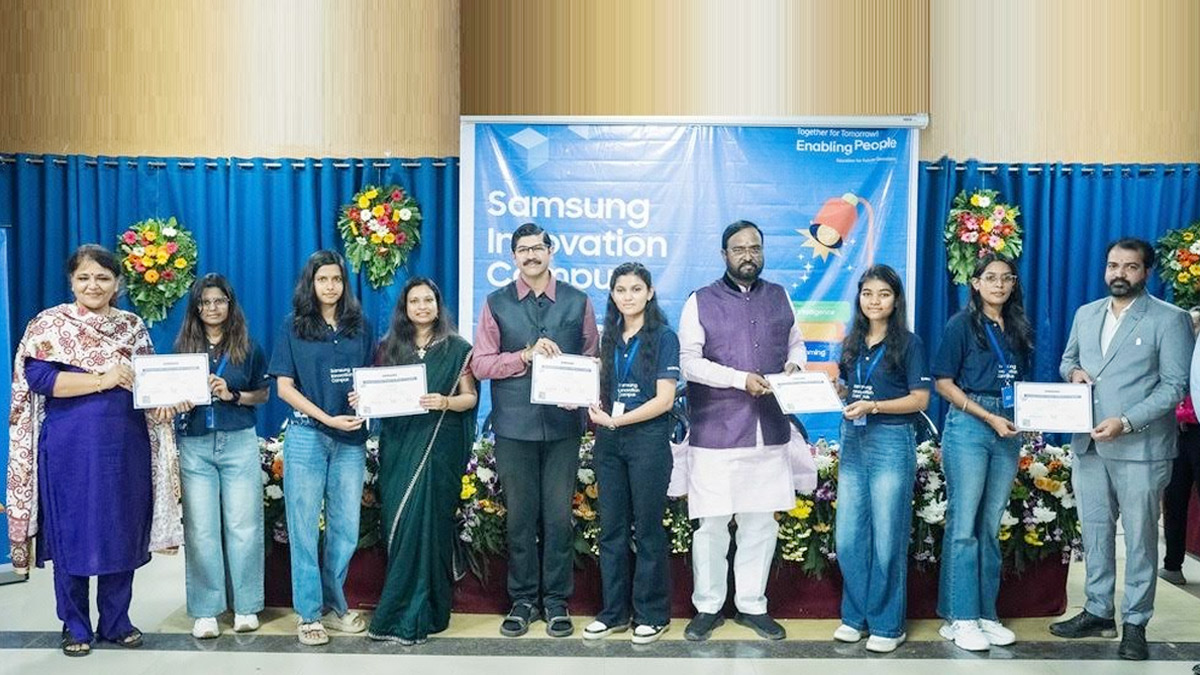
PUNE: Samsung has put 1,000 students in Maharashtra through a certified training programme in artificial intelligence and coding, the largest such drive the South Korean electronics company has run in the state and a signal that corporate India’s skilling ambitions are moving well beyond the boardroom brochure.
The certifications were awarded under Samsung Innovation Campus (SIC), the company’s flagship corporate social responsibility programme, which launched in India in 2022 with the stated aim of democratising access to future-technology education. The 1,000 graduates were drawn from four institutions: 127 from Savitribai Phule Pune University, 373 from Pimpri Chinchwad University, 250 from D.Y. Patil University’s Ramrao Adik Institute of Technology and 250 from Anjuman-I-Islam’s Kalsekar Technical Campus. All completed training in either AI or coding and programming, the two disciplines Samsung has identified as the critical pillars of the digital economy.
The programme does not stop at technical training. Soft-skills development and career-readiness modules are baked into the curriculum, a deliberate attempt to close the gap between what universities teach and what employers actually want.
“India’s digital growth story will ultimately be shaped by the quality of its talent pipeline,” said Shubham Mukherjee, head of CSR and corporate communications at Samsung Southwest Asia. “As technologies like AI move from the periphery to the core of industries, skilling must evolve from basic training to building real-world capability. This milestone in Maharashtra reflects how industry and academia can come together to create a future-ready workforce that is both globally competitive and locally relevant.”
The Maharashtra drive sits within a rapidly scaling national effort. Samsung Innovation Campus trained 20,000 young people across India in 2025, hitting its stated target for the year. Women account for 48 per cent of national enrolments, a figure the company cites as evidence of its push for an inclusive technology ecosystem. The programme is implemented in partnership with the Electronics Sector Skills Council of India and the Telecom Sector Skill Council.
Samsung, which is marking 30 years in India this year, runs SIC alongside two other initiatives, Samsung Solve for Tomorrow and Samsung DOST, as part of a broader effort to build what it calls a generation of innovators with both the technical depth and the problem-solving mindset to thrive in a fast-moving digital world.
A thousand certified students is a tidy headline. Whether they find jobs that match their new skills is the harder question, and the one that will ultimately determine whether corporate skilling programmes like this one are genuine pipelines or well-photographed gestures.






