MAM
The One Show opens its doors to the insurgents

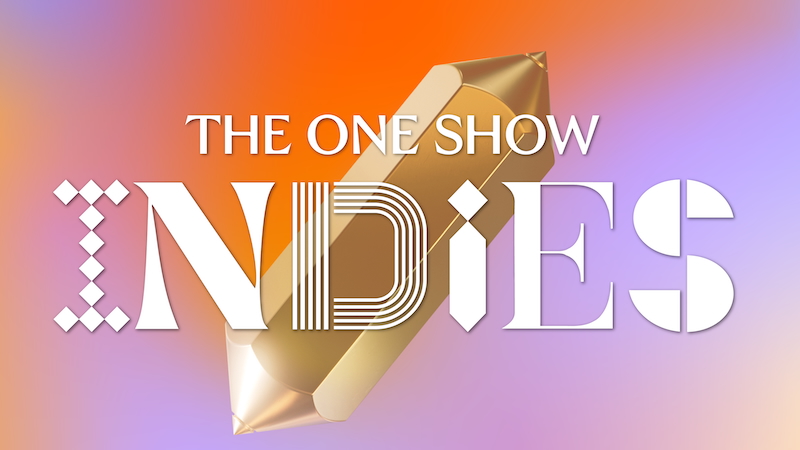
NEW YORK: The One Club has shaken up its awards structure in the most significant overhaul in decades, launching The One Show Indies—a dedicated competition designed to level the playing field for independent agencies, design firms and freelance creators locked out of the global creative spotlight by better-resourced rivals.
The new category, debuting within The One Show 2026, is a direct challenge to the holding company orthodoxy that has long dominated the industry’s most prestigious accolade. Entry is restricted to truly independent outfits: at minimum 51 per cent founder or staff-owned, with no more than four physical offices. The signal is unmistakable. The One Club reckons independent shops are being starved of recognition, and it intends to rectify that.
The One Club chief executive Kevin Swanepoel framed the initiative as an act of creative liberation. “The One Show Indies is like a new rebel wing inside The One Show,” he said, summoning the rhetoric of insurgency. “We’re recognising independent shops and creators who make powerful work without holding company budgets and restraints.”

The economics of entry have been designed to entice participation. Submissions are capped at a modest ten entries per eligible shop, with each piece of work allowed into no more than three categories. Entry fees come at a steep 20 per cent discount off The One Show’s regular rate, whilst burdensome case study films are restricted in their use as judging material. The combined effect is tangible: a genuine attempt to remove the financial and administrative friction that deters cash-strapped independents from throwing their hat in the ring.
The jury will be drawn entirely from creatives at independent agencies, using the same rigorous judging standards that underpin The One Show’s reputation. Winners will claim Gold, Silver and Bronze Pencils and Merit awards, with an additional Crystal Pencil bestowed on an overall Best of Indies champion. A separate celebration event is planned, staged in casual surroundings away from the formal May ceremonies during Creative Week.
The One Show Indies crystallises a shift in the creative industry’s consciousness. Independents have spent years grumbling about glass ceilings at award shows dominated by multinational holding companies. They’ve complained—often with justification—that the costs of entry and the judging structures inherently favour agencies with dedicated awards departments, bigger budgets, and armies of administrative staff to shepherd work through the submission process.
This new category doesn’t solve that structural imbalance entirely. But it cracks the door open. For smaller shops punching above their weight, a One Show Pencil—even one contested exclusively amongst independents—remains a genuine prize. It offers market validation, bragging rights, and the kind of industry credibility that shapes client perceptions and staff recruitment.
The One Club’s motives are plainly also commercial. Awards bodies thrive on volume and participation. Attracting a hitherto underserved cohort of independents will swell submission numbers and fortify The One Club’s position as the creative industry’s dominant credentialing authority.
Entry deadlines are stacked across four rounds, with the super-early window closing 30 October 2025, offering the deepest discounts. Regular entry runs until 23 January 2026, with a final window through 20 February 2026. Judging commences in January, with winners announced in May.
The One Club operates as a non-profit, recycling revenue from entries back into industry programming across four pillars: education, inclusion and diversity, gender equality, and creative development. That circularity—awards funding grassroots support—gives the organisation a moral sheen beyond the commercial calculus of conventional awards schemes.
The One Show Indies lands at a moment when the creative industry is reassessing who deserves a voice. This rebel wing may just prove to be the most inclusive—and competitive—corner of the awards landscape.





MAM
Lego brings Messi, Ronaldo, Mbappé, Vinicius together
Campaign clocks 314 million views ahead of FIFA World Cup 2026 buzz.
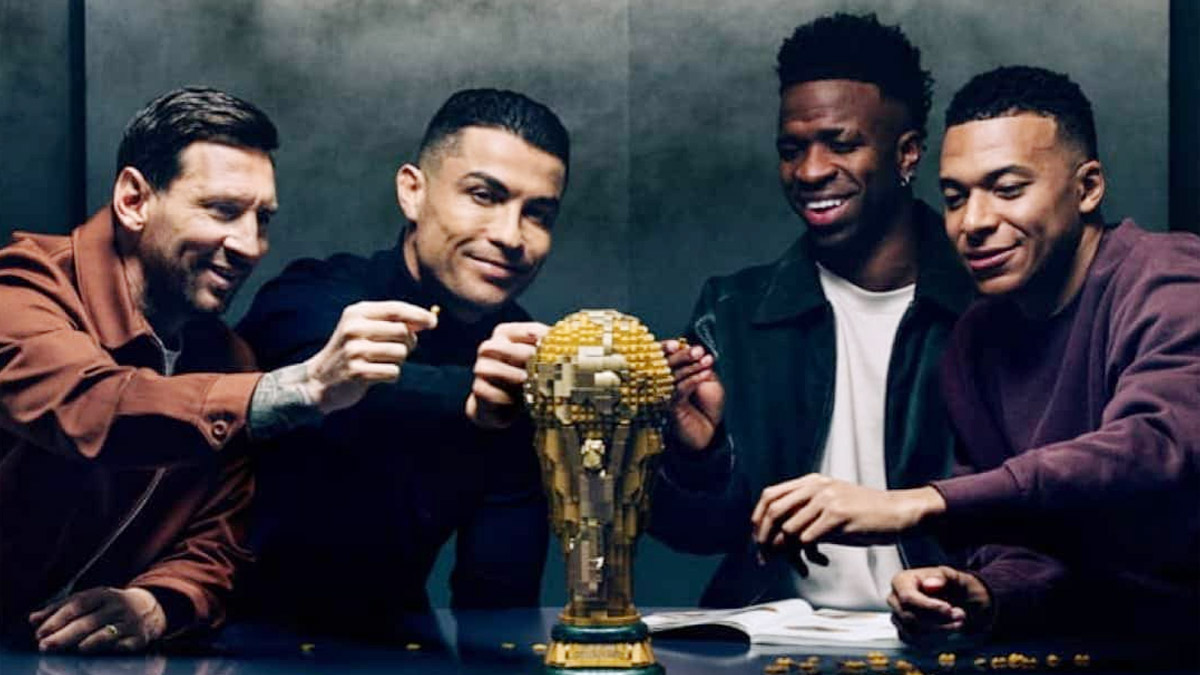
MUMBAI: Four legends, one frame and not a single tackle in sight. Lego has pulled off a crossover few thought possible, uniting Lionel Messi, Cristiano Ronaldo, Kylian Mbappé and Vinícius Júnior in a single campaign ahead of the FIFA World Cup 2026 only this time, they’re building dreams brick by brick.
Titled “Everyone wants a piece”, the campaign features the quartet assembling a Lego version of the World Cup trophy, before placing miniature versions of themselves atop it, a playful nod to football’s ultimate prize. Shared widely across social media, the ad carries a pointed disclaimer: it is not AI-generated, a subtle but telling signal in an era where even reality is often questioned.
The numbers tell their own story. The campaign has already crossed 314 million views on Instagram across the players’ accounts, with fans hailing it as a rare, almost nostalgic moment particularly for the reunion of Messi and Ronaldo, whose last shared campaign ahead of the 2022 World Cup became one of the platform’s most-liked posts.
Beyond the film, Lego is extending the play with exclusive, player-themed sets tied to each of the four stars, part of a broader football-led programme designed to ride the global momentum building towards 2026. The idea, as echoed by the players themselves, leans into the parallels between football and play experimentation, creativity, failure, and triumph.
Messi described the sets as a way to bring on-pitch moments into an imaginative, hands-on world, while Ronaldo called the transformation into a Lego figure a rare honour, blending sport with storytelling. Vinícius, meanwhile, struck a more personal note, recalling childhood moments of building with Lego and framing creativity as a universal language that transcends borders.
The timing is no accident. With the 2026 World Cup set to run from June 11 to July 19 across the United States, Canada and Mexico, and featuring an expanded 48-team format, global anticipation is already building. Argentina, led by Messi, will enter as defending champions, adding another layer of intrigue.
For Lego, the campaign does more than celebrate football, it taps into its mythology. Because when icons become figurines and rivalries turn into play, the beautiful game finds a new kind of pitch. one built, quite literally, by hand.






