MAM
The Indian Brand Summit discusses new ways to reach the consumer

MUMBAI: The India Brand Summit 2006 culminated with a final session on ‘New Ways to Reach the Consumer’. Chairing the session was Reliance Retail chief executive consumer durables Rajeev Karwal along with Lintas’ Lynn De Souza, TAM Media Research LV Krishnan, Leo Burnett’s Arvind Sharma, Maxis CEO Asia Pacific CVL Srinivas and Jet Airways DGM brands Alok Saraogi on the panel for the evening.
Lynn De Souza begun by stating that new media primarily consisted of digital (internet and IPTV), out of home, on the move media and the consumer himself, which she felt is by far the most powerful. However, she was of the opinion that that in India traditional media still has great potential to grow and predicted that it will continue to be important for at least the next 10 years, mainly by recreating itself through interaction with the consumer.
Srinivas on the other hand brought certain key concepts to the discussion. He talked of ‘Media Meshing’ which is the simultaneous consumption of media, as he believes media consumption is changing rapidly and it is time for media owners to ride the tide in this direction. He also spoke of ‘Social Media’ where people are primarily the creators, influencers and observers, something that has been fueled by a concept like blogging. “If you combine the two, you get a multi dimensional black box that will force advertising agencies think more differently. This will give us an impetus to move away from big bang advertising to ‘micropersuation’. The world is changing and change is at our doorstep.”
Sharma addressed the gathering with some eye catching visuals and highlighted the fact that ‘consumer disseminated content’ is what is leading the way. Communication between consumers via the internet and mobile phones has the capacity to spread like wildfire and thus helps to drive the brand. These could include jokes, cartoons, a 30 second spot however, a classic example was that of Gmail, which has absolutely no advertisements but is something that through invites has grown in leaps and bounds merely by consumers acting as agents to pass it on.

Saraogi on the other hand explained how the ‘human quotient’ of media or rather the human needs that new media poses to serve. He added, “Today, while technology reduces boundaries people also desire to be able to communicate thus we need to leverage the power of technology and make it relevant to each consumer.”
TAM’s LV Krishnan spoke specifically from a television perspective and eluded the point that TV has evolved from getting eyeballs to consumer engagement. Studies from his organisation supported suggested, for different categories different mechanisms are used to get more effective engagement. Like for example for house wives it is sound that forces her to rush out of the kitchen and catch the climax while for youth and kids both visuals and sound helped get kids involved in each program.
Taking a shot at the media researchers Lynn added that media research was still not adequately developed and that with the emergence of these newer mediums like the internet and DTH and the interactivity that they incorporate can provide sufficient measurability thus, there would soon be no need for media research.
All these industry experts all tread different paths in the various ways to deliver content, yet they all aim at the same goal of ultimately reaching the consumer!







Brands
Samsung certifies 1,000 Maharashtra students in AI and coding
The South Korean electronics giant marks its first large-scale skilling push in the state, with women making up nearly half the national programme’s enrolment
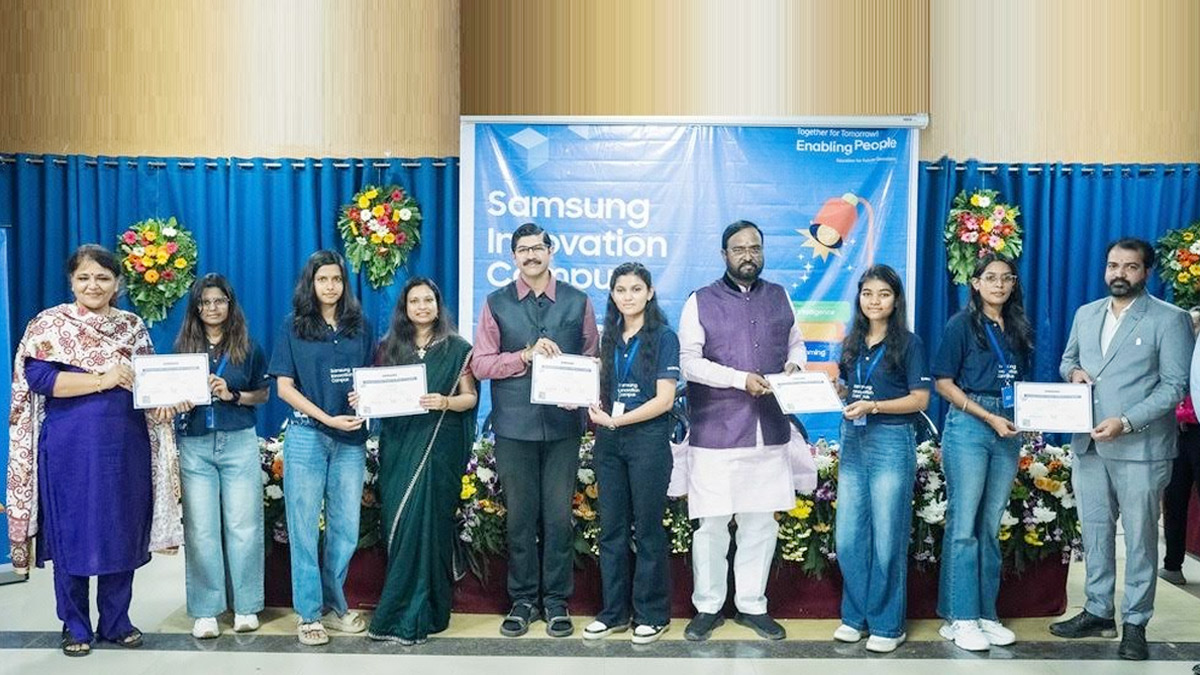
PUNE: Samsung has put 1,000 students in Maharashtra through a certified training programme in artificial intelligence and coding, the largest such drive the South Korean electronics company has run in the state and a signal that corporate India’s skilling ambitions are moving well beyond the boardroom brochure.
The certifications were awarded under Samsung Innovation Campus (SIC), the company’s flagship corporate social responsibility programme, which launched in India in 2022 with the stated aim of democratising access to future-technology education. The 1,000 graduates were drawn from four institutions: 127 from Savitribai Phule Pune University, 373 from Pimpri Chinchwad University, 250 from D.Y. Patil University’s Ramrao Adik Institute of Technology and 250 from Anjuman-I-Islam’s Kalsekar Technical Campus. All completed training in either AI or coding and programming, the two disciplines Samsung has identified as the critical pillars of the digital economy.
The programme does not stop at technical training. Soft-skills development and career-readiness modules are baked into the curriculum, a deliberate attempt to close the gap between what universities teach and what employers actually want.
“India’s digital growth story will ultimately be shaped by the quality of its talent pipeline,” said Shubham Mukherjee, head of CSR and corporate communications at Samsung Southwest Asia. “As technologies like AI move from the periphery to the core of industries, skilling must evolve from basic training to building real-world capability. This milestone in Maharashtra reflects how industry and academia can come together to create a future-ready workforce that is both globally competitive and locally relevant.”
The Maharashtra drive sits within a rapidly scaling national effort. Samsung Innovation Campus trained 20,000 young people across India in 2025, hitting its stated target for the year. Women account for 48 per cent of national enrolments, a figure the company cites as evidence of its push for an inclusive technology ecosystem. The programme is implemented in partnership with the Electronics Sector Skills Council of India and the Telecom Sector Skill Council.
Samsung, which is marking 30 years in India this year, runs SIC alongside two other initiatives, Samsung Solve for Tomorrow and Samsung DOST, as part of a broader effort to build what it calls a generation of innovators with both the technical depth and the problem-solving mindset to thrive in a fast-moving digital world.
A thousand certified students is a tidy headline. Whether they find jobs that match their new skills is the harder question, and the one that will ultimately determine whether corporate skilling programmes like this one are genuine pipelines or well-photographed gestures.






