Ad Campaigns
“The Great Escape” by 1% Club ignites financial literacy movement

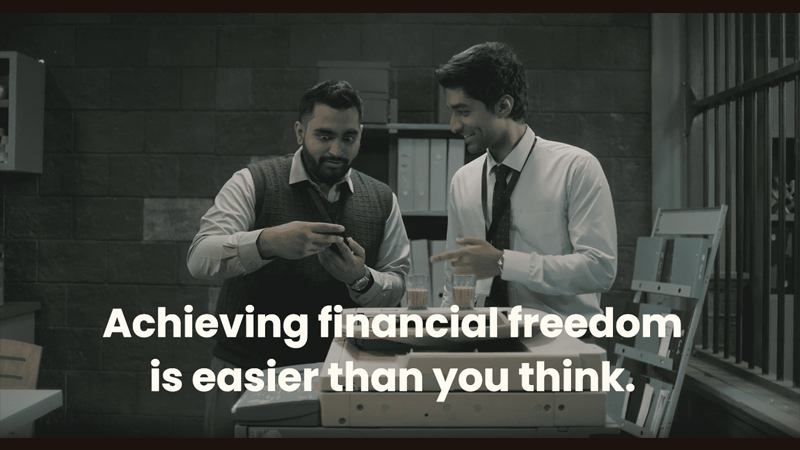
Mumbai: Tired of feeling like memes are the only relatable things that understand the woes of your work life? Feeling like no one truly understands the constant battle between living life and working hard for money? Well, what if I told you that someone not only heard your complaints but also came up with a solution—a fun one? The answer lies in the latest ad campaign from 1% Club! Written and conceptualized by Bare Bones Collective, the campaign features digital stars Finance with Sharan and Viraj Ghelani.

The brand film depicts the country’s working population. People are often stuck in jobs they dislike because financial obligations like EMIs and lifestyle expenses dictate their choices and, in a way, let money control them. They find themselves trapped in a vicious cycle, working for money that ultimately fails to liberate them, instead entangling them further due to their lack of financial knowledge. The only way out is to understand how money works. 1% Club’s “The Great Escape” sees Sharan and Viraj in a familiar corporate office filled with unfamiliar comic twists. The duo play harrowed colleagues who unlock the secret of an exclusive club. What is this club’? How do we get in? The campaign leaves us with many such interesting questions!
Co-founded by Sharan Hedge and Raghav Gupta, the ‘1% Club’ is an exclusive community that empowers people with The Money School- schools forgot to teach us about money so the 1% Club created the money school with the help of India’s top finfluencers to teach about early retirement planning, tax saving strategies, credit card hacks, stock market investment and everything else money. They also provide proprietary tools and conduct networking events to offer a one-of-a-kind membership experience.
The campaign is live on 1% Club’s social media platforms, which include Instagram, YouTube and LinkedIn.
Talking about the campaign, Bare Bones Collective co-founder and chief creative officer Girish Narayanndass said, “1% Club is a fantastic platform that is all about helping you achieve financial freedom. To communicate this, we tapped into a larger insight, i.e. working for money all your life can make you feel trapped. Our goal was to make the campaign as unique as the product itself. Sharan and Viraj have really clicked with their comic timing, and their rapport on screen is quite fun to watch”.
1% Club co-founder Sharan Hegde said, “The 1% club has so far spent all its marketing budget on performance marketing, and it felt like it’s finally time, after two years, to create an extremely professional communication with the world. Everybody perceives us as a course company . This is our way of making a statement that we are here to stay. We are here to build a brand. We are here to not just teach finance but also to launch financial services. The film beautifully captures the essence of the current working-class population. It is our way of representing that the 1% club is a solution to that problem, as almost 50,000 members of our community would attest to that statement that it has been a welcoming change in being confident about their financial planning and in their understanding of money. I hope the brand film reaches as many people as possible and becomes a light bulb movement for millions of people working across the country that life doesn’t have to be a cycle of struggle.”
1% Club co-founder Raghav Gupta, “The 1% Club is building a revolution in India through Financial freedom, every Indian deserves to get this freedom, this brand film is hitting the nerve needed to further deliver our message.”






NATIONAL: Amazon Ads has laid out a sharply tech-led vision for the advertising industry in 2026, arguing that artificial intelligence, streaming TV and creator partnerships will combine to turn brand building into a more precise, performance-driven business.
At the heart of the shift, the company says, is the fusion of AI with Amazon’s vast trove of shopping, browsing and streaming signals, allowing advertisers to move beyond blunt reach metrics to campaigns designed around real customer behaviour.
“The future of advertising is not about reaching more people, but the right people with messages that resonate,” said Amazon Ads India head and vice president Girish Prabhu. “By combining AI with deep customer insights, we help brands move from broadcasting campaigns to having meaningful conversations wherever audiences spend their time.”
One of the biggest changes, according to Amazon Ads, will be the collapse of the wall between media planning and creative development. Retail media, powered by first-party data, is increasingly shaping everything from brand discovery to final purchase, pushing marketers to design campaigns around audience insight rather than internal instinct.
AI is also moving from a support tool to a creative engine. Agentic AI, which automates and accelerates production, is expected to make high-quality creative accessible even to small businesses, compressing weeks of work into hours and giving challengers the ability to compete with larger brands on speed and scale.
Behind the scenes, AI-driven analytics will take on a bigger role in campaign optimisation, identifying patterns, spotting opportunities and recommending actions that would previously have required teams of analysts.
Streaming TV is another big battleground. With India’s video streaming audience now above 600 million and connected TV users at 129.2 million in 2025, advertisers are set to treat streaming not just as a branding channel but as a performance engine, measured increasingly by sales, sign-ups and bookings rather than just reach.
Finally, Amazon Ads sees creators and contextual advertising reshaping how brands tell stories. Creators will act less like influencers and more like long-term partners, while scene-aware ads on streaming platforms will allow brands to insert hyper-relevant offers into the flow of what viewers are watching.
Taken together, Amazon Ads argues, these shifts mark a move towards advertising that is both more human and more measurable, where AI handles the complexity, and creativity does the persuading.






