MAM
TDSAT-Ad cap: Amicus curiae No 2 takes over


MUMBAI: The TRAI ad cap hearing has entered its final stages at the TDSAT even as the second amicus curiae Aman Ahluwalia came up spoke forth, following the completion of first amicus curiae Madhavi Divan’s arguments.
Divan had opined that the Telecom Regulatory Authority of India (TRAI) has authority because duration of TV commercials is not content and quality of service is not a technical point. So the TRAI had the right to mandate any ad regulation under section 11 of the TRAI Act.
Ahluwalia put forth the point that there wasn’t a necessity to get into the larger aspects as to whether TRAI has the right to deal with content or not because duration is not content. A decision can be made as to whether duration can be taken as content and if it is not then TRAI has the powers under section 11 of the TRAI act to deal with quality of services.

Articles 19 and 14 of the Constitution will not come into the picture if it is held that duration is not content.
He also said that he had personally done an average of ad timings on English channels for a week in September, after the 12 minute ad cap regulation came into effect. His finding was that broadcasters were doing an average of 17 to 19 minutes of TV commercials and it was not as grave as TRAI was making it out to be.
The TDSAT bench questioned Ahluwalia that if there already was a provision in the Cable TV Networks (CTN) Act then what was the need to consider enforcement of regulating advertising under the TRAI Act. The bench added that it was difficult to understand that the regulation is the same as section 7 (11) of the CTN Act because they don’t have the same wording. To this Ahluwalia said that if they have powers under two laws but they have just used one then the two should be harmoniously constructed.
Ahluwalia will continue on the commercial aspects of the the enforcement of the ad cap case tomorrow after which broadcasters will get a chance to submit their rejoinders.






MAM
One Hand Clap acquires Agenseed to enter distribution space
Creative agency expands into full-stack services with strategic buyout.
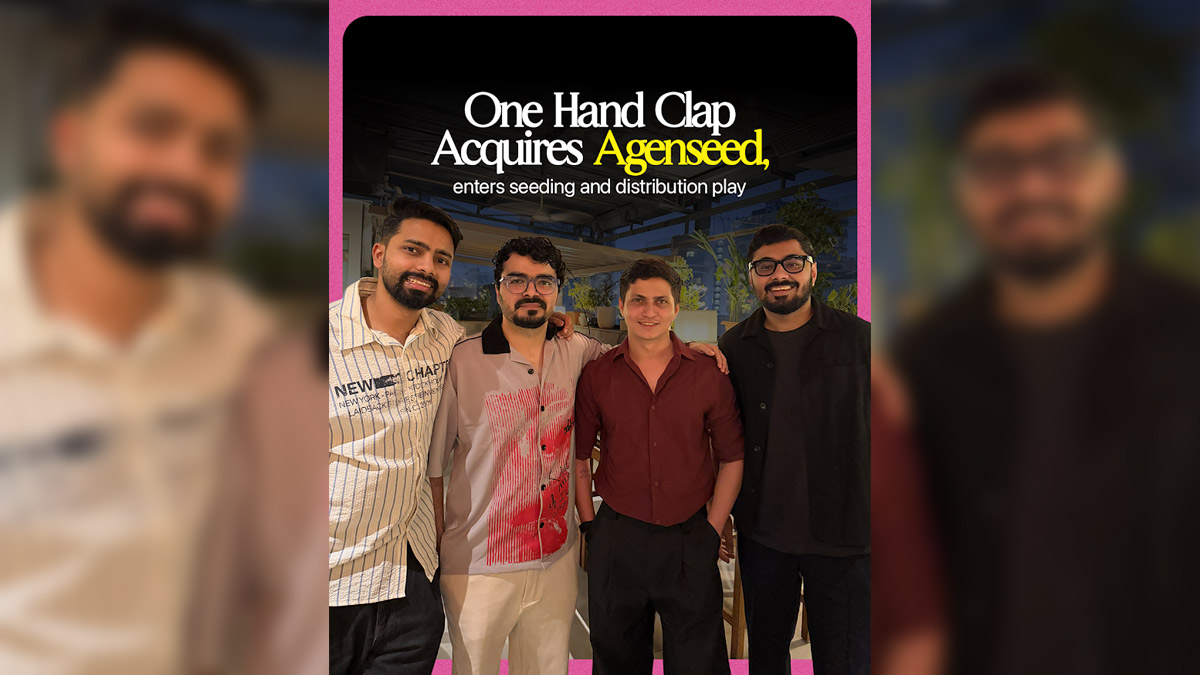
MUMBAI: One Hand Clap has decided to stop just clapping for great ideas now it wants to make sure they actually travel. The leading new-age creative agency and production house has acquired Agenseed, a seeding and distribution firm, marking its formal entry into the distribution segment. The move is aimed at expanding its role across the entire marketing value chain and unlocking new growth opportunities.
One Hand Clap expects the new distribution vertical to contribute up to 15 per cent of its overall revenues over the next 12–18 months, signalling a clear strategic shift beyond pure creative services.
Agenseed, founded by Monish Hardasani and Akram Malik, will function as the agency’s dedicated distribution arm. This acquisition strengthens One Hand Clap’s position as it aims to become a full-stack creative and distribution company in India’s rapidly growing digital advertising market.
With over 90 million posts shared daily on Instagram and brands allocating 25–35 per cent of their digital budgets to distribution and creator-led reach, amplification has become critical to campaign success. By integrating distribution early into the creative process, the agency hopes to help campaigns gain stronger cultural traction and momentum.
One Hand Clap founder Aakash Shah said, “The future of advertising is not just about executing great ideas, but about placing them intelligently. By owning both storytelling and distribution, we can drive greater impact for brands while opening up new revenue streams.”
Agenseed co-founder Monish Hardasani added, “The future belongs to ideas designed to travel. This partnership allows us to integrate distribution thinking at the source.”
Founded in 2019 by former AIB leaders Aakash Shah and Naveed Manakkodan, One Hand Clap has worked with major brands including Swiggy, Google, Netflix India, Crocs, Duolingo, CRED, Bumble, BGMI and Chetak. The agency also secured investment from Zerodha co-founder Nikhil Kamath last year.
In an increasingly fragmented attention economy, this acquisition reflects a broader industry shift where agencies are building end-to-end capabilities to stay competitive. One Hand Clap is clearly clapping louder and ensuring its ideas now reach much further.






