MAM
TDSAT-Ad cap: 2nd amicus curiae done, channels turn now

MUMBAI: The second amicus curiae Aman Ahluwalia continued his arguments today in the TDSAT-ad cap hearing. After giving the legal perspective yesterday, today he focused on the commercial implications of the ad cap regulation.
Ahluwalia said that the Telecom Regulatory Authority of India (TRAI) has the power to implement licensing under section 11 (1) (a) of the TRAI Act as well as enforcing it on broadcasters through section 7 (11) of the Cable TV Networks (CTN) Act. There is no need for it to choose the CTN act. The TRAI’s procedure may have been faulty but the bench should not strike down the ad cap regulation on account of this.
The bench wondered that when a licence is issued, the terms and conditions need to be read properly, and if the ad cap regulation issued by TRAI adds anything to section 7 (11) of the CTN act, then should it be accepted. The agreement between the licensor and licensee is only for section 7 (11) and if points like clock hour and reporting to TRAI come into the picture, it is in excess of the section.

The bench said that one cannot change, modulate or supplement the terms of the licence. If TRAI had implemented it under sections 11 and 12 of the TRAI Act that address the issue of licensing and advertisements then such problems wouldn’t have come up.
The amicus curiae read out the final draft report of the convergence bill which gives the definition of ‘broadcasting services,’ as it doesn’t have an exact one. He said that content, distribution and technical components all come under the TRAI act and content and distribution together mean carriage. By reading out reports such as the Nariman report, he chose to interpret broadcasting services to include content.
Ahluwalia then proceeded to the commercial aspects. He told the bench that after reading the code in the UK, he saw that the ad cap may work for GECs while the news channels that have less viewership will be most affected by it. The only way revenue can be raised is either by digitisation when subscription revenue will go up, or by raising advertising rates. However, if subscription rates are jacked up, viewers may not pay, and resort to cord cutting, resulting in lower viewership, and comitantly lower ad revenues as they depend entirely on viewership.
To support his statement, he also produced financial reports of Zee TV and the Sun Network which showed that their ad revenues were high as compared to news channels. Sponsored shows could be a way out for news channels to generated additional revenues but this could turn out to be dangerous as news could become coloured. And thus he suggested that genres should be dealt with differently.
According to him, English news channels will be the most affected because advertisers will start turning the screws on them as viewership will quite likely drop off the cliff. The scenario could improve when DAS is implemented completely all over the country as by then subscription and ad revenues each will contribute equally to a company’s top line.
Reading from an Ofcom (independent regulator and competition authority for the UK communications industries) report, he emphasized that TRAI’s ad cap regulation needs to be more precise in terms of the number of ads per half an hour, duration of the promos etc. Till DAS isn’t complete, it should not be implemented as, under Article 19 of the Constitution, broadcasters have the right to disseminate information and viewers have the right to receive plurality of information giving them the power to choose.
If the regulation comes into effect now, many smaller news channels may shut down and the existing ones will generate less revenue and hence news could end up being coloured as only a limited number will be left to provide news.
After Ahluwalia concluded, the News Broadcasters Association (NBA) counsel presented the rejoinder. He argued that TRAI’s analysis of the ad cap violations was incorrect.
His second argument was that TRAI has the power to implement the terms and conditions between the licencee and licensor under section 4 A of the Telegraph Act that talks about teleport licences. It cannot implement it on the basis of the uplinking and downlinking policies.
Teleport licences do not mention the CTN act at all and when TRAI is enforcing it on the basis of licensing then its line of reasoning needs to be read in the context of teleport licensing.
The NBA counsel stated that TRAI cannot act against broadcasters under the uplinking/downlinking policy since it falls under the ambit of the Ministry of Information and Broadcasting.
During its arguments, TRAI mentioned that broadcasters had suppressed documents related to licensing. The NBA counsel clarified that the data was about OB vans and teleports, which was available in the public domain.
He added that, according to Ofcom, UK channels were allowed ad commercials of 9-12 minutes averaging and not per clock hour. Also, if TRAI were to enforce the ad cap, it should be under the teleport licence under section 4 A of the Telegraph Act.
The NBA will continue its rejoinder tomorrow as well.





MAM
One Hand Clap acquires Agenseed to enter distribution space
Creative agency expands into full-stack services with strategic buyout.
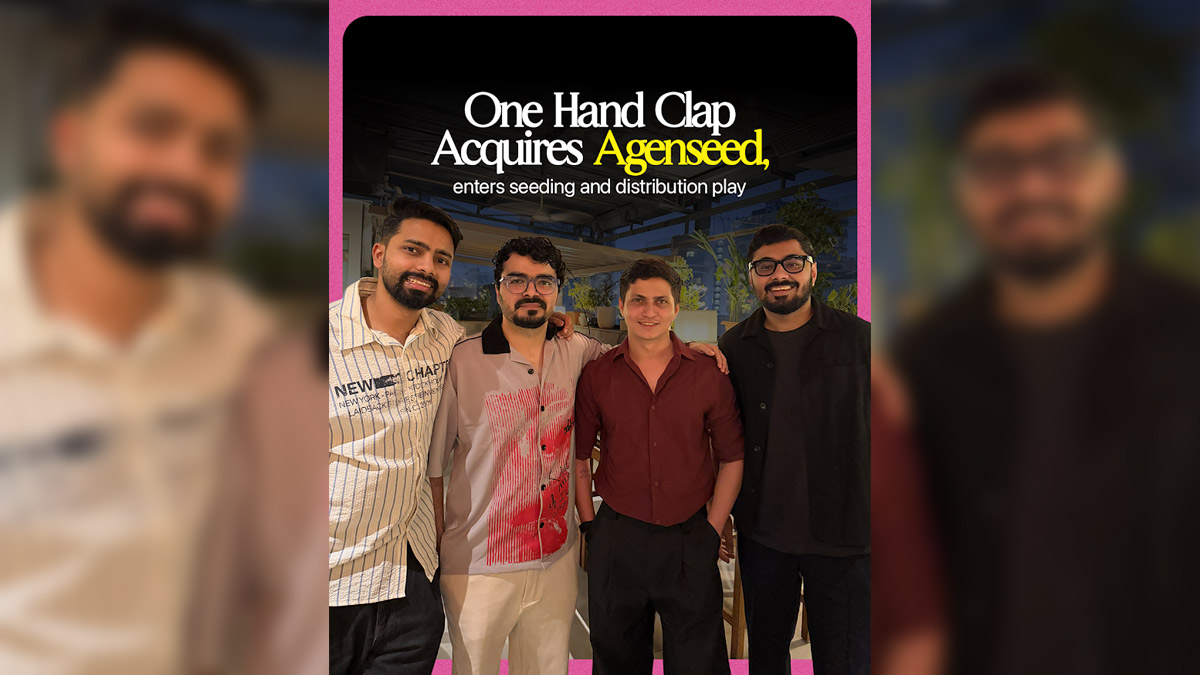
MUMBAI: One Hand Clap has decided to stop just clapping for great ideas now it wants to make sure they actually travel. The leading new-age creative agency and production house has acquired Agenseed, a seeding and distribution firm, marking its formal entry into the distribution segment. The move is aimed at expanding its role across the entire marketing value chain and unlocking new growth opportunities.
One Hand Clap expects the new distribution vertical to contribute up to 15 per cent of its overall revenues over the next 12–18 months, signalling a clear strategic shift beyond pure creative services.
Agenseed, founded by Monish Hardasani and Akram Malik, will function as the agency’s dedicated distribution arm. This acquisition strengthens One Hand Clap’s position as it aims to become a full-stack creative and distribution company in India’s rapidly growing digital advertising market.
With over 90 million posts shared daily on Instagram and brands allocating 25–35 per cent of their digital budgets to distribution and creator-led reach, amplification has become critical to campaign success. By integrating distribution early into the creative process, the agency hopes to help campaigns gain stronger cultural traction and momentum.
One Hand Clap founder Aakash Shah said, “The future of advertising is not just about executing great ideas, but about placing them intelligently. By owning both storytelling and distribution, we can drive greater impact for brands while opening up new revenue streams.”
Agenseed co-founder Monish Hardasani added, “The future belongs to ideas designed to travel. This partnership allows us to integrate distribution thinking at the source.”
Founded in 2019 by former AIB leaders Aakash Shah and Naveed Manakkodan, One Hand Clap has worked with major brands including Swiggy, Google, Netflix India, Crocs, Duolingo, CRED, Bumble, BGMI and Chetak. The agency also secured investment from Zerodha co-founder Nikhil Kamath last year.
In an increasingly fragmented attention economy, this acquisition reflects a broader industry shift where agencies are building end-to-end capabilities to stay competitive. One Hand Clap is clearly clapping louder and ensuring its ideas now reach much further.






