Ad Campaigns
Tata Motors ‘Ghar Lao Gold’ Contest winners felicitated by Akshay Kumar

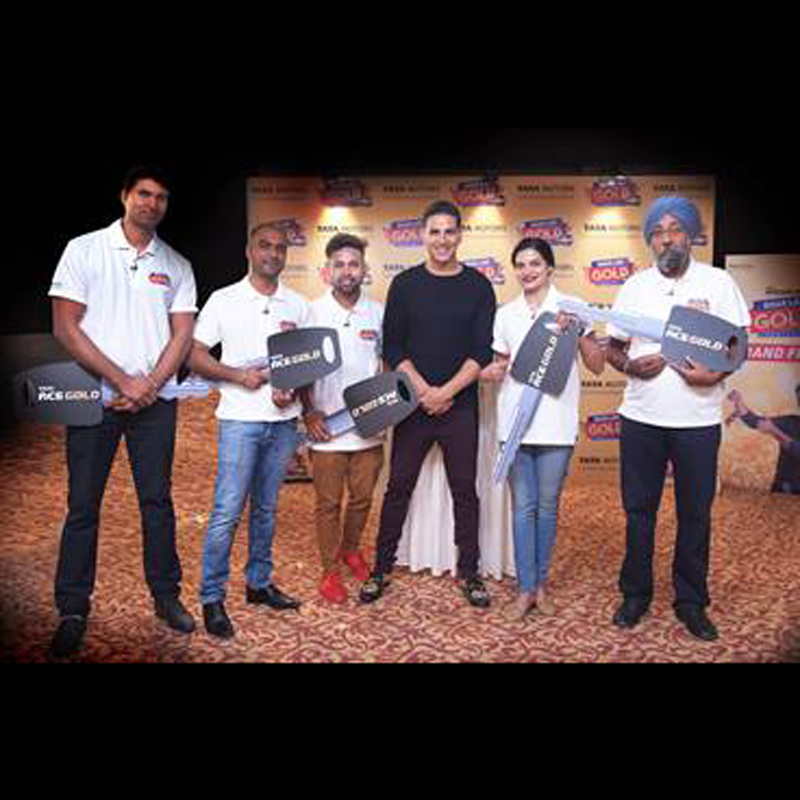
India: Encouraging self-employment and entrepreneurship in India, Tata Motors is excited to announce the winners of the ‘Ghar Lao Gold’ contest – a competition aimed to discover entrepreneurs with the most creative ideas, comprising the Tata Ace Gold. The five winners have each won a brand-new Tata Ace Gold worth Rs. 3.78 lakhs handed over by the superstar and brand ambassador of Tata Motors Commercial Vehicles, Akshay Kumar. The winners and the budding entrepreneurs, with the legendary Tata Ace Gold will look to implement their innovative ideas and turn it into a reality.
Congratulating the winners on their entrepreneurial outlook, Mr. UT Ramprasad, Head – Marketing and Brand Communications, Commercial Vehicle Business Unit, Tata Motors said, “A winner is someone who recognizes his talents, works towards developing them into skills, and uses these skills to accomplish his goals. Our Ghar Lao Gold campaign was aimed at fostering entrepreneurship, across the country. Through this campaign, we realized that India has a huge talent pool with unconventional ideas, but because of limited resources not everyone is able to showcase their creativity. We sincerely hope Tata Motors Ace Gold can catalyse their ideas into something brilliant for themselves and the society at large. We would like to congratulate the budding entrepreneurs for their creative ideas and look forward to assisting them in achieving their goals.”
The #GharLaoGoldContest received an overwhelming response with over 25,600 entries in just a span of two months. All the top 19 finalists were mentored by a group of esteemed judges and the top 5 winning business ideas were adjudged as the champions. Extending its sincere thanks to all the applicants, Tata Motors will be assisting each of them as they expand their creative ideas.

Here is a brief introduction of the 5 budding entrepreneurs, who participate and emerged victorious in the Ghar Lao Gold contest. Out of 25,600 participants, this outstanding bunch proved their mettle.
Anish Kumar – A well-qualified Mechanical Engineer who belongs to Patna, Bihar. He wants to pursue his dream while serving the society at large. His idea is to start a road repairing business where he aims to repair potholes. According to Anish, these potholes on the road cause numerous accidents every year. He envisions becoming India’s largest ‘quality’ road repairing contractor in the coming years.
Rahul Tak – He hails from Ajmer, Rajasthan and is an expert in servicing the heart of electrical transformers, which is called OLTC (On Load and No Load Tap Changer). The OLTC requires servicing and small quantity of transformer oil periodically. Rahul’s business idea is to install a small servicing unit in Tata Ace Gold and service transformers across the length and breadth of his district and expand it further over the years.
Roma Roy – The wife of an NTPC employee based in Korba, Chhatisgarh, and this homemaker’s dream is to start a mobile theme-based restaurant. Her business venture will be one of a kind in the remote are where she lives with over 300 other families.
Gurinder Singh – A 51 year old automobile spare parts marketing professional from Delhi, who left his job of 20 years to venture on his own. His idea with Tata Ace Gold is to establish his own automobile spare parts logistics business from scratch.
Aniketh Roy – A local boy from a small village in Silchar, Assam known as Saidpur. The area has poor infrastructure with almost non-existent roads. His great vision is to help all the farmers in his village by transporting their agricultural produce to the nearest town. They are currently managing this with great difficulty. A lot of produce gets wasted because it is not transported in time. He wishes to expand his venture to the farmers in nearby villages in the future.
On an average, in every 3 minutes, an Ace has created a new business, generated employment and inspired entrepreneurship opportunities, thus transforming lives in the remotest areas in India. Strategically designed to perform all tasks for the last mile movement, the Ace continues to remain the preferred choice of Indian entrepreneurs and small businesses in the country. Through the ‘Ghar Lao Gold’ contest, Tata Motors continues to inspire the new generation of up-and-coming entrepreneurs.




NATIONAL: Amazon Ads has laid out a sharply tech-led vision for the advertising industry in 2026, arguing that artificial intelligence, streaming TV and creator partnerships will combine to turn brand building into a more precise, performance-driven business.
At the heart of the shift, the company says, is the fusion of AI with Amazon’s vast trove of shopping, browsing and streaming signals, allowing advertisers to move beyond blunt reach metrics to campaigns designed around real customer behaviour.
“The future of advertising is not about reaching more people, but the right people with messages that resonate,” said Amazon Ads India head and vice president Girish Prabhu. “By combining AI with deep customer insights, we help brands move from broadcasting campaigns to having meaningful conversations wherever audiences spend their time.”
One of the biggest changes, according to Amazon Ads, will be the collapse of the wall between media planning and creative development. Retail media, powered by first-party data, is increasingly shaping everything from brand discovery to final purchase, pushing marketers to design campaigns around audience insight rather than internal instinct.
AI is also moving from a support tool to a creative engine. Agentic AI, which automates and accelerates production, is expected to make high-quality creative accessible even to small businesses, compressing weeks of work into hours and giving challengers the ability to compete with larger brands on speed and scale.
Behind the scenes, AI-driven analytics will take on a bigger role in campaign optimisation, identifying patterns, spotting opportunities and recommending actions that would previously have required teams of analysts.
Streaming TV is another big battleground. With India’s video streaming audience now above 600 million and connected TV users at 129.2 million in 2025, advertisers are set to treat streaming not just as a branding channel but as a performance engine, measured increasingly by sales, sign-ups and bookings rather than just reach.
Finally, Amazon Ads sees creators and contextual advertising reshaping how brands tell stories. Creators will act less like influencers and more like long-term partners, while scene-aware ads on streaming platforms will allow brands to insert hyper-relevant offers into the flow of what viewers are watching.
Taken together, Amazon Ads argues, these shifts mark a move towards advertising that is both more human and more measurable, where AI handles the complexity, and creativity does the persuading.