MAM
Support our efforts to compete, or get out of the way: NAB to FCC

NEW DELHI: National Association of Broadcasters (NAB) president and CEO Gordon Smith has expressed bewilderment at the manner in which the United States Federation Communications Commission (FCC) chooses to interfere with broadcasters, including its recent ruling that cracks down on joint sales agreements, while giving preference to cable and wireless.
Addressing the opening session of NAB Show in Las Vegas, Smith said no other medium, including broadband, better serves the public in time of crisis, than broadcast.

“We are here to be the public’s eyes and ears, to lead them out of darkness during times of crisis, to share profound moments, and to connect to our family, friends and neighbours. We are here to be the voices against oppression and we are here to be megaphones for freedom and democracy,” Smith said.
Local broadcast, he continued, contributes nearly $1.3 trillion to the gross domestic product.
Smith proposed a “National Broadcast Plan” — a response to the government’s National Broadband Plan — that would include, among other things, a review of regulations that he said hold back innovation and competition.
“Why is there no focus to foster innovation and investment in broadcasting to ensure our business continues to be a world leader alongside our broadband industries?” he asked.
Smith also remarked about the broadband players that are clamouring for swathes of the broadcast spectrum. “The wireless industry covets our spectrum, because they chew through their massive allocation of spectrum, attempting to deliver the video we deliver far more efficiently,” said Smith. “And they continue to milk, bilk and bill by the bit.”
Smith, a former US Senator, quoted a Wall Street Journal article that said broadcasting kept more than eight million people safe during Hurricane Sandy. “Broadband cannot do that,” he said.
Smith’s oratory struck a chord with veteran broadcasters assembled at the LVH. “It was a great rallying cry for the television industry,” said Raycom Media president and CEO Paul McTear, “It was good to see him challenge the FCC to allow broadcasters the right to compete in the future, in light of recent rulings that were more exclusionary. I thought he did a good job.”
Citadel Communications CEO and a former NAB joint board chairman Phil Lombardo said, “He showed that he knows our business and knows our business intimately.”
Univision anchor Jorge Ramos was presented with the Distinguished Service award by the NAB.
He challenged reporters to “speak truth to power” at all costs, especially on issues vital to Univision viewers such as immigration. He toasted the enormous growth of the Hispanic population in the United States. “It’s a great time to be a Latino journalist,” he said. “We have found our voice — in English and in Spanish.”
Univision chairman and Saban Capital Group CEO Haim Saban spoke of his days in a Beatles cover band “I was a really lousy player so they kicked me out and made me the manager”, his success in turning “Mighty Morphin Power Rangers” into a smash, and the unique relationship between Univision and its viewers. “Univision really is the home away from home for our community,” said Saban.
He also criticised the FCC when he said the letters FCC stand for “Friendly Cable Commission.”
He stressed the importance of a new transmission standard to help broadcasting thrive on all platforms. Saban’s mandate to the technology people working on the initiative: “Make it freakin’ happen.”



MAM
Lego brings Messi, Ronaldo, Mbappé, Vinicius together
Campaign clocks 314 million views ahead of FIFA World Cup 2026 buzz.
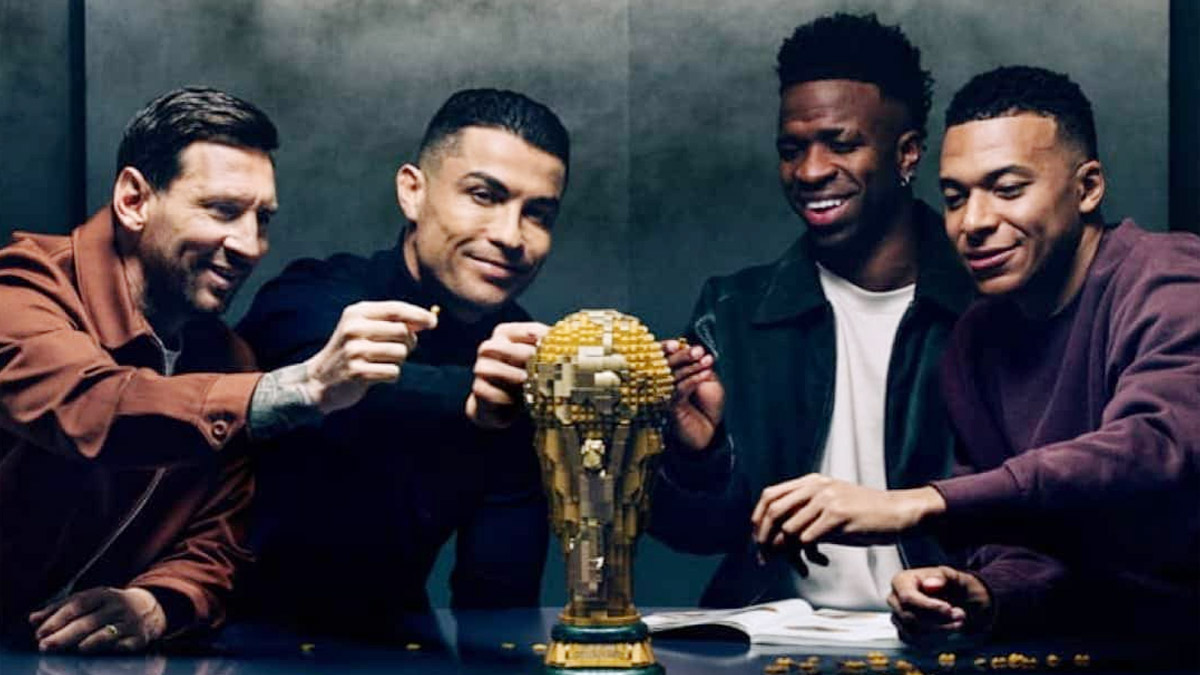
MUMBAI: Four legends, one frame and not a single tackle in sight. Lego has pulled off a crossover few thought possible, uniting Lionel Messi, Cristiano Ronaldo, Kylian Mbappé and Vinícius Júnior in a single campaign ahead of the FIFA World Cup 2026 only this time, they’re building dreams brick by brick.
Titled “Everyone wants a piece”, the campaign features the quartet assembling a Lego version of the World Cup trophy, before placing miniature versions of themselves atop it, a playful nod to football’s ultimate prize. Shared widely across social media, the ad carries a pointed disclaimer: it is not AI-generated, a subtle but telling signal in an era where even reality is often questioned.
The numbers tell their own story. The campaign has already crossed 314 million views on Instagram across the players’ accounts, with fans hailing it as a rare, almost nostalgic moment particularly for the reunion of Messi and Ronaldo, whose last shared campaign ahead of the 2022 World Cup became one of the platform’s most-liked posts.
Beyond the film, Lego is extending the play with exclusive, player-themed sets tied to each of the four stars, part of a broader football-led programme designed to ride the global momentum building towards 2026. The idea, as echoed by the players themselves, leans into the parallels between football and play experimentation, creativity, failure, and triumph.
Messi described the sets as a way to bring on-pitch moments into an imaginative, hands-on world, while Ronaldo called the transformation into a Lego figure a rare honour, blending sport with storytelling. Vinícius, meanwhile, struck a more personal note, recalling childhood moments of building with Lego and framing creativity as a universal language that transcends borders.
The timing is no accident. With the 2026 World Cup set to run from June 11 to July 19 across the United States, Canada and Mexico, and featuring an expanded 48-team format, global anticipation is already building. Argentina, led by Messi, will enter as defending champions, adding another layer of intrigue.
For Lego, the campaign does more than celebrate football, it taps into its mythology. Because when icons become figurines and rivalries turn into play, the beautiful game finds a new kind of pitch. one built, quite literally, by hand.






